
‘1000 aircraft service 1.4bn Africans’
Africa’s aviation sector is under renewed scrutiny as industry stakeholders warn that the continent’s airline capacity remains grossly inadequate for its population, with fewer than 1,000 aircraft currently serving about 1.4 billion people. This concern was highlighted at the Nigerian Aircraft Acquisition & Investment Summit in Lagos, where the Chief Executive Officer of the Airlines […]
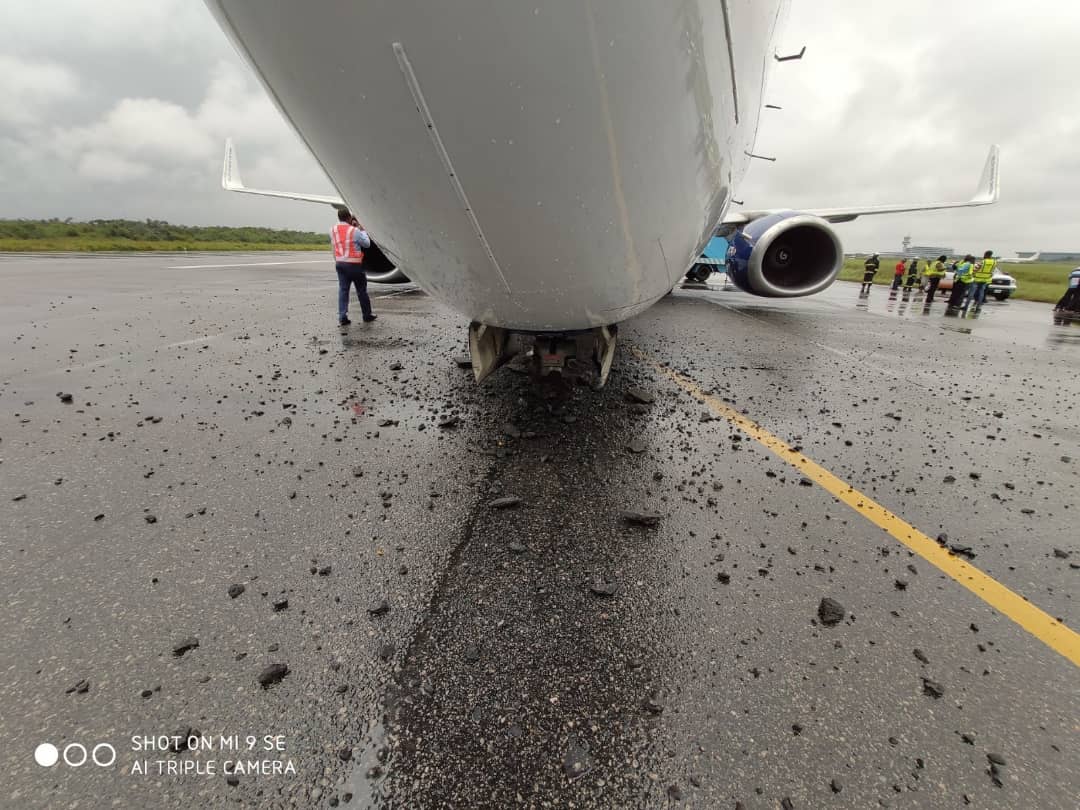
An Air Peace flight from Port Harcourt to Lagos experienced a hard landing which caused a tyre burst and damage to the aircraft’s nose wheel at the Murtala Muhammed International Airport (MMIA) in Ikeja Lagos. The aircraft with 133 passengers and six crew members after making emergency landing reportedly veered off the runway on 18R. Photo: Abdullateef Aliyu, Lagos 23/7/19
Africa’s aviation sector is under renewed scrutiny as industry stakeholders warn that the continent’s airline capacity remains grossly inadequate for its population, with fewer than 1,000 aircraft currently serving about 1.4 billion people.
This concern was highlighted at the Nigerian Aircraft Acquisition & Investment Summit in Lagos, where the Chief Executive Officer of the Airlines Association of Southern Africa, Aaron Munetsi, described the situation as a reflection of deep structural challenges within the industry.
“The whole continent has less than 1,000 aircraft,” Munetsi said, noting that the figure is alarmingly low when compared to global standards.
He pointed out that Delta Air Lines alone operates about 1,500 aircraft, underscoring the scale of the disparity.
According to him, Africa’s aviation sector contributes only about two per cent to global air transport despite its vast landmass and growing population, highlighting a significant gap between potential and reality.
Munetsi further revealed that out of 52 airlines across the continent, only seven are fully operational, and just one is profitable. This, he said, reflects the fragile state of airline operations and the difficulty operators face in sustaining viable businesses.
“Something is wrong somewhere,” he stated, adding, “How do you grow an industry where only a handful of airlines are functional and even fewer are profitable?”
He attributed the challenges to a combination of weak economic structures and regulatory inefficiencies, arguing that many African markets are not conducive to airline growth or fleet expansion.
“The economies are not working. Regulators, in many cases, are the biggest problem. Instead of enabling growth, they create barriers that make it difficult for airlines to survive,” Munetsi said.
Meanwhile, Fidelity Bank and Aircraft Finance Germany signed a strategic partnership aimed at simplifying aircraft leasing and acquisition for Nigerian carriers.
The partnership aims to leverage AFG’s technical expertise and Fidelity’s financial capabilities to support the sector’s development.
The deal between the companies was announced by Christian Hatje, managing director, Business aviation and SVP commercial, AFG.
Executive Director at Fidelity Bank, Stanley Amuchie, said the collaboration combines financial capacity with technical expertise to lower entry barriers for operators.
“Aviation is an industry where technical know-how is non-negotiable. By bringing AFG’s sourcing capabilities together with our structured financing, we are creating a platform that allows operators to grow without massive upfront capital,” he said.
The partnership is expected to enable airlines to adopt lease-based models, allowing them to scale operations gradually while improving efficiency and competitiveness.
Amuchie said the deal which includes both financing and leasing is a step to the right direction.
“We’ve supported Air Peace a lot, Ibom Air and most of the other airlines. In fact, when the industry was a bit skeptical about financing aviation, we were the ones that took the bull by the horn and we started supporting. This is just another step we are taking in the right direction.
“It involves both financing and leasing. It depends, if you have part of your money, you just want outright purchase, why not? Because AFG will be able to source the right kind of aircraft based on your needs, based on what you want to use it for. Therefore, if you want financing to buy, of course, we can do that. We have done that already.
Also speaking, Director-General of the Nigeria Civil Aviation Authority, Capt. Chris Najomo, described the collaboration as a positive step toward strengthening the sector.
He expressed optimism that more modern aircraft would enter the Nigerian market within the next five to six months as operators take advantage of the new financing structure.