
2027
“Give advice. If people don’t listen, let adversity deal with them”. African Proverb Ready or not, Nigeria appears to have been effectively placed in an election mode. There is enough in the last by-elections to draw some clues about the rest of the journey, and the elections themselves. There is also a huge space […]
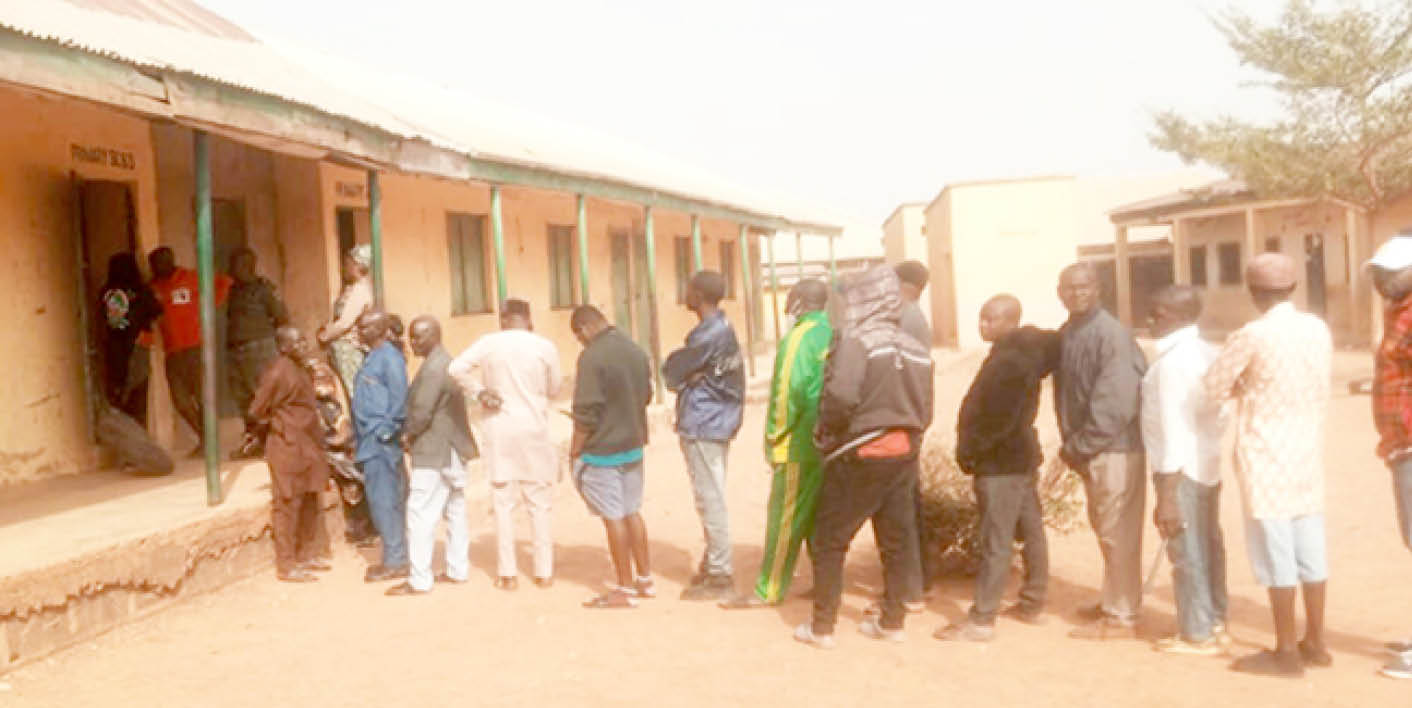
Voters queuing to cast their votes at Polling Station U/Boro Unit EC 30 and 32 during the bye-election in Chickun LGA of Kaduna State on Saturday.
“Give advice. If people don’t listen, let adversity deal with them”. African Proverb
Ready or not, Nigeria appears to have been effectively placed in an election mode. There is enough in the last by-elections to draw some clues about the rest of the journey, and the elections themselves. There is also a huge space for dramatic and mundane developments which give character to Nigerian politics, so that a fair survey could provide an informed assessment of the rest of a campaign which is on its way, and hazard possible outcomes.
The ruling APC may yet rue its misreading of the times and the tasks ahead when it reacted to attempts by some opposition elements to cobble together a platform that could promise a little more than the remnants of the hijacked PDP and a motley of unsettled politicians who lacked muscle and presence to threaten it. As it is, the state of play does not appear to have changed much since the ruling APC gave itself a resounding commendation while Nigerians were on the run from insecurity, crushing poverty, and a scary future. The coalition ADC is bleeding from indecision, deadweight of egos, and pronounced anomie, at precisely a time it should be flexing muscle and turning the PDP into what it deserves: a pitiable has-been.
Half of PDP is talking tough over Wike. The other half is split between Wike’s large pockets and attempts to keep seats warm in ADC. Smaller parties are scattered and floating, although one or two think they could muster enough dream to coalesce into another coalition, or some sort of threat to the big boys. The journey ahead will be long, tough, and bruising, and it will decide whether Nigeria’s democratic traditions can be salvaged from its current pathetic condition, or it will mark the point of an irretrievable decline. Several factors will hold the key to deciding wins and losses in 2027:
- The Parties
At this stage APC looks like it has such an advantage, it will be difficult to see it being part of a healthy electoral competition. It has the supreme advantage of a rogue incumbency: an awesome position which allows it to freely help itself to all the spoils of office it wishes. It is growing a presidency with more powers than any in our history. This power can bridge the massive deficiency in its quality of governance, provide a sense of equity in a nation of many parts, and cultivate real empathy for a hard-pressed citizenry to a point where it will have a fair chance in a fair fight to win a second term. Where that option is unavailable owing to a lack of capacity, wrong choices, a strong opposition, a registered character in Nigerian politics which insists that it is easier to steal an election than win one, it has other options. It can continue to weaken the opposition, deepen sensitive fault lines across the country, rig the election massively, and dare Nigerians to go to court or protest. Unless there is a dramatic improvement in the quality of the opposition, APC will work itself back into power in 2027. Its chances will be more challenging if President Tinubu is not its candidate, though. Everyone knows that Nigerian politics at this stage is all about Tinubu. The architect of this perception, Tinubu himself, is his party’s strongest asset and its most threatening liability.
PDP is likely to continue to show all the signs of a mortally wounded opposition up to the elections. Between the effects of Wike’s successful subterfuge, an ADC that will tear off a huge chunk of the PDP at the most painful moment, and the relative poverty of its key financiers, the PDP will approach the elections as an old and tired warrior with stories about a glorious past, and little more. It can make a lot more impact if it deploys some imagination and discipline in its choices of party leaders and flag bearers, but this is very unlikely. Key members like Atiku and Obi can make massive differences in the North and Southeast, but massive personal ambitions and narrow constituencies will get in the way. 2027 is actually a two-horse race. It will be APC and all the others, the latter working together to change the current trajectory, or helping the APC to another term.
- The Elections
INEC will come under the most tremendous pressure to improve the credibility of the elections. It could improve its technology, but it has no powers over ballot snatching, vote buying, compromised security officials, or rogue collation officers. A new Chairman of the Commission will be appointed before the end of this year and it is inconceivable that partisan motives will not be read into the appointment. Some National Commissioners will end their terms literally between the two elections. Vote buying will be more open and damaging, having become a vibrant element in our political culture. Large turnouts will be a liability for politicians who have to buy votes, and an asset for those with little money but sealed political strongholds. Electoral violence will be a major feature in an election where the incumbent administration feels threatened. Turnout will be largely determined by the cohesion and potential of the opposition, as well as the perception that the current administration will resist a loss at all costs. As usual, the judiciary will have the final and, in keeping with our hallowed traditions, the most condemnable say.
Nigeria’s attempt to build a useful democratic process will be severely tested in 2027. It’s fair to say this process is quite possibly in its worst form. It works only for leaders ‘elected’ by the people. Nigerians know democracy only as voters, many literally selling huge chunks of their lives every four years. The quality of governance has been getting worse, as voters are bribed or scared into voting for people whose major desire is to plunder the commonwealth. The bandit, the insurgent, and the phone snatcher see the elected leader when they look into the mirror. Both break the laws of the land, and both keep the citizen helpless and wretched. Nigerians ask how this democratic system can improve their lives and assure them that the next generation can live a secure, productive existence. Those with the responsibility to save our democratic system and the country need to become more involved. It is no longer the job of the politician.