
34.7m Nigerians projected to face food crisis in mid-2026
About 34.7 million people, including over 650,000 internally displaced persons across 27 states and the Federal Capital Territory (FCT), are projected to face worse levels of food insecurity between June and August 2026. The projections were contained in the latest Cadre Harmonisé (CH) analysis presented yesterday in Abuja during the national consolidation and validation workshop […]
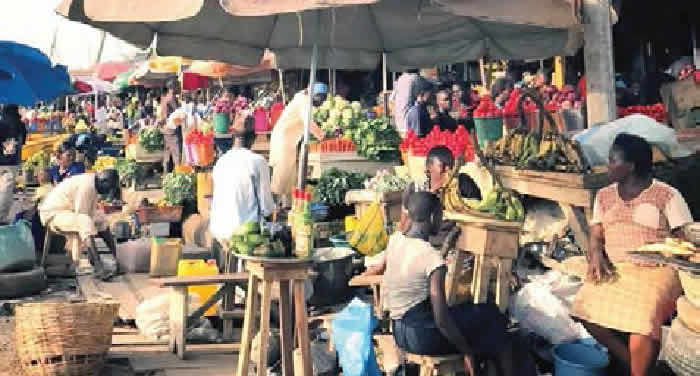
food market
About 34.7 million people, including over 650,000 internally displaced persons across 27 states and the Federal Capital Territory (FCT), are projected to face worse levels of food insecurity between June and August 2026.
The projections were contained in the latest Cadre Harmonisé (CH) analysis presented yesterday in Abuja during the national consolidation and validation workshop and results presentation organised by the Food and Agriculture Organisation of the United Nations (FAO).
The analysis, covering 27 states and the FCT, reveals a worsening food and nutrition insecurity situation, driven by persistent inflation, insecurity, high agricultural input costs and climate shocks.
During the current period (October to December 2025), about 27.2 million Nigerians, including 485,109 displaced, are already experiencing food insecurity categorised as Crisis (CH Phase 3) or worse.
- Genocide claims: Trump’s CPC decision on Nigeria based on jaundiced, obtrusive data – IMPI
- Senate: Why we halted Ramat’s confirmation as NERC chair
The projected figures show that the number of people facing hunger could rise sharply by mid-2026 if urgent interventions are not scaled up.
Speaking at the presentation held in Abuja by stakeholders to reveal, validate and discuss the latest data and evidence on the food and nutrition situations across the 27 states and Federal Capital Territory, Mr Hussein Gadain, the Food and Agriculture Organisation (FAO) representative in Nigeria, commended the federal government and partners for successfully completing the October 2025 CH analysis cycle, which marks a decade of CH implementation in Nigeria.
“This year also marks a decade of CH analysis in Nigeria, a milestone that reflects the growing relevance and impact of this initiative in shaping food and nutrition security responses,” he said.
He added, “Multiple shocks, armed conflict, organised crime, economic pressures and climate extremes are undermining livelihoods and food systems across the country. In this context, the CH analysis remains our most relevant early warning tool, guiding humanitarian programming and development planning.”
Gadain highlighted that flooding, inflation and insecurity continue to displace farmers and disrupt food production, while high input prices threaten the upcoming planting season.
The FAO country rep called for stronger collaboration between government agencies and partners to address data gaps, particularly in inaccessible areas of Borno, Adamawa and Yobe states.
He called on all stakeholders – government, partners and communities – to work together to end hunger in Nigeria, emphasizing that “the CH process is a powerful tool, but its impact depends on our collective commitment and action.”
Key findings and regional data
The CH analysis revealed that the cost of essential complementary foods, such as vegetable oil, dairy products, meat and condiments remains high, up by more than 35 per cent largely due to foreign exchange fluctuations.
Many households maintaining acceptable food consumption levels did so by reducing meal portions, eating less diverse diets or borrowing money to buy food.
The report warns that these coping mechanisms are unsustainable and could lead to further deterioration in food security outcomes during the lean season.
The CH nutrition analysis places several northern states between alert (Phase 2) and critical (Phase 4) levels. Borno, Yobe and Katsina recorded particularly concerning malnutrition rates, while parts of Benue showed relatively stable conditions. Mortality rates were generally low but reached emergency levels (Phase 4) in parts of Borno and Adamawa.