
A country without electricity
For many years, Nigeria’s electricity sector has remained trapped in a vicious cycle of promises, reforms, scandals and failures. The recent conviction of a former Minister of Power, Saleh Mamman, over the laundering of N33.8 billion meant for the Mambilla hydropower project is not merely another corruption story. It tells how the Nigeria’s power sector […]
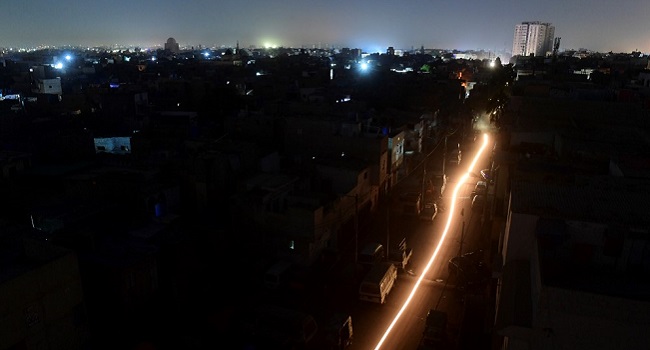
pakistan electricity blackout
For many years, Nigeria’s electricity sector has remained trapped in a vicious cycle of promises, reforms, scandals and failures. The recent conviction of a former Minister of Power, Saleh Mamman, over the laundering of N33.8 billion meant for the Mambilla hydropower project is not merely another corruption story. It tells how the Nigeria’s power sector has become a graveyard of public trust, a theatre of monumental waste and a symbol of state failure.
No serious country grows without electricity because factories cannot function optimally, hospitals cannot guarantee safe health care, students cannot study effectively and digital economies cannot flourish in darkness. Yet Nigeria, with over 220 million people and vast deposits of gas, enormous hydro resources, abundant sunshine and significant wind potential, still struggles to generate and distribute barely 4,000 megawatts of electricity on most days. That figure is scandalously inadequate. South Africa, with less than one-third of Nigeria’s population, generates over 40,000 megawatts. Egypt crossed 50,000 megawatts years ago. Even smaller African economies outperform Nigeria in power stability.
The tragedy is not that Nigeria lacks resources or technical knowledge. The fact is that leaders saddled with the responsibilities have continued to repeatedly sabotage the country through corruption, policy inconsistency, vested interests and weak institutions.
When former President Olusegun Obasanjo assumed office in 1999, expectations were high that the power crisis would finally be addressed. His administration embarked on ambitious reforms and reportedly committed about $16 billion to the power sector through the National Integrated Power Project (NIPP) and other interventions. Yet, despite the huge expenditure, Nigerians saw little improvement. Instead, allegations of inflated contracts, abandoned projects and diversion of funds became widespread. It was during this period that the controversial Mambilla hydropower contract associated with former Minister of Power, Olu Agunloye, emerged, a matter that still haunts the country decades later.
The power sector reforms under Obasanjo led to the unbundling of the old Power Holding Company of Nigeria (PHCN) into Generation Companies (GenCos), Distribution Companies (DisCos) and the Transmission Company of Nigeria (TCN). The idea was meant to introduce competition, attract private investment and improve efficiency.
However, the privatisation exercise later carried out largely failed to deliver the expected transformation. Many of the investors who acquired the assets lacked both technical competence and financial strength. They inherited weak infrastructure but also became trapped in a dysfunctional market, where tariffs were politically controlled, collections were poor and debts accumulated rapidly.
The result is Nigerian having GenCos that are unable to produce optimally because they are owed trillions of naira; DisCos incapable of upgrading infrastructure because of liquidity crises; and a TCN struggling with obsolete equipment that cannot wheel sufficient electricity across the country. Grid collapses became routine national embarrassments.
Under the administration of Umaru Musa Yar’adua, attempts were made to review aspects of the privatisation process and address governance concerns, but the sector remained largely stagnant. The Jonathan government continued with privatisation and promoted independent power projects, yet corruption allegations and weak implementation undermined progress. The Buhari administration later unveiled the Siemens power deal with Germany, promising incremental expansion from 5,000 to 25,000 megawatts. Nigerians were hopeful once again. However, years later, tangible outcomes remain far below expectations.
Now under President Bola Ahmed Tinubu, another round of reforms is underway. The Electricity Act signed in 2023 decentralised the sector by granting states powers to generate, transmit and distribute electricity within their territories. This is one of the most significant structural reforms in decades.
Just recently, President Tinubu approved a N3.3 trillion legacy debt settlement plan for the power sector to clear longstanding liabilities accumulated between February 2015 and March 2025. The intervention aims to restore financial liquidity, clear outstanding obligations to gas suppliers and GenCos) and stabilise grid operations. This is good news, but we are closely monitoring the situation with cautious optimism because of the experiences of the past.
Several states have moved to establish independent electricity market, and in the process, expended billions of naira. Only few of them can justify the investments because the people still live in darkness and industries largely comatose.
Evidently, Nigeria’s off-grid solar market continues to grow, with thousands of homes, schools and health centres now powered through renewable energy. These are commendable developments, especially in a country blessed with enormous solar potential throughout the year.
Yet, despite these reforms and initiatives, the country remains trapped in darkness. Why?
The answer lies partly in entrenched vested interests that profit immensely from dysfunction. Nigeria has developed an entire economy around power failure. From diesel importers and generator dealers to contractors feeding endlessly on failed interventions, many powerful actors benefit from the chaos. Reliable electricity would destroy some of these profiteering networks.
The conviction of Saleh Mamman, therefore, represents more than individual criminality; it exposes the deeper rot within the system. It is disgraceful that a minister accused of diverting billions meant for national development could still aspire to govern a state until he was nabbed by security operatives from his hidden place and thereafter sent to Kuje prison. This is someone from Taraba State, which hosts the site for the Mambilla project. Mamman’s case reflects a dangerous erosion of public morality and accountability in governance.
Sadly, the failures are not isolated. The power sector has witnessed repeated scandals involving inflated contracts, abandoned transmission projects, dubious privatisation deals and questionable policy reversals.
Nigerians have heard every promise imaginable like the claim of stable power in six months; 10,000 megawatts in one year; uninterrupted electricity by a certain date; the country continues its humiliating merry-go-round around 4,000 megawatts.
Meanwhile, countries that succeeded approached electricity differently. Egypt invested massively in integrated generation and transmission infrastructure while ensuring policy consistency. Ghana strengthened regulation and encouraged diversified generation. Morocco aggressively pursued renewable energy with long-term planning and investor confidence. China and India expanded electricity access through state-backed infrastructure financing combined with decentralised generation systems. These countries treated power as a strategic national priority rather than a political slogan. Nigeria must do the same.
The government cannot continue to pretend that all is well. Nigerians deserve honesty. The authorities must explain clearly why trillions spent over decades have produced so little. The sector requires more than cosmetic reforms; it needs institutional cleansing, credible regulation, strict prosecution of corruption and massive investment in transmission infrastructure.
The current Minister of Power, Joseph Olasunkanmi Tegbe, faces enormous responsibility. The power sector cannot continue drifting.
Nigeria’s electricity crisis is no longer merely an infrastructure problem, it is a national emergency. No industrial revolution can occur without stable power. The digital economy, green energy transition, manufacturing expansion, and job creation being promised by successive governments will remain fantasies in darkness.
The country must finally decide whether electricity is a public necessity or merely another avenue for elite enrichment. Until that choice is made, Nigeria will remain a giant stumbling blindly in the dark.