
Africa’s push for permanent UNSC takes centre stage at UNGA
Africa’s call for a permanent seat on the UN Security Council gained fresh momentum on Wednesday at the 2025 General Assembly, with Kenyan President William Ruto sharply criticizing the Council’s current structure. In a speech that resonated across the continent, Ruto described Africa’s exclusion from permanent membership as “unacceptable, unfair and grossly unjust.” “You cannot […]
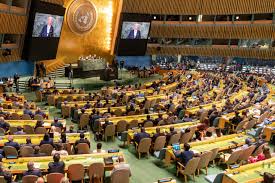
UNGA
Africa’s call for a permanent seat on the UN Security Council gained fresh momentum on Wednesday at the 2025 General Assembly, with Kenyan President William Ruto sharply criticizing the Council’s current structure.
In a speech that resonated across the continent, Ruto described Africa’s exclusion from permanent membership as “unacceptable, unfair and grossly unjust.”
“You cannot claim to be the United Nations while disregarding the voice of 54 nations. It is not possible,” Ruto told world leaders in New York, challenging the legitimacy of a system that continues to sideline Africa despite its central role in global peacekeeping and conflict resolution.
In 2005, African leaders meeting in Ezulwini, Swaziland, adopted the Ezulwini Consensus, demanding two permanent seats with veto power and five non-permanent seats for Africa on the Security Council.
- Kidnappers shoot victim over insufficient funds in account
- State police key to ending Plateau insecurity – Mutfwang
The consensus was a unified call for justice, equity, and representation in the highest organ of global governance. Yet, as Ruto noted, “this demand continues to be ignored, deferred or endlessly debated, to the detriment of both Africa and the legitimacy of the United Nations itself.”
Despite being one of the most active contributors to UN peacekeeping missions and dominating much of the Council’s agenda, Africa remains the only continent without a permanent seat at the table.
Ruto emphasised that decisions about peace, security, and development are routinely made without Africa’s voice, calling the current arrangement outdated and a threat to the UN’s credibility.
Ruto’s case for urgent reform
In his address, President Ruto demanded reforms that would grant Africa “at least two permanent seats with full rights – including the power to veto – and two additional non-permanent seats.”
He argued that reforming the Security Council is not a favour to Africa, but “a necessity for the United Nations’ own survival.”
“If the United Nations is to remain relevant in this century, it must reflect today’s realities, not the postwar power arrangements of 1945,” he said.
The UNSC currently consists of five permanent members—the United States, China, Russia, the United Kingdom, and France—all of whom hold veto power.
The remaining ten seats are non-permanent and rotate among member states. This structure, rooted in the aftermath of World War II, has faced increasing criticism for failing to reflect the geopolitical realities of the 21st century.
Ruto’s remarks come amid wider concerns about the UN’s credibility and capacity. He warned that the institution faces its “deepest crisis,” citing funding cuts, bureaucratic delays, and a Security Council that remains “frozen.”
These challenges, he argued, are compounded by the lack of inclusive representation, particularly from Africa.
“Africa is no longer willing to wait on the margins of global governance while decisions on peace, security and development are made without our understanding, perspective and voices,” Ruto said.
His speech echoed sentiments shared by other African leaders and civil society groups who have long argued that the continent’s exclusion undermines the legitimacy of international decision-making.
The call for reform is not merely symbolic—it is a demand for structural change that reflects Africa’s role and stake in global affairs.
Haiti mission as a cautionary tale
Ruto also used Kenya’s leadership in the Multinational Security Support (MSS) mission in Haiti to illustrate the shortcomings of current global security structures. He described the mission as both a success and a cautionary tale.
“Kenya stepped forward, stepped up, and deployed our officers,” he said.
But the mission remains “underfunded, underequipped and operates below 40 per cent of its authorised personnel strength.”
Despite these constraints, Ruto noted that the MSS has achieved significant gains—restoring government institutions, reopening schools, and reducing kidnappings. “This begs the question: what more could have been accomplished if the United Nations fraternity had truly acted together in solidarity with the people of Haiti?” he asked. The Haiti mission, authorised by the UN Security Council in October 2023, was intended to be a multinational effort to combat gang violence and restore order in Port-au-Prince.
While Kenya has deployed over 600 police officers, the mission has struggled to attract sufficient troop contributions from other nations. Armed gangs continue to control large parts of the capital, and the mission operates under severe resource constraints.
Ruto’s critique of the Haiti operation underscores a broader concern: that the current structure of the UN, particularly the Security Council, is ill-equipped to respond effectively to global crises. He urged the Council to consolidate the “hard-won gains” achieved so far and ensure that the mission does not falter due to lack of support.
Is the road ahead easy for Africa?
Africa’s push for permanent representation on the Security Council is gaining momentum, but the road ahead remains uncertain. Reforming the UNSC requires consensus among its current permanent members, some of whom are reluctant to dilute their influence.
The debate over expanding the Council has been ongoing for decades, with proposals from various regions—including the G4 nations (Germany, Japan, India, and Brazil)—also seeking permanent seats.
What sets Africa’s case apart is its unified stance through the African Union and the Ezulwini Consensus. The continent has spoken with one voice, demanding not just representation but full participation in shaping global decisions.
Whether this push will translate into actual reform remains to be seen. But as Ruto made clear, Africa is no longer content to be a spectator. “Reforming the council is not a favour,” he said. “It is a necessity for the United Nations’ own survival.”