
Albinos face hard times in schools
Albinism is a hereditary condition where people are born without the usual pigment (colour) in their bodies. Their bodies won’t make a normal amount of melanin, the chemical responsible for eye, skin, and hair colour. Most people with albinism have very pale skin, hair and eyes. In some traditional systems Albinos are regarded as highly […]
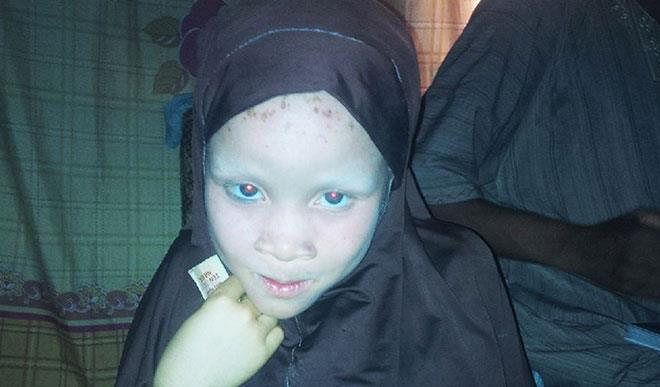

Albinism is a hereditary condition where people are born without the usual pigment (colour) in their bodies. Their bodies won’t make a normal amount of melanin, the chemical responsible for eye, skin, and hair colour. Most people with albinism have very pale skin, hair and eyes.
In some traditional systems Albinos are regarded as highly spiritual people and they are bound to be treated as such. For instance, the Yorubas believe that albinos like handicapped people are favoured by the gods.
Nevertheless, they tend to face challenges in schools ranging from discrimination and stereotyping to visual problems in the classrooms which undermine their chances of success. Those who spoke to this reporter said they have problem of confidence and socialisation because of stigmatization. Teachers also find it difficult to handle albinos whose vision is profoundly impaired.
The Minister of Education Malam Adamu Adamu said during the 2016 Commonwealth Day Celebration in Abuja recently that government would increase school enrolment and pupils’ retention as well as “integrate albinism education into the school system.”
Modupe Ibrahim is the only albino in her family; she completed her secondary school education recently. She said she almost dropped out of school due to discrimination from teachers and fellow students. She is shunned by colleagues and spent times alone.
“When I was younger, I usually cried whenever they called me Albino. Then, I thought they were abusing me but as time went on, I realized that was what the people with my complexion are called, so I stopped crying.
“Many times, my parents will follow me to school while my teachers also warned my school mates against making jest of me but I turned the table around when I grew up.
“I make jest of myself before people do and usually tell jokes and make remarks to make fun of myself until they laugh so they became fond of me. Even if I am not around, they usually look for me,” Ibrahim said.
On her thought about having a special school for Albinos, she said that would further distance other people from them because if she has to meet with only Albinos for the years she will spend in school, it will be difficult to socialise with other people and further face extra uphill task to attain her chosen career in future.
“Albinos are not different from other human beings; the only difference is the pale skin we have. So, I see no reason why we should be secluded from other people. Albinism is not a disease that can be contacted, so why should there be a special school for us? I don’t support the idea.”
She said finding a job to earn a living after school was also an issue that wasn’t easy for persons with albinism, adding that government has to come to their aid.
“If government has any plan for us, it should be in the area of employment because I believe some employers may not want to employ an albino which is not supposed to be. Many of us are brilliant students, so we should be given the opportunity to contribute our quota to the development of the society,” she said.
Another student with albinism Abdulmalik Yunus, said his own predicament was from his parents who would not let him move around freely for the fear of being kidnapped by ritualists which greatly affected his education.
“When I was still very young, my parents were over protective of me which made them not to send me to school on time. They don’t want me to walk alone but to always be in the company of others for protection. I started school late because of that but apart from that, I don’t have issue of stigmatisation among my peers. Even if they want to, I don’t give them room to do that to me,” Yunus said.
Rasheedat and Abdulsalam are siblings and both Albinos. Rasheedat, who is just ten years old, has had her own experience as an Albino in the hands of her school mates who discriminated against her which made her cry each time she had an encounter with them in school.
Raheedat’s story changed when her mother gave birth to Abdulsalam, her younger brother who happened to be Albino as well. His birth gave her courage and made her concentrate more in everything including her education, she said.
Ismail Jimoh, Rasheedat’s father said he hasn’t got any problem with his kids.
“Abdulsalam has not started school but Rasheedat has and when I took her to the school she was accepted without any stress.
“I sent her to a school that is not far from the house. It is a walking distance from the house and I made sure that almost all the people around know her and take care of her.
“She started school when she was six and she is now in primary three at 10 years,” Jimoh said
Jimoh, who is also an educationist, explained that albinism does not affect Rasheedat’s schooling rather she started late.
According to him, “my daughter sees clearly without any assistance, it does not affect her sight. She cried sometimes that people called her albino but we calmed her and explained that it is not an abuse.
“I haven’t gone out with her before over insult but I kept assuring her that she was also created by God.”
Mr. Lawal Akinyemi, a teacher, said most albinos are usually intelligent.
“When you are teaching them, you have little or no stress in making them understand your teachings, if people complain about their pale skin, they should have an encounter with them in term of their intelligence,” Akinyemi said.