
Almajiri and un-enforced child rights
Legendary South African leader, Madiba Nelson Mandela, spent 27 years in prison. Before his incarceration he was known to be fond of cigarettes, alcohol and the company of women. Upon his release, he was asked what he missed most during imprisonment. Surprisingly, he said, “The sound of a child’s laughter”. After he regained freedom, he […]
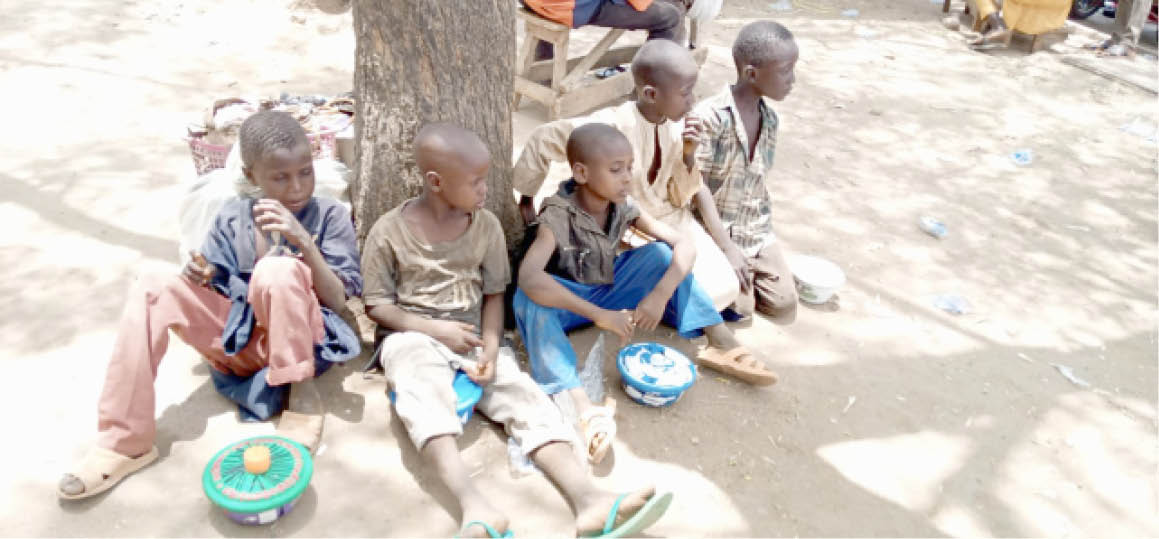
FILE PHOTO: Children sitting under a tree
Legendary South African leader, Madiba Nelson Mandela, spent 27 years in prison. Before his incarceration he was known to be fond of cigarettes, alcohol and the company of women. Upon his release, he was asked what he missed most during imprisonment. Surprisingly, he said, “The sound of a child’s laughter”.
After he regained freedom, he surrounded himself with children as often as he could. Under normal circumstances, every right-thinking person loves children. However, in Nigeria there is one group of children who through no fault of their’s are detested as undesirable nuisances. These are the almajiri kids from the North.
Street begging by unkempt children is not a culture in the South of the country, so it is not surprising that the almajiri are seen as symbols of the irresponsibility of their parents and callousness of northern political leaders. In addition to denying kids their rights, the almajiri system does not impart any technical, vocational or academic skills necessary to equip them to function as responsible adults.
Due to their begging, the almajiri face stigmatisation, although supporters of the almajiri system claim that it teaches children to be pious, moral and to bebeneficial to society.
It, however, defies logic to believe that a life of begging benefits society. With the arrival of the COVID-19 pandemic, the problem of almajiri has again made headlines. All the children are vulnerable to poor living conditions, poverty, inadequate health care, poor nutrition and environmental pollution. So it is no surprise that the almajiri have become infected. The kids are deliberately neglected by their parents and political leaders who appear to have lost humanity to power and religious sentiments.
The northern elite praise the almajiri system while sending their own children to the best schools in non-Islamic western nations. It is trite that people cannot give what they do not have. Expecting northern leaders who happily preside over mass poverty and degradation to feel compassion towards almajiri is asking them to give what they do not have.
Former President Goodluck Jonathan built 125 almajiri schools with boarding facilities, libraries, sports arenas, free tuition, free food, free uniforms and casual clothing. This laudable attempt to get these kids off the streets and give meaning to their lives and provide hope for their future was deliberately frustrated and the clock set backwards.
The Muslim Rights Concern (MURIC), with its well-earned reputation for hate-speech, religious disharmony, divisiveness and agent-provocateur statements, has condemned all attempts to ban almajiri to improve the lives of the children.
MURIC claims quite irrelevantly that attempts to educate them will place Muslim children in the hands of Christian teachers. They appear to have no interest in the harmonious interdependence of mankind irrespective of religion. They and their likes have reduced an issue of grave societal and national security implications to a matter of superficial religious populist rhetoric.
It goes without saying that there are more than enough devout Muslim doctors, professors, lawyers, engineers, pilots, architects and other highly qualified professionals worldwide to debunk MURIC’s claim that modern education is incompatible with Islam. That aside, at the end of the day government has responsibility for shaping society; not religious leaders.
Nigeria is ruled by northerners, yet the region has the highest rate of poverty and illiteracy. Their political leaders appear to concentrate on the trappings of power while ignoring the responsibilities that go with it.
In terms of controlling the education system, the Minister of Education, Executive Secretary of the Tertiary Education Trust fund (TETFund), Executive Secretary of the National Universities Commission (NUC), Vice-Chancellor of the National Open University (NOUN) and the Executive Secretary of the National Teachers Institute (NTI) are all from the North, yet 69 per cent of the children in the region reportedly have no access to proper education.
Albert Einstein famously said, “Education is not the learning of facts, it is rather the training of the mind to think.” This appears to be the reason why northern leaders oppose what they describe as “western education” which will teach their people to think for themselves and know their rights.
Almajiri children are not possessions which parents can do as they please with. They have rights and the action or inactions of government impacts them more than any other group.
Nigeria has Child Rights legislation which takes into consideration the vulnerability of children and the necessity to protect and assist them. These rights involve feeding, education, sports, leisure and cultural activities, access to information and freedom of conscience, thought and religion. These rights must be enforced in order to enable children reach their fullest potentials.
All these rights are trampled upon by the almajiri system, and it is noteworthy that 11 northern states are yet to pass the Child Rights legislation. Considering the COVID-19 pandemic, this is the right time to abolish the archaic almajiri system.
The Governor of Kaduna State, Nasir el-Rufai, has correctly stated that the system has outlived its usefulness and that its disadvantages are greater than its advantages.
Investing in children is paramount if Nigeria is to realise the potential of an increasingly young population.
In order to curb the spread of COVID-19, many states in the North and the South are deporting almajiri back to where they came from.
There are northern leaders who oppose the deportation claiming that almajiri have a right to be anywhere they want in the country. Even though internal deportation is unconstitutional and an anathema, this argument is fallacious. Right to freedom of movement belongs only to adults. Children have far greater rights. They do not have “right” to beg whereever they want. Rather, they have a right to take pride in their circumstances, right to a better life and right to education and an opportunity to develop and reach their full potentials.
Nations which fail to enforce these rights cannot possibly be said to be on the path to a prosperous and peaceful future.