
Almajiri: View from the bottom
A distant relation I had fallen out with some years ago somehow found a way to call me last week. Between poor connections and long, nervous protocols to make up for lost time, we had a difficult conversation. It turned out that he had been advised to request me to help locate his eleven-year old […]
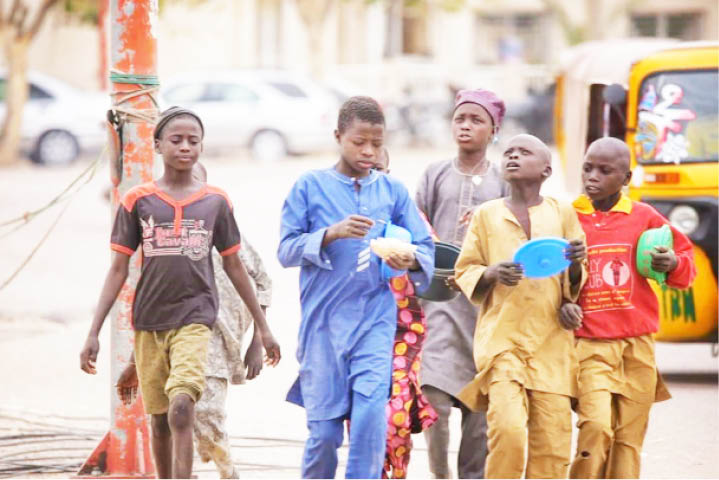
FILE PHOTO
A distant relation I had fallen out with some years ago somehow found a way to call me last week.
Between poor connections and long, nervous protocols to make up for lost time, we had a difficult conversation. It turned out that he had been advised to request me to help locate his eleven-year old son, an almajiri he had sent to a Malam in Suleja, Niger State.
The Malam later relocated to Kaduna with all the children and young men under his care last year after security agents on the trail of bandits operating near Shiroro had interrogated him over a former almajiri of his that had been identified as a bandit. I had no idea his son lived in the same city as I, but that did not surprise me. He had not seen his own child for four years, and did not even know he had been relocated to Kaduna by his Malam.
I could have given him alms or left-over food countless times without knowing that we were related. The child may never have heard of me.
The cause of the quarrel came flooding back. I had been persuaded that I had enough influence and muscle to persuade him not to send his second son, the child under discussion, to a Malam almost 400 kilometers away as almajiri. His first son was also almajiri in Kano, and their mother, another relation, had reached out to relations to persuade him not to send the second son away as almajiri as well.
We all failed. In my own case, I even offered to take the child under my care and send him to school along with my children. His reaction to my offer was shocking, and I suspect it may actually have been responsible for tipping him over and sealed the fate of the child to spend a childhood as almajiri. He told me he would rather lose the child than have him attend a western-style school (boko). I told him in turn that he was irresponsible and would stand to account for his wickedness and ignorance before Allah on the day of judgment. We had not spoken until now.
Listening to him, you would not believe that this was the same man who swore before many of us that he, and only he, was responsible for his children’s education, training and the manner they will grow as Muslims. He was distraught.
He had been told that the Malam who had his child had told the children that government had decided to close all tsangaya (almajirci) schools and ban almajirci (studying and begging). Every almajiri was to find the money in one week for their transport and return to their parents. The owner of the house they lived in at Rigasa had told the Malam of a meeting where they were told that they had two weeks to stop accommodating all tsangaya schools or face severe penalties. It was the first time he learnt that his child was now in Kaduna, not Suleja where he had sent him.
My relation lives in a village in Kebbi State. He could travel to Kaduna and help trace his son, but movement to, and entry into Kaduna had become difficult. The last information he had about his son was that the Malam had left the children in charge of a few young adults with instructions to them to make sure all of them left for their parent’s places.
I promised to help, but for the life of me, I did not even know where to start. I had heard that government of Kaduna State was rounding up almajirai for ‘deportation’ to their states of origin. I spent two days roaming the sprawling, hugely- populated and unique phenomenon that is Rigasa looking for Malams who had almajirai. I must have stuck out like a sore thumb. Gender, the appearance, the questions and the bewildered looks at a world I never knew existed in Kaduna made me a curiosity myself. I was astounded by the numbers of almajiri schools in a part of the city that is bigger and more populated than many old Hausa towns.
I tapped many friendly official contacts to verify stories that census of almajirai was being taken, and plans were afoot to ‘deport’ them. No one was in a position to get me closer to the child. I did see an incredible amount of worry and even panic among many Malams and almajirai who were anxious to leave Kaduna State, but had no means to do so.
On the third day, I received a contact from Rigasa who said he was aware that the child I was looking for had left Kaduna for Kano with about twenty other almajirai on the instructions of their Malam who, it turned out, had gone to Kano when he left Kaduna.
The Malam had found a new place for his school in Kano, and was now re-assembling children who had not yet returned to villages. The next day, he returned with a location in Kura in Kano where the Malam had now settled with our child. I spent the next two days trying to make contact with my relation to give him the good news.
When we eventually spoke, the conversation left me weak and bewildered. My relation, a tough, hardened peasant who himself had been an almajiri for about ten years of his life, broke down when I told him that his child could be alive, free and living with the Malam in a new location in Kano.
So, this man who could hand over his seven year old child to a stranger to take hundreds of miles away to live a life of desperate privation has feelings, and actually loves his son? His relief was unmistakable and unbelievable.
His gratitude for my efforts cannot be described. He said he had been told that many almajirai had been rounded up in Kaduna and detained because they have contracted the rich people’s illness (Covid-19).He said he would leave for Kano in a day or two to see his child. I made one request. Could he, I pleaded, please take the child home, at least until this pandemic is over? In spite of his emotional state and the circumstances of our conversation, he would not commit to my request. He said he will take him home first to see his mother, and then he will decide.
Our child is back in Kaduna. His father never saw him in Kano. He and about ten other almajirai were woken up ten days ago by police and other stern-looking people in their school in Kano. Everyone was asked only one question: where did you leave to come here? Most of them said Kaduna. That night, they were loaded in a bus with a few more almajirai from other schools and driven back to Kaduna. They went through a lot of questions and hands, eventually ending up in a building at the heart of the city. His father missed him by a day and is now back at the village. Our child is now suspected of being infected by the virus. He is in the isolation centre. I am not allowed to visit. I do not really want to visit. I am terrified to tell his father.