
As January 23 deadline looms
Unless President Muhammadu Buhari transmits to the National Assembly by January 23 [i.e. Wednesday next week] an executive bill to enact N30,000 as new National Minimum Wage, organized labour comprising of Nigeria Labour Congress [NLC], Trades Union Congress [TUC] and United Labour Congress [ULC] are threatening to begin a nation-wide general strike from that day. […]
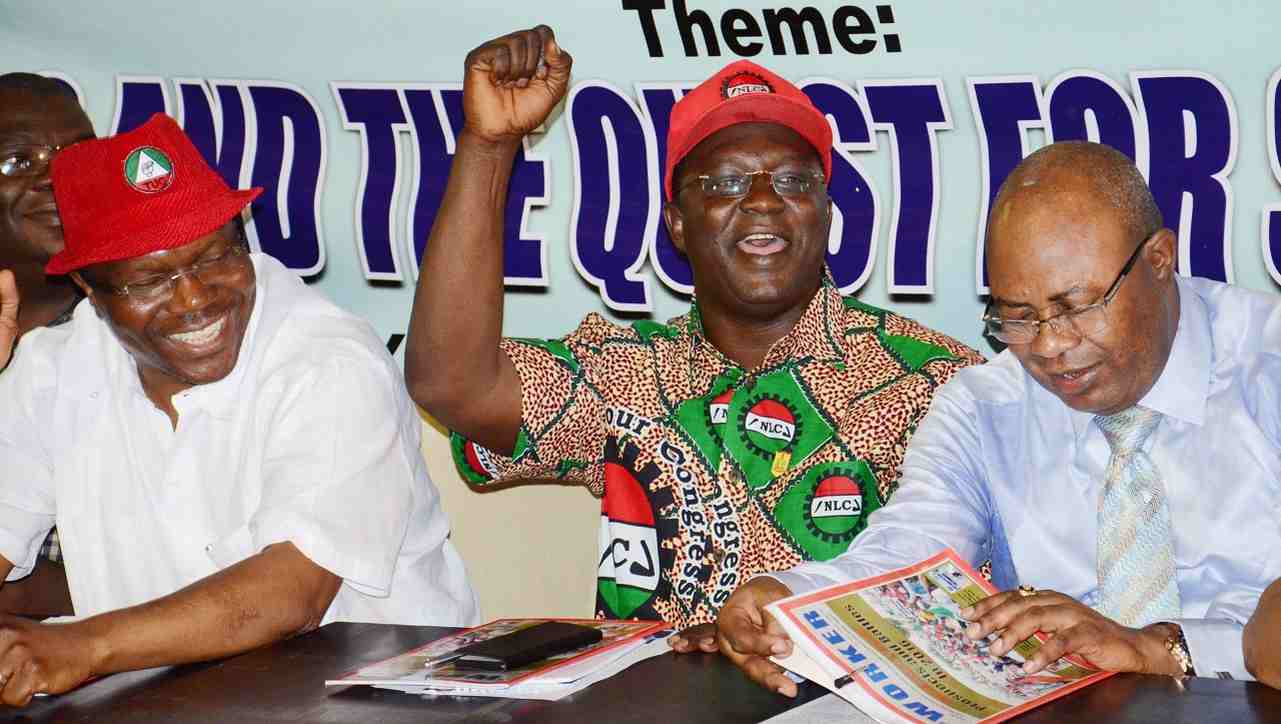
Mr Ayuba Wabba, President Nigeria Labour Congress [NLC]
Unless President Muhammadu Buhari transmits to the National Assembly by January 23 [i.e. Wednesday next week] an executive bill to enact N30,000 as new National Minimum Wage, organized labour comprising of Nigeria Labour Congress [NLC], Trades Union Congress [TUC] and United Labour Congress [ULC] are threatening to begin a nation-wide general strike from that day.
According to labour, the tripartite process between it, government and employers of labour leading to agreement on the new national minimum wage was thorough, hence the President has no reason not to transmit the bill to the National Assembly for a N30,000 minimum wage. Labour initially demanded for N56,000 but later settled for N30,000 which was recommended to the President by the Tripartite Committee headed by former Head of Service Ms. Ama Pepple.
NLC president Ayuba Wabba has accused the government of dilly-dallying on the issue but the Federal government has signed a Memorandum of Understanding [MoU] with labour leaders to transmit the new national minimum wage bill to the National Assembly on or before January 23rd. Minister of Labour and Employment Dr. Chris Ngige said the federal government will try to religiously implement all the processes before transmitting the bill within the stipulated time. He said, “We have a target time of January 23, 2019 and we hope that all things being equal, the executive will be able to do so. We will take on the statutory meetings of Federal Executive Council (FEC), National Economic Council (NEC) and Council of State to enable us transmit the bill on the new national minimum wage.”
While the Federal Executive Council is expected to ratify the deal because President Buhari has apparently endorsed it and the Council of State is usually docile, resistance is likely to come from NEC which is dominated by state governors. They have several times said through the Nigeria Governors Forum [NGF] that state governments cannot afford to pay N30,000 a month as minimum wage. They pointed out that many states have trouble paying the current wage and most would have been unable to pay it if not because of federal interventions in two tranches and through the Paris Club refunds. The governors instead offered to pay N24,000 as minimum wage.
Needless to say, labour rejected this and has accused governors of wasteful spending and poor arrangement of priorities. Instead, labour is piling up pressure on the president to send the N30,000 bill to the National Assembly. Trouble is, National Assembly may not pass this bill against the determined opposition of state governors, not to mention the organised private sector, which could respond to the new minimum wage through cuts in the workforce. The Federal Government seems to be having second thoughts too because soon after signing the MOU with labour, President Buhari inaugurated on Wednesday last week a Technical Advisory Committee on the implementation of a new National Minimum Wage led by leading economist Mr. Bismarck Rewane.
The President said the committee would recommend “modalities for the implementation of the new minimum wage in such a manner as to minimise its inflationary impact, as well as ensure that its introduction does not lead to job losses.” He added, “The work of this technical committee will be the basis of a Finance Bill which will be submitted to the National Assembly, alongside the Minimum Wage Bill.’’ The president was also quoted as saying that after the new wage bill is passed, salaries above the minimum wage will be renegotiated. How this will be done remains to be seen and it could lead to further unrest in the public service.
NLC president Ayuba Wabba reacted to the Rewane committee’s inauguration by saying it has no bearing on the MOU signed by government and labour. He also said it would not in any way affect the January 23 timeline for transmitting the bill to National Assembly. Clearly, something urgent must be done to ensure that these obstacles are cleared in good time to avert next week’s threatened nation-wide strike.