
At summit, global business leaders back Imo investment drive
Owerri, the capital of Imo State, buzzed with energy at the Imo State Economic Summit 2025 which attracted government officials, investors, development partners, and community leaders from across Nigeria and beyond. The event provided a platform to highlight the state’s plans for economic transformation, investment opportunities, and innovative development strategies. From the very first address, […]
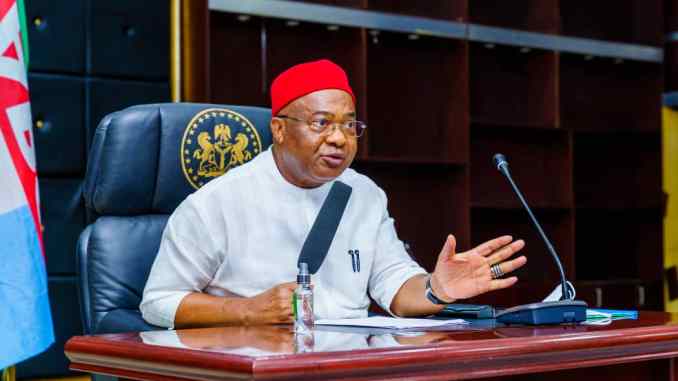
Governor Hope Uzodimma of Imo State
Owerri, the capital of Imo State, buzzed with energy at the Imo State Economic Summit 2025 which attracted government officials, investors, development partners, and community leaders from across Nigeria and beyond.
The event provided a platform to highlight the state’s plans for economic transformation, investment opportunities, and innovative development strategies.
From the very first address, it was clear that Imo State intends to take a leading role in shaping the future of business, technology, and sustainable growth in the country.
Governor Hope Uzodimma opened the summit with a clear message of ambition and determination.
He spoke passionately about the state’s commitment to creating an environment conducive to business and industry, emphasizing that reliable infrastructure, particularly electricity, is essential for economic growth.
Uzodimma detailed the state’s ongoing initiatives to provide continuous power to households and industries, stressing that this would form the foundation for investment, industrialization, and technological advancement.
“Imo State is ready to partner with all stakeholders to unlock its economic potential. Our focus on power, technology, and innovation is designed to benefit every resident and to create opportunities for growth and prosperity,” Uzodimma said, drawing strong applause from the audience.
He acknowledged the impact of the economic reforms of President Bola Ahmed Tinubu, saying, “For the first time in decades, Nigeria is witnessing bold, market-driven policy resets, notably the courageous removal of the restrictive fuel subsidy and the strategic harmonization of the foreign exchange market.
“Apart from signaling a decisive shift towards transparency, market liberalization, and fiscal stability, these intentional reforms have created a fertile environment where the private sector can truly thrive. This national momentum is the perfect backdrop for our own initiative, and reinforces that our drive for a $1 Trillion USD Economy is synchronized with the Federal Government’s agenda of economic renewal, paving the way for states like Imo to take the lead in regional development.”
The governor listed areas of investment in agriculture and manufacturing, technology, energy. He explained that the state also took time to holistically address the issue of land and titles for investors, by ending the manual method of land titling.
“This is to avoid a situation in which investors will be scared, reluctant, or outrightly discouraged from acquiring land for investment in the state. Before now, it was a problem in our state, too, owing primarily to the fraud-prone analogue system that was in place.
“We have now dismantled it and successfully replaced it with an efficient, fraud-free automated system,” he said.
He disclosed that he recently launched the Imo Land Information Centre (ILIC), a one-stop centre offering comprehensive digital land administration information across the state.
“All land records are now digitalized and migrated to a secure portal, utilizing blockchain technology to create tamper-proof ledgers. This guarantees unprecedented ease of doing business from anywhere in the world,” he said.
His government, he stated, has “built the foundation: security, infrastructure, power, and transparent land administration.”
He said the state has vast arable land that is suitable for the production of a wide variety of crops, which can serve as food and provide raw materials for the industry. “But more importantly, we are home to Adapalm; one of the largest palm plantations in West Africa,” he said.
“It is not possible to run a modern industrial operation without access to global markets.
Our Sam Mbakwe International Cargo Airport is now fully fitted for night operations. We are actively seeking partnerships to maximise the cargo component, positioning this airport as a major logistics hub in West Africa,” he added.
Following the governor’s address, former British Prime Minister Boris Johnson shared his perspective on international perceptions of Nigeria. While acknowledging reports about security concerns, he emphasized that his visit to Owerri had been completely safe. Johnson praised the governor’s efforts in providing 24-hour electricity and noted the significance of reliable power in supporting economic development and attracting investment.
He highlighted the importance of embracing technological change and preparing for future economic demands. According to Johnson, regions with stable power supply and forward-looking policies are well positioned to benefit from global trends in innovation and industry. “Reliable electricity and infrastructure are essential for sustainable development and for creating an environment that encourages investment,” he said.
Former United Nations Secretary General Ban Ki moon then addressed the summit, placing Imo State’s ambitions within a global context. He highlighted Africa’s potential to provide solutions to global challenges, particularly in climate change and sustainable development. Reflecting on his visit to Imo, Ban Ki moon spoke of the continent’s historical struggles and resilience, noting that Africa’s experiences have valuable lessons for development and progress.
He pointed out that although African nations contribute only a small fraction of global emissions, they are among the most affected by climate-related disasters. Ban Ki moon stressed the urgency for action on climate issues and highlighted the importance of clean energy initiatives and sustainable infrastructure projects in states like Imo.
Vice President Kashim Shettima reinforced the federal government’s commitment to supporting Imo State’s economic transformation. He identified the state as a critical pillar in Nigeria’s plan to diversify its economy beyond oil, citing opportunities in technology, gas utilization, agro-industrial processing, and small and medium-scale enterprises. Shettima emphasized that national prosperity depends on every state taking ownership of its economic direction and leveraging its unique advantages.
He described Imo State’s development prospects as strategic, aligning closely with the federal government’s agenda to stabilize the business environment and attract long-term investment. Shettima highlighted the mechanisms of support, including financing from the Bank of Industry and the Development Bank of Nigeria, as well as structured public-private partnerships in housing, transport, and renewable energy.
The Vice President emphasized key sectors for growth, such as free trade zones, agro-industrial processing zones, and expanded gas utilization for domestic and industrial purposes. He also stressed the need for strong digital infrastructure to attract technology firms and integrate the state into the knowledge-driven economy.
Shettima reaffirmed the federal government’s commitment to investor protection, policy consistency, and reducing risks for private investments. He highlighted the importance of innovation, talent development, and technology in strengthening global competitiveness, urging Imo State to prioritize these areas in its growth strategy.
Federal programs supporting Imo State include initiatives to empower young innovators, expand digital skills training, strengthen technology clusters, promote science and technology education, and deepen research partnerships with universities. The Vice President emphasized that Imo’s youth are ambitious and creative, and with the right support, they can drive the state’s transformation in technology, industry, and entrepreneurship.
The summit was structured as a working forum, emphasizing the need to turn discussions into actionable projects. Delegates were encouraged to ensure that ideas were followed by funded initiatives, measurable outcomes, and tangible improvements in livelihoods.
The summit highlighted the connections between infrastructure, technology, and human capital in driving growth. Reliable electricity, digital readiness, and strong industrial policies were presented as prerequisites for attracting investors and fostering an environment conducive to enterprise and innovation.
By hosting policymakers, investors, and global leaders, Imo State positioned itself as a proactive player in Nigeria’s economic development. The summit showcased the state’s strategy to transform ambition into action and leverage partnerships for a resilient, inclusive, and competitive economy.
The summit attracted notable global and national figures, including Ameenah Gurib-Fakim, former president of Mauritius; Americo Ramos, Prime Minister of Sao Tome and Principe; Joseph Boakai, former president of Liberia; Nigeria’s Finance Minister Wale Edun; business magnate Aliko Dangote; and governor Abdullahi Sule of Nasarawa and Abdullahi Ganduje, former governor of Kano. Their presence highlighted the significance of the event as a platform for partnerships, investment, and economic transformation in Imo State.
With clear strategies for infrastructure, investment, youth empowerment, and innovation, Imo is poised to attract partnerships, stimulate industrial development, and contribute significantly to Nigeria’s economic progress.
The summit sent a clear message that through strategic planning, effective policy implementation, and collaborative investment, Imo State can emerge as a hub of opportunity, innovation, and sustainable development, solidifying its position at the forefront of the nation’s economic transformation.