
Atiku, Obi and the coalition
His Excellency, former Governor of Anambra State and presidential candidate of the Labour Party (LP) in the 2023 election, Peter Obi, has a 2027 decision to make right now. How he makes that decision could well tell how far the very idea of an Obi presidency, an idea that has so far inspired and animated […]
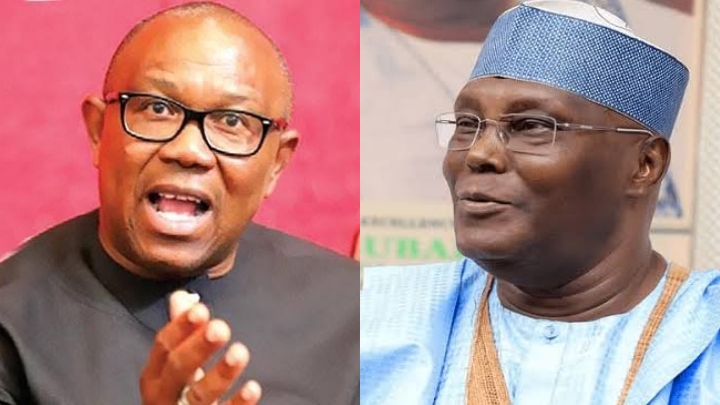
His Excellency, former Governor of Anambra State and presidential candidate of the Labour Party (LP) in the 2023 election, Peter Obi, has a 2027 decision to make right now. How he makes that decision could well tell how far the very idea of an Obi presidency, an idea that has so far inspired and animated millions of Nigerians even if millions more display stark indifference or mild irritation to it, would go beyond the coming winter and spring.
Let me explain. Electoral politics is a game of sides where voters generally tend to choose a side early, often long before Election Day. And for many Nigerian voters, the sides in the 2027 presidential election are already set: those voting for President Bola Ahmed Tinubu and his ruling APC, and those against him for the opposition coalition, whoever would be flying its flag. We can, therefore, guesstimate that about 60 per cent of Nigerians who will be voting in that election may have already decided which way to cast their ballots even at this point.
Where does Peter Obi stand in this electoral matrix? It is not clear. What is clear is that the man is undecided up to this point on which side he stands, which is a serious problem in politics. On the one hand, Obi remains a member of the LP. But as things stand, Obi has little practical influence in the LP, and might yet not find it easy to fly its flag as happened in 2023. On the other hand, Peter Obi is actively flirting with both PDP and ADC opposition parties. On Friday, he was invited to return to the PDP by Bauchi State Governor and Chairman of the PDP Governors’ Forum, Senator Bala Mohammed, during Obi’s visit there. At the same time, Obi has been seen publicly mingling with many key leaders of coalition in the ADC in recent months, and has dangled the half carrot of serving only one term of four years to the ADC to field him in 2027. This kind of politics might appeal to Obi and his supporters as a smart move that gives him control over the still uncertain politics of the 2027 presidential election.
It is dangerous politics, however. Political ruin comes sooner to the politician who looks out only for himself on all sides because the golden rule of politics is win or lose; you must have a side. As long as FCT Minister Nyesom Wike’s tight grip holds, the PDP and the ADC cannot be on the same side, and therefore, Obi cannot be on both sides at the same time. This leaves Peter Obi with the weak option of taking over another party as he did with the LP in 2023, or the more plausible option of joining up with the coalition ADC, where he will meet with former Vice President Atiku Abubakar for the third time in Nigerian presidential election politics.
As I see it, there are three key issues for Peter Obi in the ADC coalition. The first is the half a carrot of serving only one term he is now dangling to all opposition parties, including the ADC. I don’t know how much Obi believes it when he says it, but I am confident no one believes it other than his supporters. As a political journalist, I do not believe him and I don’t expect any serious politician to believe him. This does not mean that Obi is being insincere, but that such a promise is not what any serious politician or observer should believe. The future is simply too short in politics for such promises, not to mention that we have been there before in Nigeria.
The second issue is whether Obi should get the ADC coalition ticket in 2027 as almost all his supporters insist. In my view, this is working against political reality, since Atiku is already in the ADC, and he is there for the coalition ticket, pure and simple, as we say in Nigeria. Atiku is a former Vice President of Nigeria, and a presidential candidate of a major party 16 years before Peter Obi. In a two-way race with Buhari in 2019, Atiku brought in 11.2 million votes, and in the four-way race in 2023, he came second with 6.9 million votes. He was also Obi’s direct boss on the same PDP ticket in 2019 and polled higher in 2023. I don’t know by what political variables some people are calculating, but I find it cheeky that such a person would be skipped over for Peter Obi by a any political party that seriously wants to win an election.
So, should Obi run again as Atiku’s running mate in the ADC? This is a hard nut to swallow for most Obi supporters, and a deal breaker for many. There are two reasons for that itself.
First, Peter Obi’s candidacy represents a deep, deep emotional quest for belonging among the Igbos that cannot and should not be discounted. Fifty-five years after the Nigerian civil war, an Igbo president, through the ballot box, is the only thing acceptable to the Igbos of Nigeria as a marker that they as valued as equal Nigerians with everyone else. It is therefore a collective project that is larger than Obi himself. I have been reading Nigerian newspapers actively since age 11, and I don’t see anything special that Peter Obi, the person or the politician, possesses better than his peers in Nigerian politics. All the talk about integrity, record, competence and what not are just the things you say when you cannot openly say give us Igbo presidency.
What makes Obi special is that his candidacy represents an important milestone, not just for Igbos, but for all Nigeria. This is why I have previously written in these pages that Nigeria must find a way to make Igbo presidency a reality, and as soon as possible too. But for all that his candidacy represents, it cannot mean an automatic ticket anywhere. Peter Obi can only make it to the Nigerian presidency through the ballot box only with the kind of regional electoral coalition that won it for Shagari in 1979, Abiola in 1993, Obasanjo in 1999, Yar’adua in 2007, Jonathan in 2011, Buhari in 2015 and Tinubu in 2023. Regional electoral coalition is the iron law of Nigerian presidential elections and the only path to victory under current laws.
What Obi needs is therefore serious negotiation with other people who control other voting blocs. Unfortunately, both Peter Obi and his supporters tend to have an exaggerated sense of his electoral clout. This is the second reason why stepping down to Atiku’s running mate in the ADC would be emotionally difficult for him and his supporters. But the stark reality is that the real competition in the 2027 presidential election does not include Obi or his supporters. For Obi’s core voters, it is Obi or nothing, which will make their votes a hard sell for either Tinubu or Atiku should he not be with either. But his numbers are not likely to reach the 6.1 million votes he won in the 2023 election, when he came third, because Tinubu has now made effective inroads into the same northern minority voting bloc that supported Obi, not to mention that Lagos would no longer be there for the taking for Obi, given the current ethnic politics there.
In other words, Obi will not be taking away anyone’s votes in 2027, and outside of the ADC coalition, he is well likely to perform less than he did in 2023. Therefore, the real competition in 2027 will be between Tinubu’s 8.7 million voters and Atiku’s 6.9 million in the 2023 election. Those 15 million or so votes will decide the election, regardless where Obi stands. Tinubu will be looking to keep as much of his 8.7 million 2023 voters as possible, while also trying to compensate for any 2023 losses with new voters in both the north and south. Atiku, on the other hand, will be looking to turn as much of Tinubu’s 2023 votes to his side as possible, while also looking to retain much of his own 6.9 million 2023 votes.
Atiku’s real challenge is not to win over Obi’s voters, but to turn as much of Tinubu’s 2023 support to his side as possible, with or without Obi. If Atiku and Obi are together in the ADC coalition, it will be a significant added advantage for the ADC to win it. But he can still nick it without Obi if he can keep most of his 2023 votes, which do not include Obi’s voters, and then turn even half of Tinubu’s 2023 votes to his side. Likewise, if Tinubu can compensate for any 2023 loses with new voters in the north and south, he wins, where Obi is standing alone. For Obi, therefore, the writing is clear on the wall, and he should not need me to spell it out.
This article was first published on August 11, 2025