
Audu Innocent Ogbeh (1947-2025)
Chief Audu Ogbeh, OFR, who passed away on August 8, 2025, was an epitome of an idealist politician who maintained his sanity and held his head high in the flood of corruption in Nigeria’s polity. He featured variously in Nigeria’s politics from the Second Republic, through the return of the country to democratic rule in […]
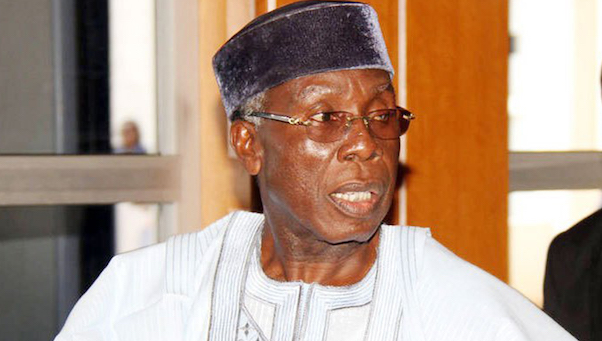
Chief Audu Ogbeh
Chief Audu Ogbeh, OFR, who passed away on August 8, 2025, was an epitome of an idealist politician who maintained his sanity and held his head high in the flood of corruption in Nigeria’s polity. He featured variously in Nigeria’s politics from the Second Republic, through the return of the country to democratic rule in 1999, until the first term of former President Muhammadu Buhari from 2015 to 2019. Either as a member of the Legislature or Executive or as the chairman of a ruling party, Chief Ogbeh maintained his integrity; he was never mired in any web of scandal, especially those related to corruption.
Chief Ogbeh came to political limelight in 1979 when he was elected Deputy Speaker of Benue State House of Assembly under then ruling political party, the National Party of Nigeria (NPN). Before the election, he was in the education sector, first, as a lecturer at the Institute of Education of Ahmadu Bello University Zaria, and later Head of Humanities at the Murtala College of Arts, Science and Technology, Makurdi, from 1977 to 1979. Former President Shehu Shagari would appoint Chief Ogbeh as the Second Republic Minister of Communication, and later Minister of Steel Development, a position he held until the military sacked the civilian government in 1983.
Between 2001 and 2005, Chief Ogbeh was the National Chairman of the Peoples Democratic Party (PDP), a delicate and turbulent period in the party’s history. In that role, he brought to bear his experience as a political actor in the Second Republic NPN era, when political parties were considered supreme. Today, politicians look back at Chief Ogbeh’s four-year tenure at the Wadata Plaza secretariat of the PDP with nostalgia, as Ogbeh was considered to be a very powerful and independent-minded party chairman who had the temerity to speak truth to power, even to former President Olusegun Obasanjo.
He faded from active politics temporarily in 2005, but resurfaced in 2015 when the late President Buhari appointed him as Minister of Agriculture and Rural Development. With the appointment he had the challenge of scaling up his passion for agriculture. A man who always made recourse to farming when not holding political position, Chief Ogbeh faced the task of making Nigeria food sufficient from its vast arable land and abundant livestock resources. The most visible success story he recorded was the mass production of rice in Nigeria during the first term of the Buhari government, a feat achieved through the Anchor Borrowers Scheme (ABS). Though the loan scheme came under criticisms, it led to what may be considered the golden era of rice production in the contemporary history of Nigeria’s agriculture. Nigerians would remember Chief Ogbeh as a practitioner and policymaker in the sector, a man who put in tremendous efforts to modernise the sector to ensure food security.
- 2027: Nigerians are hungry, they know what to do – Kwankwaso
- Now that we know there is no more corruption in Nigeria!
In addition to his passion for agriculture, Chief Ogbeh was a playwright, lover of literature and an intellectual in his own right. His advocacies for investment in agriculture were punctuated with data, which he rolled out without blinking his eyelids. In one of his interviews, Chief Ogbeh talked about some potential in Nigeria thus: “The Chinese are demanding two million tonnes of soya beans, the Indians are looking for our produce also. With these demands, we must all be involved in agriculture;” or arguments for more universities of agriculture by referring to practices in other countries. He said, “India has 87 universities of agriculture and you know they are exporting rice to us. Brazil has 70 universities of Agriculture and they are exporting rice to us.” Journalists who encountered him wondered how Chief Ogbeh amassed so much data in his memory.
Chief Ogbeh demonstrated that he was a patriotic Nigeria, never espousing ethnic or religious bigotry. Though his origin is linked to the minority ethnic communities in the North Central, he was in 2020, appointed as the Chairman of the Arewa Consultative Forum (ACF). He played a pivotal role in ensuring that the North was united in spite of its besetting farmers-herders conflict, economic and political challenges.
Born in Otukpo, Benue State on July 28, 1947, the late Chief Ogbeh attended Catholic schools for his primary and secondary education. First, he attended St. Francis Primary School, Otukpo, and later, Mount St. Michael Secondary School, Aliade, Benue State. Later he attended King’s College, Lagos, for his Higher School Certificate, from 1967 to 1968. For his tertiary education, Chief Ogbeh studied French at Ahmadu Bello University, Zaria to obtain B.A. in French in 1972. He obtained a Master of Letters in French Literature (1974) from the University of Toulouse, France.
The late Chief Ogbeh expressed pessimism about Nigeria in his last interview with Daily Trust, published on the day he died. Ogbeh reflected about Nigeria thus: “I am a sad person. I tried to find happiness but I am scared of the future. I may not be here, I am way over 70, heading to 80, but I don’t like what I smell. It is very depressing.” In spite of such thinking, Chief Ogbeh will be remembered as a man of vision; he did not become wealthy in and out of political office, but he left this world with his integrity intact.