
Avenues for affordable housing
One of the major objectives of a private initiative that is called African International Housing Show, which organises international housing conference and exhibition, on annual basis, is to assist the government in the facilitation of the delivery of affordable housing. The organisation is based in Abuja and the initiator of the Abuja Housing Show 20 […]
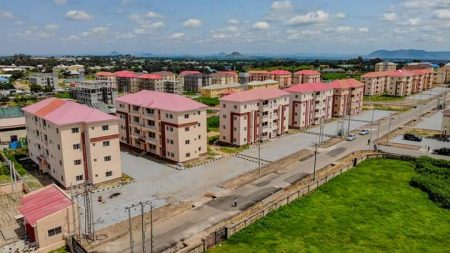
fct mass housing
One of the major objectives of a private initiative that is called African International Housing Show, which organises international housing conference and exhibition, on annual basis, is to assist the government in the facilitation of the delivery of affordable housing. The organisation is based in Abuja and the initiator of the Abuja Housing Show 20 years ago.
It graduated to Abuja International Housing Show before its transformation to African International Housing Show, due to its growing global patronage. This year it will be holding its 20th edition. However, due to some challenges, achieving affordable housing objective in Abuja is still a mirage.
The basic elements of housing that determine affordability are land, finance, infrastructure, building materials and labour. Our government has stopped the direct provision of houses. Where it builds it sells them to recover the investment, either on short or long term basis. In such circumstances, the major areas where the government can directly play key role are land acquisition, the provision of infrastructure, and favourable policy for the achievement of the objectives. The organised private sector and individuals provide the finance, building materials and labour.
Just like any other urban area, Abuja city cannot survive without the urban poor, who overwhelmingly constitute the labour force sustaining the city. Thus many houses are needed to accommodate the labour force. But, the many housing estates available are exotic, mostly not tailored for the affordability of the ordinary citizens who belong to the low income group. Thus, the housing problem in Abuja is not that of availability, but affordability.
Measures for ensuring housing affordability are included in the Abuja Master plan and have always been in the policies of the Federal Ministry of Housing over the years. Of particular concern is that the government is yet to find a solution to land speculation, because almost all are involved. This is a major challenge militating against affordable housing.
Previously, Accelerated Mass Housing developments, Malaysian Housing model and others were among the policy options explored by the Federal Capital Development Authority. Clearly, all these previous options neglected the aspect of affordability.
The solution for the ordinary citizen is to explore where housing rents are affordable, or where they can build their houses at affordable rates. Therefore, rather than living in the city where they earn their livelihood, majority of the labour force of the federal capital city live outside. This is what is responsible for the Abuja city’s working population living in Suleja, Madalla, Mararraba and Masaka, and other surrounding suburbs, in Niger and Nasarawa states. The absence of affordable houses is also responsible for the ghost city life in the city at weekends and public holidays.
Also, worthy of note is the fact that the financiers of most of the housing estates have dubious source of income and are often not in hurry to see their houses occupied. They often wait for their desired prices no matter how long and in spite of the harsh economic climate. Unlike genuine investors that require continuous fund for reinvestment, these people do not care. We have earlier advocated for heavy tax on houses lying fallow without occupants as a remedy to the situation.
Making land acquisition less expensive and cumbersome and ensuring the prompt provision of infrastructure have in no small way contributed to reduction of the cost of housing in the city. However, it is still not adequate for the attainment of the desired affordability to the urban poor. Housing in Abuja will remain the exclusive reserve of the rich for a very long time to come.
Infrastructure, as one of the key components, improves the value of land. Contrarily, instead of becoming an advantage to lower the cost of land and housing, the provision of infrastructure by the government is being used by estate developers to increase rent and cost of houses.
The Authority should encourage the emergence of strong community based associations, which it can collaborate with, by providing land at suitable locations, assist them in the areas of acquiring soft loans from financial and mortgage institutions to build their houses. The employment of community based labour and knowledge of special low cost construction technology through assistance from government and established philanthropic organisations shall be an added advantage. Typical example is the Kambi Moto model in Nairobi Kenya.
In the FCT, the local inhabitants are threatened by relocation. The upgrading of informal housing through community development approach could be applicable for the integration of local and indigenous communities threatened by relocation as a result of the city’s expansion.
Community driven projects are favoured policy options for meeting the needs and aspirations of the urban poor. They rely on the community resources and initiative to find affordable, innovative and sustainable solutions to housing shortages that meet local needs. More of the government role is to be on creation of favourable policies and as one of the resource supporters, rather than direct provision.