
Aviation: New handling rates begin January 1
After an initial delay, the Federal Government through the Nigeria Civil Aviation Authority (NCAA) has finally approved a discount of 25 percent on new handling charges as requested by the ground handling companies. To this end, the ground handling operators have signed a memorandum for the commencement of new safety handling threshold charges on January […]
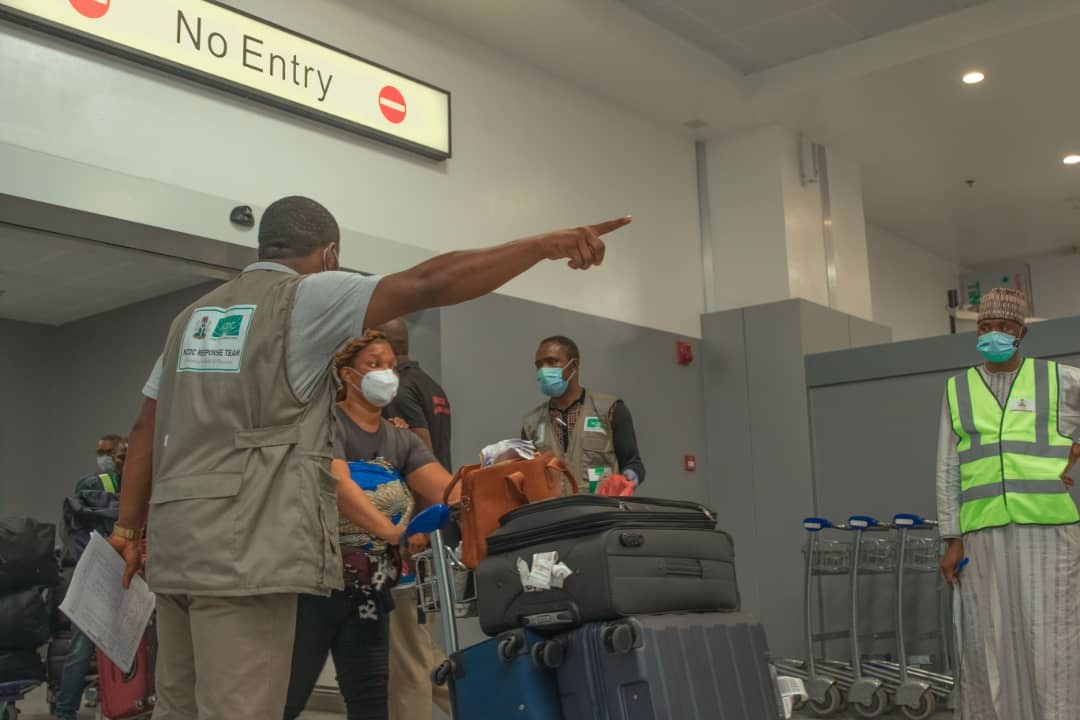
Disease detectives direct human traffic at airport
After an initial delay, the Federal Government through the Nigeria Civil Aviation Authority (NCAA) has finally approved a discount of 25 percent on new handling charges as requested by the ground handling companies.
To this end, the ground handling operators have signed a memorandum for the commencement of new safety handling threshold charges on January 1, 2022.
This is coming after consultations with the NCAA, the National Assembly and other relevant stakeholders within the aviation industry.
Daily Trust reports that the NCAA had approved new handling rates to take effect in October this year for international airlines and January 1, 2022 for the domestic carriers before the National Assembly intervened following a petition from airlines.
But three months after, the Chairmen and the Chief Executive Officers (CEOs) of the five handling companies in Nigeria have finally signed a joint agreement ahead of the take-off of the new rate.
A communique by the five CEOs indicated that the new handling rates are between $1,500 and $5,000 (passenger and cargo flights) for narrow and wide body aircraft on international routes, respectively, while for domestic operators’ rate is pegged at N25,000 and N70,000, depending on the aircraft type.
“In view of the foregoing, kindly find attached the new revised ground handling rates for our operations. The commencement date for these new revised rates is as follows:
“International/regional operations; effective January 1, 2022 and domestic operations; effective March 1, 2022.”
The new rate is coming 36 years after the last review was carried out.
Before the new rate, international airlines were paying as low as $400 to handle narrow body aircraft, while they were charged between $1,000 and $1,200 for wide body aircraft.
This was said to be the lowest in Africa fueling agitation by the handling operators to bring the rate at par with international standards.
Chairman of the Association of Ground Handlers of Nigeria (AGHAN), Mr. Olaniyi Adigun said the operators needed to increase the rates based on the economic realities on ground.
He commended the Minister of Aviation, Senator Hadi Sirika and the NCAA DG, Capt. Musa Nuhu for the approval.
“To us, it is a win-win situation for us all, including the airlines,” he said, adding that the association is setting up machinery to monitor compliance.
Also, CEO of Butake Handling Firm, Alhaji Bello Salihu, said, “All the five of us unanimously agreed to apply sanctions for whosoever that violates the agreement. Sanction will be applied and NCAA will be involved in punishing any recalcitrant member of AGHAN that violates the agreement. Anyone that does that, we are going to report such to the NCAA.”
NCAA Director-General, Capt. Musa Nuhu also justified the increase.
He said, “The issue of the handling rates was justified because for over 30 years, the handling rates were not adjusted and imagine, these ground handlers, they import a lot of their equipment using foreign exchange, just like the airlines use foreign exchange to procure their machines.
“So, what affects the airlines, directly affect these ground handlers and the ground handlers are a critical component for the success of the industry. So, we sat down, compare what we charge here with that of the other countries, but because of the devaluation of naira and the non-increase of ground handling over the years, the increase looked very high.”So, the airlines complained. Then, we mediated into the issue, listened to their complaints and reduce the new rates with 25 per cent. We did this so that we don’t shock the system, but we can gradually fully increase. I just read something this morning, the ground handlers have come together and know that the competition is detrimental. So, they are working together now. I think if the ground handlers can work together, they should be able to implement the new rates. The handlers were undercutting themselves in the past.”