
Before the beggars’ strike
Nasarawa State Governor Abdullahi Sule had no words to spare when he signed the Child Rights Protection Executive Order into law. The Executive Order banned child street begging in the state, and prescribed a 10-year imprisonment for parents who allowed their children to go into the streets begging. Earlier in May last year, Governor of […]
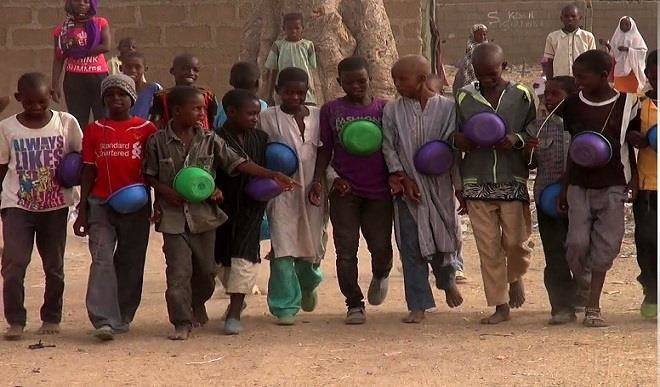
File photo of children on the street.
Nasarawa State Governor Abdullahi Sule had no words to spare when he signed the Child Rights Protection Executive Order into law. The Executive Order banned child street begging in the state, and prescribed a 10-year imprisonment for parents who allowed their children to go into the streets begging. Earlier in May last year, Governor of Kaduna State Nasir el-Rufa’i signed a bill into law prohibiting child hawking and begging, specifying that every child between the ages of six and 15 must be in school not on the street hawking or begging. Parents would be held liable, prosecuted, and sent to prison.
Likewise a week ago in Kano, the governor of the state, Dr. Abdullahi Umar Ganduje, promptly announced that the almajiri system had been integrated into the state’s universal basic education and therefore outlawed street begging and hawking. The government then launched the Basic Education Service Delivery for All tagged BESDA, and appointing 7,500 volunteer teachers. “This policy of free and compulsory basic and secondary education goes along with integration of pupils of almajiri system of education into the mainstream policy implementation, which provides that English and Arithmetic must be included in the Almajiri schools curriculum along with Qur’anic education”, said Governor Ganduje who warned Almajiri teachers – “If you cannot accept that, you leave the state…” Also, that “the parents or guardians of such children will be taken to court for disrespecting our laws.”
I believe that the onslaught on the almajiri and the street children which the banning of street begging and hawking implies, will sweep across the Northern States like a gale. Indeed, it may not be moving fast enough.
One imminent challenge however is that of enforcement of the law, as purposeful and desirable as it is. Already, our security personnel are overstretched with criminal activities of petty thieves and burglars, bandits, murderers, kidnappers and terrorists. This initiative by some state governments may please the ear now, but clearly the states do not have the capacity and muscle to keep the almajiri and beggars off the streets. Behind the initiative must be a sincere political will and unflinching commitment because we are dealing with a projected 13.5 million street children, not to even add the vulnerable groups of the sick, the physically challenged, the poor and destitute.
Meanwhile, already the reaction of the vagrant children in states where this law is being implemented is to play hide and seek with enforcers, scampering from controlled zones and locating to parts of town where the arm of the law is not long enough to reach – and there are many safe havens in every municipality. In the same vein, the street children will find no difficulty migrating from any state where there is a ban to the other state where no ban is in place. It will therefore take a while before we see impact. If you clear them from Nasarawa State, they will locate to Adamawa State for instance.
The question then is; if you ban begging, and the children must live, eat, and pay returns to their guardian protectors, what will they do? Unless all northern governors come together to look at this problem as a regional one and apply common solutions that bind all states, and even at that, make a collective heave against the menace, the whole effort would be futile. Pronouncing an executive order is one thing, whereas ensuring obedience is quite another. Were the northern governors to work together applying common solutions given the regional similarities, we may suggest that the children across the region are all “harvested” to schools with ensured feeding of at least a meal a day and education, both “boko” and Quranic. Once started, ways of sustainability can be ensured, exploiting the partnership of the philanthropic private sector and religious organisations that may apply Zakat, and Tithes to grants for child education and care. The northern states have the highest amount of funds for Universal Basic Education, lying fallow at the Trust Fund. The state governments have not met the required conditions for accessing the fund and applying it to basic education infrastructure development.
Late last year, Senator Isah Misau had proposed a bill at the National Assembly to ban street begging nationwide and it had substantial backing of majority of lawmakers. Their reasoning was that worsening menace of street begging was a result of not so much the insecurity related displacement of rural folks, but parental irresponsibility and criminal exploitation. All the indices count and contribute of course. But the proposed bill was criticized by human rights and civil society organisations. According to them, what was required was first to regulate the almajiri practice and bring all their tutors under state control through licensing. We have not even analysed the demographics to determine those beggars induced by illness, poverty and homelessness.
The activists both secular and religious warn that throwing a dragnet over the beggars would be an inhuman display of aimless political muscle.
The real social problems of destitution and street begging are poverty and a lifestyle in a society whose members have no qualms about bringing in more children to the world than can be catered for. Without an attitudinal change through enlightenment and the mitigation of poverty through empowerment, the figure of out of school children will only climb above the current projection of 13.5m. Ignorance and poverty will produce the children, the children will satisfy and feed a growing number of exploiters, and as well serve to swell the number of bandits, kidnappers, and supply insurgents with fighting .
I title this piece ‘Before the beggars’ strike’ because I see the scenario captured in Aminata Sow Fall’s masterpiece novel, ‘Beggars’ Strike’, presenting itself. We may today see the destitute as lacking in human perception and feeling in view of their deprivation and want. But we would be mistaken. The day they reason same way as motivated by the blind character Nguirane in the novel concluding – “We’re not dogs! You know perfectly well we are not dogs. And they’ve got to be convinced of this too. So we must get organised,” we would be in for it. They already know the real compulsion for society to give them alms is not “out of the goodness” of our hearts, but “out of an instinct for self-preservation.” We need to give alms because we need their “prayers – wishes for long life, prosperity, to drive away their bad dreams, and for a better tomorrow…”.
When this happens, we would be in for it, maybe even as bad as Boko Haram if not worse. Thus all hands must be on deck in a rethink. It is necessary to see the children not like dogs or scum but as an inheritance of promising human resource – not a burden but indeed a common patrimony getting education from comprehensive schools. Northern elite must subdue political cleavage that divide us and commit to working with governors to address the damage.