
Boko Haram, 10 years and counting
Last week, the Boko Haram insurgency in Nigeria turned the tenth year corner. How could I not write a few words on it? It was my notes titled ‘Maitatsine and Boko Haram – Lessons not learnt’, published by this medium that I believe, caught the attention of the Editorial Board to so graciously ask that […]
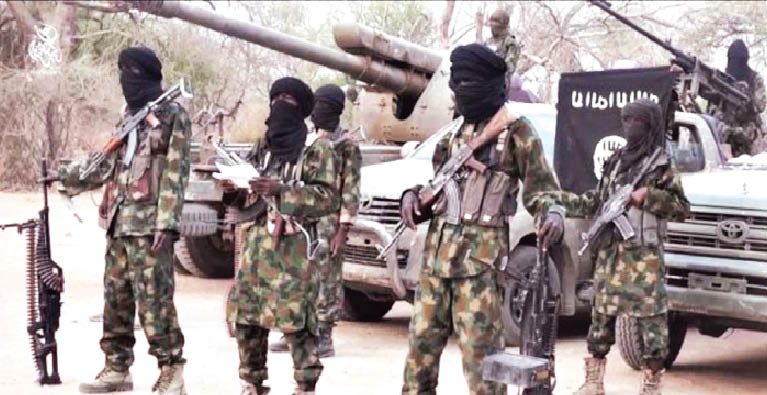
FILE PHOTO
Last week, the Boko Haram insurgency in Nigeria turned the tenth year corner. How could I not write a few words on it? It was my notes titled ‘Maitatsine and Boko Haram – Lessons not learnt’, published by this medium that I believe, caught the attention of the Editorial Board to so graciously ask that I retained this opinion column from November 2009. Thus in a way for the both of us, it is a shared 10th anniversary.
In that article, I suggested conditions that might have caused the Boko Haram rebellion, highlighting that mistakes akin to those made leading to the Maitatsine Uprising in 1983 and 84, were being made, and that if the ongoing subjugation of ordinary folk into abject poverty, the lack of social amenities and especially the abandonment of education of millions of children continued unchecked, the Boko Haram, then a rebellion of fundamentalists would become an insurgency. I noted that ordinary folks suffering this against the profligate lifestyle of our corrupt political class have every reason to see a lot of Haram in our type of boko.
Last week, the international focus was on Nigeria and 10 years of fighting Boko Haram. Clearly the global conclusion is that to date, “Nigeria has no answer” to the challenge, that “there is still no respite” for the displaced Nigerians, and that “the Nigerian military is “lacking in manpower, technology, and capacity” to address the challenge. The Nigerian Presidency is thin-skinned to any such suggestions of lack of success over Boko Haram. The defeat of the insurgency was a cardinal promise President Muhammadu Buhari made while campaigning for in the run up to the 2015 election. For a great many Nigerians, he was the choice over President Goodluck Jonathan, the fact that Buhari was a military general with war and governance experience and hence endowed with the technical management skill to crush the devastating insurgency promoted his choice to victory.
In response to global conclusion of failure, the Nigerian Presidency last week reiterated the claim that Boko Haram by its reckoning, has been “defeated”. Said a Presidential spokesman, “The position of the Nigerian government is that the Boko Haram terrorism has been defeated. The real Boko Haram we know is defeated.”
There is no disputing the fact that Boko Haram has been degraded, decapitated, or “defeated”, any term can be applied, yet it is also clear that we have not recorded success that is commensurate with our promise, our boast, and our capacity. Nigerians in deed the global community had expected a much more decisive determination of the Boko Haram challenge, that is still wreaking havoc in Borno, Yone, and Adamawa States of the country. Boko Haram has killed nearly 30,000 Nigerians since its inception in 2009, according to the United Nations. A recent attack in Nganzai, where more than 65 people were killed, was one of the deadliest in recent years, and a “stark reminder that the conflict is still actively raging in the states of Borno, Adamawa, and Yobe”, said a UN spokesman. The Military has itself suffered severe losses. There is no known figure of military personnel losses, but estimates are too high for comfort. The global body Council on Foreign Relations (CFR) has these statistics of overall deaths of both civilian and military, as more than 51,567. Over 3 million Nigerians are recorded as displaced.
Thus for 10 years and counting, Nigeria is still in the woods as far as the Boko Haram insurgency is concerned. Indeed the overall security situation in Nigeria has since taken a turn for the worse given the many other insurgencies that have cropped up, bandits and cattle rustlers in Zamfara, Kaduna, Kebbi, Plateau, and Taraba States, and the so-called armed “herdsmen” operating in the country and accounting for mass killings, abductions and kidnapping. Military Expenditure in Nigeria increased to nearly $2bn in 2018. This did not include additional “donations” to the military, being made by State Governments as assistance for the maintenance of security. A record $1bn dollars was recently accessed from the Excess Crude Account and committed to military supplies and still, the cry of the armed forces is that there is a deficit in fighting equipment, accounting for the inability to finally put the Boko Haram tragedy behind the country.
Without an ascertained suppression of Boko Haram, it has been impossible to restore infrastructure mainly in roads, bridges and government offices in the North East sub-region. State Governments hamstrung by heavy salary burdens have not been able to adequately rise up to the demand for restoration. It is however significant that President Muhammadu Buhari has finally inaugurated the North East Development Commission charged with the responsibility to, “among other things, receive and manage funds from allocation of the Federal Account and international donors for the settlement, rehabilitation and reconstruction of roads, houses and business premises of victims of insurgency as well as tackling menace of poverty, illiteracy level, ecological problems and any other related environmental or developmental challenges in the North-East states – namely Adamawa, Bauchi, Borno, Gombe, Taraba and Yobe. On April 9, 2019, the Senate confirmed the appointment of Major-General Paul Tarfa (rtd) as Chairman of the North East Development Commission (NEDC), with highly reputable members drawn from each of the country’s 6 geopolitical zones. Secretary to the Government of the Federation Mr. Boss Mustapha, recently unveiled the profile sum of N55 billion, detailing the sum of N10 billion as having been earmarked for the initial take-off, and N45 billion as the budgetary allocation for the year 2019. Expectations are high given the pitiable plight of the people in the region so badly destroyed by the avoidable insurgency. The nation has confidence in the leadership of the retired General Paul Tarfa to diligently deliver on the mandate of the Commission. A successful reconstruction intervention will put paid the confidence reposed not only on Tarfa, but as well on President Muhammadu Buhari, whose recorded success is the clear recovery of all the urban centres hitherto seized by the insurgents.