
BRF @ 56: The art of making things better…
“Our people may doubt what we say or plan, but certainly will not doubt what we do.” Those were the words of former Governor of Lagos State and former Minister of Power, Works and Housing, Mr Babatunde Fashola, SAN at the 7th Lagos Economic (Ehingbeti) Summit on 8 April 2014. A few months thereafter, […]
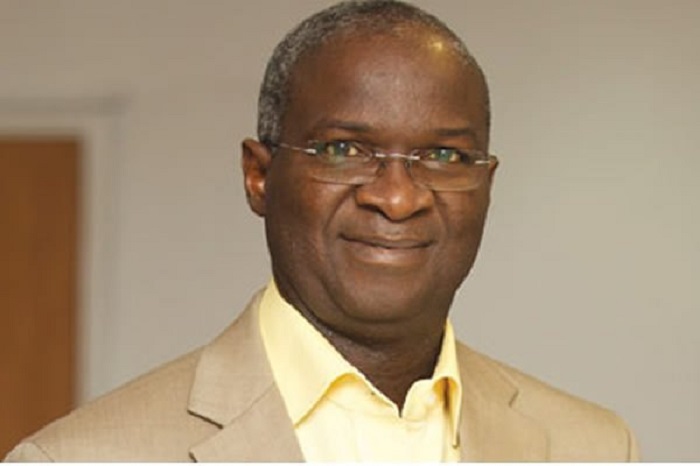
Babatunde Raji Fashola
“Our people may doubt what we say or plan, but certainly will not doubt what we do.”
Those were the words of former Governor of Lagos State and former Minister of Power, Works and Housing, Mr Babatunde Fashola, SAN at the 7th Lagos Economic (Ehingbeti) Summit on 8 April 2014.
A few months thereafter, in what represents a vote of confidence on the performance of Fashola and his team, Fitch, a global rating agency, upgraded Lagos State’s National Long-term rating from ‘AA (nga)’ to “AA+ (nga)’ “for its continued solid operating performance, improved transparency and efforts towards an increasingly sophisticated and transparent administration, which is conducive to growing private sector investments.”
Without a doubt, Lagos State, and by extension Nigeria, has been the better for the circumstances which brought out Mr Fashola from his private legal practice and thrusted him into public service, who in his characteristic self, applied himself wholly to the responsibility.
“Being in public office for us cannot be a tea party. It cannot be a picnic. Rather, it demands the highest degree of discipline, sacrifice, commitment and determination to make enduring changes,” he had told his colleagues in the Executive, and members of the Legislature, during the presentation of his maiden Budget as the Governor in 2008.
This prior commitment to public service must have been his guiding principle when he responded to the challenge of heading the unprecedented combo of the hitherto separate Ministries of Power, Works and Housing from President Muhammadu Buhari.
Fashola rolled up his sleeves, and like the “skilled mechanic” (credit Nobel Laureate Prof Wole Soyinka) that he is, – for his methodical approach and detailed planning to solving problems – soon after being inaugurated, headed to the various ministries, and for weeks received comprehensive briefings from the public servants there in preparing for his maiden Press Briefing where he laid out his agenda for each of the sectors under the merged Ministry.
With overwhelming support from President Buhari, and with increased budgetary allocations to the Ministry, infrastructural renewal began to manifest across the country within a short period of time to the extent that there was no State in the Federation without Federal Government presence. As Fashola would put it, “if we are not building a road in a state, we are building a house or intervening in a transmission system.”
A columnist with The Nation newspaper, Steve Osuji who had earlier wondered why such critical sectors could be handed over to one individual, even if the person had proven track record of deliverability was later to testify to the wisdom in the President’s decision.
Wrote he: “Who says a tree cannot make a forest; who says only an engineer could head the Works, Power and Housing ministry, who says leadership is not everything?” He termed it the “Fashola Effect.”
In May 2017, during his tour of duty as Minister of Power, Works and Housing, Fashola travelled “by road to 34 states to visit road projects, driving for a minimum of 12 hours per day.” He later toured the remaining two States – by road as well.
In Kano, the Emir, HRH Muhammadu Sanusi III told him: “…Nobody needs to know how many megawatts of power you are producing now; we experience it. We know the number of hours we used to be in darkness and what we are experiencing now. Most people now get electricity for 16,17, 18 hours on the average since you came in. Frankly, that is significant progress….”
A journalist, Ebitimi Tamuno, wrote in The Nation of 3 April 2017 that Fashola and his entourage arrived the Borno State Government House in Maiduguri a little over midnight (and) Governor Kashim Shettima was bewildered because nobody had driven on that route that late in seven years of Boko Haram then.
For the records, Mr Fashola’s then colleague, the Minister of State, Hon. Mustapha Baba Shehuri, testified at the valedictory session (on 28 May 2019) for both of them: “(The) Minister is an embodiment of hard work, a visionary, excellent, innovative, focused and integrity-based leader…which made it possible for us to hold and discharge our responsibility reasonably well.”
And, that indeed, is what drives Mr Fashola: working with his heart and might to make things better than how he met it. Perhaps, it is better put by Modestus Umenzekwe, a former President of Odunade Building Materials Dealers Association, and a frequent road user, who wrote in The Cable (8 September 2016): “One admirable thing about Fashola is that he executes every assignment as though his life depended on them. He is, to a considerable extent, the face of what the Catholic Church has in recent decades popularised as common good.”
And, on that good note, here’s wishing my boss a hearty 56th birthday.
Bello is Special Adviser, Communications to the former Minister of Power, Works and Housing