
Buhari’s broadcast on COVID-19 fight
In a nationwide broadcast on Sunday, President Muhamadu Buhari provided an update on the country’s fight against the COVID-19 pandemic, just as he also mentioned the thrust of the government’s response going forward. In the broadcast, the president commended Nigerians for the solidarity they offered the government during this most trying period of the pandemic. […]
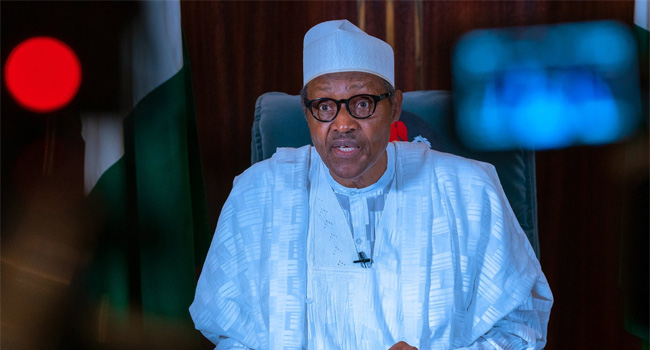
In a nationwide broadcast on Sunday, President Muhamadu Buhari provided an update on the country’s fight against the COVID-19 pandemic, just as he also mentioned the thrust of the government’s response going forward. In the broadcast, the president commended Nigerians for the solidarity they offered the government during this most trying period of the pandemic. He also marshalled out some sobering facts about the crisis and the government’s planned remediation efforts in the coming days and months.
However, some of the most significant highlights of the broadcast include the extension of the four-week lockdown on Lagos and Ogun states as well as the FCT by one more week during which a phased withdrawal of the lockdown in compliance with the new measures is envisaged. Also in the package is the imposition of a two-week lockdown of Kano State, a nationwide overnight curfew which will be effective from 8pm to 6am. There will also be a ban on non-essential interstate passenger travel with the exclusion of essential goods and supplies. Just as well shall be the restriction on social and religious gatherings with the compulsory use of face masks in public places by all citizens.
Interestingly, much of the content of his broadcast comprised recommendations by the Nigerian Governors Forum (NGF) which had adopted same after a recent teleconference on the pandemic. The broadcast, therefore, captures a shared concern by the federal and state governments of the escalating incidence of the pandemic and the associated spikes in casualties, which render the efficacy of previous efforts at containment, needy of sustenance and consolidation. Hence also is the seeming justification of the retention of some aspects of the restrictions on personal liberties of the citizenry.
However, the broadcast could have fared better if it had included in its coverage, some other aspects of the COVID-19 conundrum, to significantly enhance the response calculus for the pandemic. Some of the most significant areas it should have addressed include the burning issue of lack of enough testing kits and palliatives which administration by respective government agencies, is presently a matter of grave concern across the country.
It is not a secret that the scope and modalities for administering the palliative regime fall far short of expectations, across the country. Given the widespread level of poverty with most Nigerians living from hand to mouth at the best of times, the present state of affairs should have impelled the various governments to consider, as a matter of national emergency, the resolution of how the ordinary Nigerian eats on a daily basis. Put graphically, the compromised state of palliative administration has led many Nigerians to question which is the bigger danger between the COVID-19 pandemic and deepening hunger and starvation.
Beyond the superfluous treatment by the broadcast of the shortage and mismanagement of palliatives is the total silence on taking the country back to economic recovery whenever the pandemic is contained. It must constitute a major oversight for the government not to consider and include a mention of life after the pandemic at any point of its assessment of the run of the hard time on Nigerians. For one, available facts confirm that the COVID-19 dispensation is not a transient matter but may stay around for some time. This implies that the world and Nigeria, in particular, must learn to live with it both here and afterwards.
This reality dictates that a more sustainable response regime than merely caging Nigerians must be adopted for fighting the pandemic both in the short and longer terms. What happens after the uncaging is also important.
Meanwhile, Nigerians expect a more robust COVID-19 response mechanism that will minimize their anguish with more attention to local remedies that are within reach of the ordinary citizen.