
Buhari’s speech at UNGA
President Muhammadu Buhari’s 14-minute address at the 73th Ordinary Session of the United Nations General Assembly in New York, USA on Tuesday, September 25 focused on global conflict, terrorism, migration and corruption. Important though these issues were, there are others that are more pressing from our point of view. Unlike his previous speech at the […]
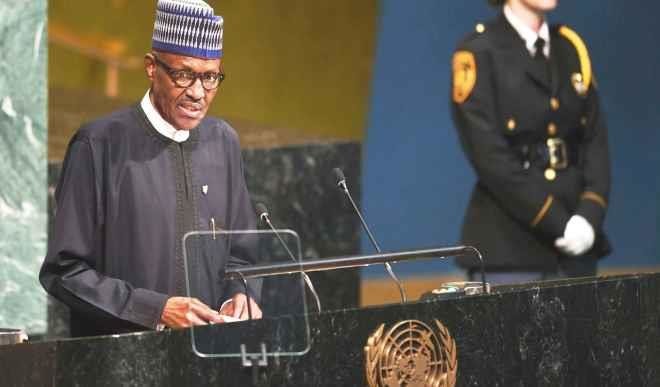
President Muhammadu Buhari’s 14-minute address at the 73th Ordinary Session of the United Nations General Assembly in New York, USA on Tuesday, September 25 focused on global conflict, terrorism, migration and corruption. Important though these issues were, there are others that are more pressing from our point of view.
Unlike his previous speech at the UN in which he outlined his administration’s major objectives and successes attained in the war against Boko Haram insurgency, President Buhari this time around dwelled on foreign issues from the violent conflicts in Syria, Iraq, Palestine and Yemen to the humanitarian crisis in Myanmar and the persecution of Rohingya Muslims as well as international terrorism with reference to Al-Shabab and ISIS. He commended the United States, South Korea and North Korea for their role in dousing tension in the Korean peninsula over nuclear arms proliferation and praised their leaders for initiating a ‘historic summit’ to address the issue.
On the mounting crises and threats to global peace Buhari said, “Regrettably, many of the crises and threats to peace and security around the world which we debated last year as we did over several previous years remain unresolved. In some cases, matters got worse…” We agree with the president that the international community needs to do more in tackling these issues in order to build a peaceful and developed world.
However, we feel at a time like this the speech should have been more about issues that bother Nigeria and Nigerians. Issues such as poverty, insecurity and ethno-religious violence have worsened in the country in recent years. The president ought to have reassured the international community of his government’s willingness to address these issues. More so, as we head towards next year’s general elections, the world would love to hear about Nigeria’s plans for the conduct of free and fair polls.
President Buhari said at the UN General Assembly, “Corruption within countries and illicit flow of funds across national boundaries have huge negative impact on the stability, peace, and economic prospects of millions in developing countries. Corruption significantly deprives national governments of resources to provide meaningful livelihoods to their populations who are predominantly youths, thus giving rise to more irregular migration… The fight against corruption, therefore, involves us all. It is in our collective interest to cooperate in tracking illicit financial flows, investigate and prosecute corrupt individuals and entities and repatriate such funds to their countries of origin.”
We entirely agree that corruption is the source of many evils pervading the world today. Even though fighting corruption is the key plank of the Buhari Administration, the successes so far recorded are minimal with respect to retrieving looted funds, punishing corrupt persons and blocking the bureaucratic loopholes that enable theft of public funds.
The president also stayed on message while expressing his government’s commitment to the attainment of sustainable development. He said, “Nigeria has always mobilised the required human and material resources to achieve set United Nations goals, including the recently adopted 2030 Agenda for Sustainable Development. We are resolute in complementing the efforts and examples of the United Nations to promote gender equality and youth empowerment as necessary pillars for sustainable development.” The recent report by Bill & Melinda Gates Foundation called the 2018 Goalkeepers Report which tracks progress on the United Nations’ 17 SDGs implied that Nigeria’s poverty has worsened and will grow considerably worse before it gets better. It stated that 30 years from now, about half of the world’s extremely poor will be citizens of Nigeria and the Democratic Republic of Congo. More worrisome is the statement that even a 50 per cent reduction in our poverty rate would leave the number of the poor the same because the population of Africa is projected to nearly double by 2050.
With grim domestic issues like these, we urge the President, when next he addresses the UN General Assembly, to focus on them rather than the problems of Korea and Iraq.