
Cameroon votes today amid Anglophone crisis
Cameroon heads to the polls today with eight candidates aiming to unseat 85-year-old President Paul Biya, who is seeking a fresh seven-year mandate in what could be his seventh term. Biya has been in office since 1982 and was prime minister in the seven years before that. He is banking on a divided opposition to […]
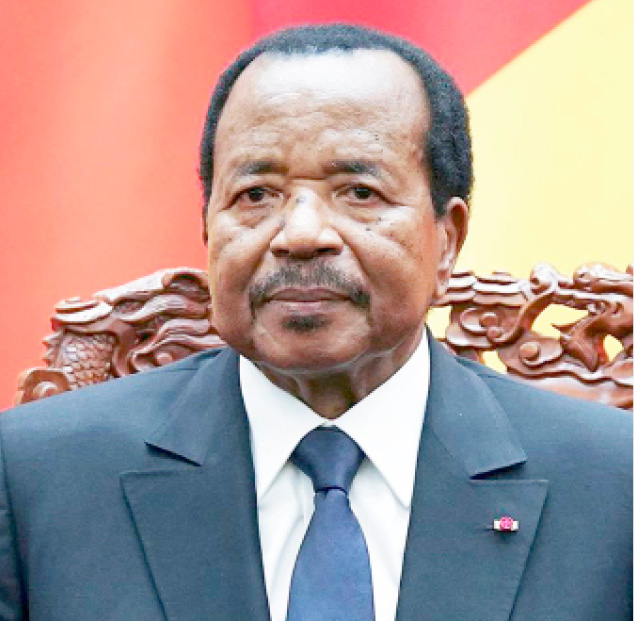
Cameroon President Paul Biya
Cameroon heads to the polls today with eight candidates aiming to unseat 85-year-old President Paul Biya, who is seeking a fresh seven-year mandate in what could be his seventh term.
Biya has been in office since 1982 and was prime minister in the seven years before that. He is banking on a divided opposition to easily win his fifth election since adopting a multiparty system in 1992.
He ruled for a number of years in what was effectively a one-party state until the 1990s when multi-party rule was introduced. In the one-party era, the Cameroonian National Union was the sole political entity.
The government of Biya introduced political reforms which eventually led to the introduction of multi-party politics in the early 1990s.
Cameroon has in the multi-party era witnessed four elections, 1992, 1997, 2004 and 2011, the upcoming poll is the fifth.
In 1996, a new constitution was introduced which limited presidency to two seven-year terms, with Biya’s second term under that constitution to expire in 2011.
However, in 2008, Cameroon’s parliament adopted a constitutional bill, removing the two-term limit to allow President Paul Biya extend his rule, making him one of Africa’s longest-serving leaders.
The contenders
Those angling to unseat Biya include Joshua Osih of the main opposition Social Democratic Front and Akere Muna, a veteran lawyer, former vice president of Transparency International and son of a former vice president of Cameroon running with the Front Populaire Pour Le Developpement (FPD). Both are from the English-speaking provinces.
There is also Maurice Kamto, who leads the Mouvement pour la Renaissance du Cameroun (MRC) party. He was justice minister during the 2008 constitutional amendments that revised presidential term limits and led the legal team in negotiations with Nigeria over the disputed Bakassi peninsula in the early 2000s. He has a strong following in the west of the country, where he hails from.
Most young people seem to favour Cabral Libii, an eloquent 38-year-old journalist with Univers Party and law lecturer at the University of Yaounde II. Kamto and Libii have roots in the Francophone regions.
The presidential candidates have been made to pay a CFA 30million ($52,100) caution fee – to guarantee they won’t encourage their supporters to violence – and were given half that amount by the government to fund their campaigns barely two weeks before the elections.
No consensus exists among Cameroonian politicians on the electoral law, which clearly benefits President Biya’s ruling party, the Cameroon People’s Democratic Movement (CPDM).
The opposition regards the body responsible for organising the election (Elecam) as biased and denounces the president’s control over the judiciary, particularly the Constitutional Council, which resolves electoral disputes.
Today’s election comes at a tense moment. Aside the Boko Haram crisis in the Far North and North regions and rebel incursions from the Central African Republic into the Eastern region, Cameroon is plagued by the Anglophone crisis.
Separatists in the South West and North West, home to Cameroon’s English-speaking minority, have announced a boycott of the poll.
It is unclear how many of the 4000 polling stations due to open in the Anglophone regions will function on Sunday, though some are determined to cast their ballots. Others said they would not risk voting and described feeling powerless.
Bilingual Cameroon, a union of two parts colonised separately by the British and the French, has long had a fragile harmony.
For years, Anglophones have felt deliberately sidelined and neglected, their infrastructure left to crumble, despite their vital importance to Cameroon’s economy. Much of the country’s oil production is off the coast of the Southwest region, and onshore are its biggest cocoa-growing areas.
In 2016, the fractures grew larger as the Anglophone minority, protesting the imposition of French systems in the courts and schools were attacked, triggering a war between the government and separatists.
At least 400 people have died so far. A further 20,000 people have fled into neighbouring Nigeria as their villages were razed.
Early this year in Abuja, the Nigerian capital, the self-declared leader of the separatist agenda, Julius Ayuk Tabe, was arrested with nine others and has since being extradited to Cameroon for trial on charges of treason.
What should be done?
In a more peaceful climate, the International Crisis Group said the election could have offered Cameroon the political renewal it needs. But with the current situation, it risks further polarising society.
However, the Brussels-based organization advised that the government could take steps to calm tensions and prevent violence.
“The government and Anglophone armed groups should declare a ceasefire, at least for the election week. The outside power can encourage this by threatening sanctions against those on either side who commit violence. The government should also take steps to curb divisive rhetoric and dedicate more resources to election logistics,” the group said.
After the vote, the group urged that, “both government and separatists should support efforts by religious leaders to hold an Anglophone General Conference.
“Such a dialogue ought to reflect on defining the structure of the state (federalism or decentralisation); providing better economic, political and cultural representation for Anglophones in governing Cameroon; granting greater autonomy in certain sectors such as education and law to those regions; and rectifying injustices as well as historical discrimination.
“The new government should also initiate reforms of the country’s centralised and hyper-presidential governing system, which has contributed to conflicts in its peripheries and to countrywide discontent.”