
Campaign promises and 2019 election
Political campaigns have no doubt become an integral part of modern democracy. Ordinarily, its basic essence allows candidates to sell their party programme and launch efforts to convince voters to support them in an election. But often times, campaigns, especially in developing democracies such as Nigeria, are easily turned into an opportunity to tell the […]
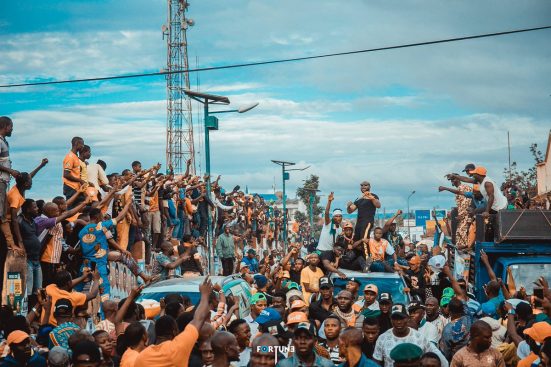
PHOTO SPEAK: Singer Davido arrives Ilesa in Osun state as part of campaign activities for his Uncle, Ademola Adeleke who is contesting at the state forthcoming gubernatorial election set for 22nd September 2018
Political campaigns have no doubt become an integral part of modern democracy. Ordinarily, its basic essence allows candidates to sell their party programme and launch efforts to convince voters to support them in an election.
But often times, campaigns, especially in developing democracies such as Nigeria, are easily turned into an opportunity to tell the electorate exact opposite of what lies in the heart of the campaigner; spin tissues of lies about candidates capacity; boast about unfounded achievements, and slur and attack opponents sometimes with ferocious and fiendish intensity.
Last Sunday, (November, 18, the 2018), candidates’ vying for political offices began their campaigns, in line with the time table by the Independent National Electoral Commission (INEC). Out of the 91 registered political parties in Nigeria, no fewer than 79 of them will be fielding candidates for the presidential election scheduled for 16th February 2019. As it stands, you may never know or be able to mention some of the parties and their candidates for next year’s election even if a dagger is held close to your jugular.
Since contemporary political campaigns are mediatized, not all of the parties and their candidates will get adequate coverage, especially in the mainstream media. This is understandable, because the media are characteristically biased towards the big parties. So it is safe to predict that they will focus on only three parties: All Progressives Congress (APC), Peoples Democratic Party (PDP), and the Rest.
Already, Incumbent President Muhammadu Buhari who is running for re-election on the platform of the APC has unveiled his campaign. In his 2019 campaign manual tagged the “Next Level,” President Buhari said his administration had worked hard to fulfill his promises, laid the foundations for a strong, stable and preposterous country, particularly in the core areas of economic revival, anti-corruption and fight against insurgency, despite challenges posed by weak oil prices and low oil production.”
Now with these ‘fulfillments’ in mind, he and his party are convinced that they are “in good stead to trudge on the next level of building an even stronger nation for our people.” The President added that the next level of efforts would focus on job creation across various businesses and help create over 15 million new jobs, overhaul the education sector, remodel 10,000 schools every year to train teachers to impart science, technology, engineering, art and mathematics.
President Buhari’s main opponent, Alhaji Atiku Abubakar, who bears the flag of the Peoples Democratic Party, (PDP) unveiled his own campaign on Monday, 19th November, 2018. Tagged “Let‘s Get Nigeria Working Again,” Atiku, talked about his plans to develop the country, focusing mainly on human capital development, job creation, poverty eradication and infrastructural development. According to Atiku, if elected president of Nigeria, “I will be proactive in attracting investments and supporting the N50million small and medium scale enterprises across Nigeria for the purpose of doubling the size of our gross domestic product to US$ 900billion by 2025.” His government, he added, would provide skill acquisition opportunities and enterprise development for job and wealth creation and improve citizens’ access to basic infrastructure services – water, sanitation, power, education and health care.
Prior to the lifting of the ban on campaigns by INEC, Prof. Kingsley Moghalu, presidential candidate of the Young Progressives Party (YPP), had pledged to set up a one trillion naira venture capital fund to open up capital for businesses, and to wage a frontal battle on poverty, by tackling the factors that created it, if elected. The presidential candidate of the African Action Congress (AAC). Omoyele Sowore once announced to a large cheering crowd of party supporters about his plans for civil servants and Youth Corps (NYSC) members whom he promised to pay a “hundred Thousand Naira.”
There is also the presidential candidate of the Allied Congress Party of Nigeria (ACPN), Obiageli Ezekwesili, who in her twitter handle recently talked about how her government would reduce the number of out-of-school children by 20 percent annually, and bring it down from the current 13.2 million to about 5.4 million by 2023, and engage in massive programme of deregulation of the Nigerian economy.
Aside from these candidates, many others are struggling to register their presence in the media space, especially in the social media, even though they may not be able to overtake the two big two political parties in this battle.
However, it is instructive to note, at this early stage of campaign, the candidates’ relative focus on substantive issues, which revolve around the economy, poverty alleviation, social infrastructure, educational upliftment, security, among other areas.
In presidential campaign literature, focus on substantive issues is usually more favoured than horserace – which conceptually include campaign strategy, events, polls, predictions, endorsements, fund raising and spending – because it does not only afford the electorate the chance to make informed electoral choices, but also give them the right to hold the candidates accountable to their promises. While dealing with issues of personal quality and other less substantive issues have their own merit, their excessive dominance in most campaigns can be unhealthy for democracy.
However, proclaiming a litany of campaign promises under the guise of focusing on substantive issues, are both cheap and predatory. Nigerians have been treated to a bellyful of phony promises in the past, many of which have been largely unfulfilled, unmet, and without clear convincing plans for actualizing them. Besides, some promises made at campaigns have turned out to be vehemently denied and contested. The 2015 presidential campaign was notoriously sore for such perverse denials.
As the race towards 2019 gathers momentum, it is hoped that Nigerians will continue to grow wiser and work towards strengthening democracy by refusing to be beguiled by unsubstantiated campaign promises. They need to know that every day may be for the politicians, there is one significant day in the hands of the electorate to make a lot of difference. How this opportunity is used determine the kind of future that we envisage.
Dr Yakoob wrote this piece from Abuja