
Celebrating Buratai and the Nigerian Army Of Hope
The restoration of Nigeria’s democracy in 1999 brought excitement to Nigerians, especially democrats famed for their repulsion to military dictatorship. The transition from military to civilian rule saw the general elections conducted and supervised by the military junta of Gen. Abdulsalami Abubakar almost hitch-free. However, the rhythms changed when the President Olusegun Obasanjo’s – led […]
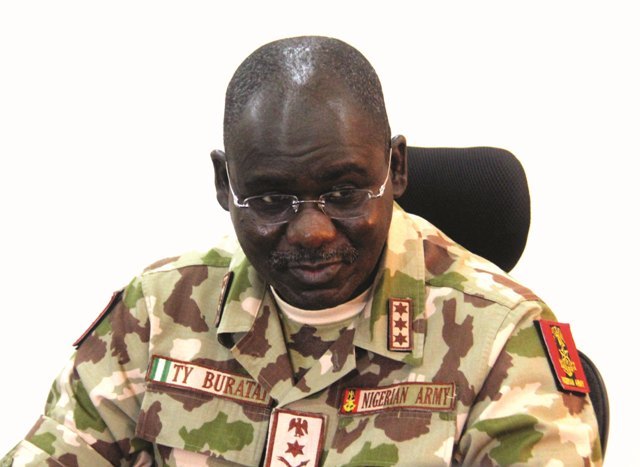
Lieutenant General Tukur Yusuf Buratai (Retd)
The restoration of Nigeria’s democracy in 1999 brought excitement to Nigerians, especially democrats famed for their repulsion to military dictatorship. The transition from military to civilian rule saw the general elections conducted and supervised by the military junta of Gen. Abdulsalami Abubakar almost hitch-free.
However, the rhythms changed when the President Olusegun Obasanjo’s – led democratic government was to conduct the general elections for a civilian to civilian transition in 2003. Politicians became incensed and the struggle for power became deadly and satanic. The general elections held, but left trails of tears and blood across the country. And over the years, that is, from 2007 to subsequent political dispensations, general elections in Nigeria have assumed the character of war rather than a democratic exercise, which the citizenry should observe in tranquil and peace.
It is unfortunate that at the end of every general election, Nigerians count losses in violence, deaths and destruction of both public and private properties. What such gory experiences have persistently revealed to all Nigerian leaders in every political dispensation is the inadequacy of civil security like the Police, DSS, NIA, and Civil Defence to contain the magnitude of violence, each segment of elections throws up during and after the polls.
The situation has always begged for additional security. And by the 2015 general elections, supervised by former President Goodluck Jonathan, or much earlier in isolated ballots, soldiers were deployed to provide extra security. But the experience of Nigerians indicated that soldiers and other security agents rather paired and connived with desperate politicians to commit electoral robberies on Nigerians. Soldiers on election duty particularly displayed open partisanship and indulged in various awful unethical and professional misconducts.
And with the sustenance of the culture of electoral violence in Nigeria, certain parts of the country were identified by security reports as permanent flashpoints of violence. Soon and as it is peculiar with some Nigerians, electoral violence, ballot box snatching, hijack and diversion of electoral materials became a norm, which domesticated and expanded tentacles to other parts of the nation.
Therefore, the 2019 general elections posted very fearful prospects of widespread violent electoral heists by power mongers in Nigeria. It was contrived to deprive Nigerians of the liberty to freely exercise their franchise in a free, fair and credible elections. Thus, a foresighted leader President Muhammadu Buhari proactively plotted to extricate Nigerians from being caught-up in the web of electoral violence and usurpation of lawful rights to decide their leaders through the ballot.
Regrettably, Buhari’s consent of the Nigerian Army’s involvement in the 2019 general elections, sparked understandable disapproval in some quarters. Nigeria’s main and minor opposition parties kicked against it, expressing fear of unholy interference of soldiers with the electoral process.
The opposition parties were right, if anyone critically factors the previous experiences of Nigerians with soldiers on electoral duty. They deserve no blame; hence there had been genuine reasons to fault the idea. Previously, the Army advertised itself more as sinners rather than saints or destroyers of the electoral system, instead of salvaging it as spelt by the election duty mandate. The entire aim had always been frustrated and defeated.
But surely, in blind fury, the antagonists forgot to remember that based on Mr. President’s antecedents, anyone could vouch for his mastery of the game. And again, those opposed to the idea never remembered that Nigerian Army under the COAS and leader of the counter-insurgency operations in Nigeria, Lt. Gen. TY Buratai has been rebranded, repackaged and professionalized.
These are leaders who apply extensively, the best leadership philosophies. They believe in the counsel of former American President, Mr. Barack Obama who enunciated the ideology that “Africa needs strong institutions, not strong men.” So, both have paired to make the Nigerian Army a strong institution and crippled soldiers who became stronger than the Nigerian Army; misbehaved and went scot-free.
No Army personnel dare engage into professional misconduct, especially violating the human rights of Nigerians, while on special assignments, without reprimand from the Human Rights Desk of the Army under Buratai’s leadership. It’s a tradition Gen. Buratai cultivated from the onset of his leadership.
So, the Nigerian Army now wears a new face, as while misconduct by a few bad eggs is inevitable, punishment of culprits is also inevitable, in the past three years he has spent fighting terrorism and associated armed violent insurrections in Nigeria.
Buratai approaches his national assignments with the inspiration of Ron Paul, the American-born author, physician, and former politician who said; “I have never met anyone who did not support our troops. Sometimes, however, we hear accusations that someone or some group does not support the men and women serving in our Armed Forces. But this is pure demagoguery, and it is intellectually dishonest.”
Nigerians have shirked from coming out to boldly challenge the role soldiers on election duty played in the 2019 general elections because of its faultlessness. Where there are written complaints about soldiers on professional misconduct, Gen. Buratai has raised special committees to probe the allegations because he not influenced to shield wrongdoers.
Therefore, Gen. Buratai has clearly understood the role of the military in democracy. So, he filed out soldiers to assist civil security and the INEC, the electoral umpire in providing excellent security for the general elections. And those claiming the exercise was militarized to blackmail the Army, as supporting the incumbent government are unfair to the Army as facts of its post mortem have revealed otherwise.
Nelson Mandela once echoed that; “The world will not respect Africa until Nigeria earns that respect. The black people of the world need Nigeria to be great as a source of pride and confidence.” And Gen. Buratai is truthfully and tirelessly railroading the realization of this dream through the Nigerian Army to sustain Nigeria on the map as the leading light to other democracies in Africa. And like Sankara, the Nigerian Army boss only knows that, “ I want people to remember me (him) as someone whose life has been helpful to humanity.”
Okpabi, a researcher in peace and conflict resolution wrote this piece from Nile University of Nigeria, Abuja.