
Dairy farmers get new technology to improve cows’ productivity
A new technology that will allow dairy farmers to improve the overall efficiency and productivity of their cows has been developed. Researchers from the Tokyo University of Science, Japan, have developed an innovative location information-based technique that uses multi-camera systems to track individual cows across an entire barn. In a release shared with the Daily […]
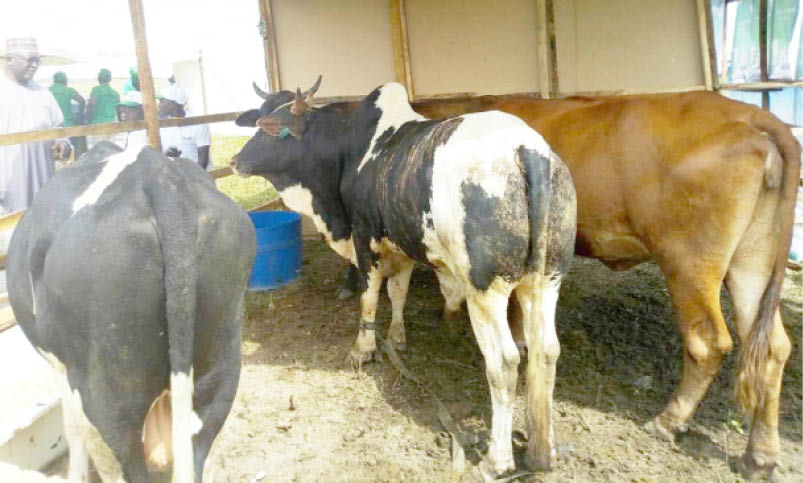
Improved breed from a dairy farm in Keffi, Nasarawa State
A new technology that will allow dairy farmers to improve the overall efficiency and productivity of their cows has been developed.
Researchers from the Tokyo University of Science, Japan, have developed an innovative location information-based technique that uses multi-camera systems to track individual cows across an entire barn.
In a release shared with the Daily Trust by Rishita Sachan, on behalf of the university’s public relations team, it was said that the new technology would improve the health and productivity of dairy cows.
This is good news for many dairy farmers who want to expand and enhance the quality and quantity of milk in their farms even as the Federal Ministry of Livestock Development seeks to modernise the sector and improve the country’s milk output.
- I will be just, fair to all warring parties in Plateau – New GOC
- How ICPC recovered N20bn ghost workers’ pension deductions in 2024 – Chairman
High-quality milk remains in high demand, but managing the health of dairy cows is becoming increasingly challenging, particularly for countries like Nigeria.
Deploying the new technology will enable “health monitoring, early disease detection, and gestation management, making it ideal for large-scale implementation to ensure dairy farm health and ensure consistent, high-quality milk production.
“As dairy farmers dwindle every year, the demand for high-quality milk remains steadfast, driving a surge in dairy farming. Although this shift improves efficiency, it makes managing the health of individual cows more challenging.
“Effective health management has thereby become a critical issue in the dairy industry. Early detection of abnormalities, swift diagnosis, prevention of disease spread, and maintaining proper breeding cycles are essential for desirable and stable milk production,” the university stated.
The team of researchers from the Japanese university who developed the innovative technology was led by Assistant Prof. Yota Yamamoto from the Department of Information and Computer Technology, Faculty of Engineering, along with Mr Kazuhiro Akizawa, Mr Shunpei Aou, and Prof. Yukinobu Taniguchi and their findings published in Volume 229 of Computers and Electronics in Agriculture on February 1, 2025.
“While there are invasive methods, like using mechanical devices attached to dairy cows for health monitoring, non-intrusive and non-contact techniques are preferred. These methods are less stressful for the cows, as they do not require any physical attachments, making them more suitable for everyday use on farms. These include advanced deep learning methods, such as camera-based tracking and image analysis.
“This approach is based on the idea that dairy cows often exhibit unusual behaviours and movement patterns due to illness, diseases, the estrus cycle, stress, or anxiety. By tracking individual movements using cameras—such as walking patterns, visits to feeding stations, and water consumption frequency—farmers can analyse cow behaviour, enabling early prediction of diseases or health issues,” the findings stated.
Dr Yamamoto, the lead researcher, explained that “this is the first attempt to track dairy cows across an entire barn using multi-camera systems. While previous studies had used multiple cameras to track different species of cows, each camera typically tracks cows individually, often the same cow as a different one across cameras.
Although other methods enable consistent tracking across cameras, they have been limited to two or three cameras covering only a portion of the barn.”
Key findings
In tests using video footage of cows moving closely together in a barn, this method achieved about 90% accuracy in tracking the cows, measured through Multi-Object Tracking Accuracy, and around 80% Identification F1 score for identifying each individual cow.
This marks a significant improvement over conventional methods, which struggled with accuracy, especially in crowded or complex barn environments. It also performs well in different situations, whether the cows are moving slowly or standing still, and also addressed the challenge of cows lying down by adjusting the cow height parameter to 0.9 meters, lower than a standing cow’s height. This adjustment improved tracking accuracy despite posture changes.
Dr Yamamoto said, “This method enables optimal management and round-the-clock health monitoring of dairy cows, ensuring high-quality milk production at a reasonable price.”
The researchers said that in the future, the team plans to automate the camera setup process to simplify and speed up the installation of the system in various barns. They also aim to enhance the system’s ability to detect dairy cows that may be showing signs of illness or other health issues, helping farmers monitor and manage the health of their herds more efficiently.