
Dangote refinery listing, recapitailisation, others to shape economy in 2026
Key activities are expected to shape Nigeria’s economy in the year 2026, which is also a pre-election year as checks by Daily Trust show that these major events are considered as stimulants to economic growth and development across different sectors of the economy. These events include the planned listing of Dangote refinery on the Nigerian […]
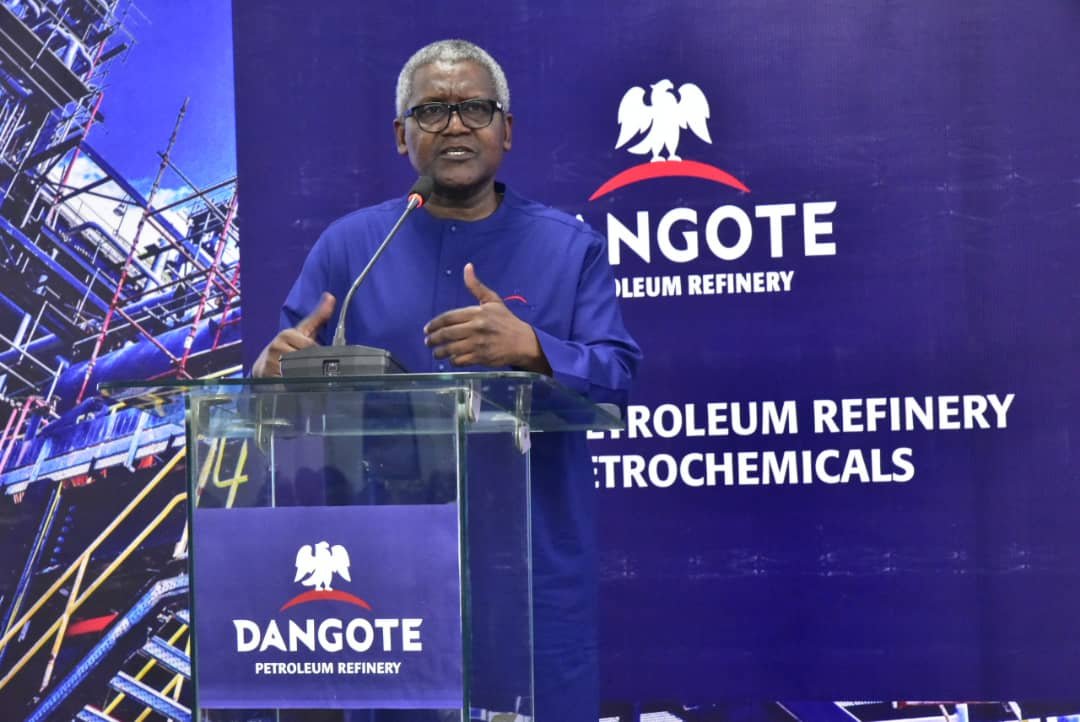
dangote refinery
Key activities are expected to shape Nigeria’s economy in the year 2026, which is also a pre-election year as checks by Daily Trust show that these major events are considered as stimulants to economic growth and development across different sectors of the economy.
These events include the planned listing of Dangote refinery on the Nigerian Exchange, banking and insurance sector recapitalisaion, implementation of budgets and tax laws among others.
Dangote’s listing on NGX
Daily Trust reports that on December 12, 2025 Aliko Dangote, the President of Dangote Industries Limited, unveiled a landmark plan to list a 10% stake in his $20 billion refinery on the Nigerian Exchange (NGX) in 2026.
Dangote further announced that the company is currently in discussions with market regulators to facilitate future dividend payouts in US dollars, offering a hedge against the persistent challenges posed by currency volatility.
“The most honourable Minister of Finance and Coordinating Minister of the Economy will approve this,” Dangote said.
He stated this during the unveiling of the Dangote Vision 2030, a long-term strategic roadmap, in Lagos.
During his speech, Dangote highlighted that his team is collaborating closely with both the NGX and the Securities and Exchange Commission (SEC) to finalize the structure for the proposed initial public offering (IPO).
“You buy in naira, but you get dividends in dollars,” Dangote added.
Banking sector recapitalisation
In March 2024, the Central Bank of Nigeria (CBN) announced recapitalisation exercise for the country’s banking sector, targeted at strengthening financial sector resilience.
The recapitalisation provides N500 billion for commercial banks with international authorisation, N200 billion for national banks, and N50 billion for regional banks. For non-interest banks, the thresholds are N20 billion (national) and N10 billion (regional).
The 24‑month compliance window is expected to end on March 31, 2026, as banks continue to race in order to meet up the recapitalisation exercise.
It would be recalled that the banking sector recapitalisation was anchored in 2004 exercise under the then CBN governor Charles Soludo, which directed banks to raise capital to N25 billion from N2 billion.
That singular directive slashed the number of lenders from 89 to 25 and paved the way for stronger players to emerge.
Checks by Daily Trust showed that as of January 8, about 20 lenders have completed the new capital requirement with nearly four months to the conclusion of the recapitalisation exercise.
Checks show that commercial banks with international presence and tier-one lenders have already met the threshold.
They include Access Bank, Zenith Bank, GTBank, United Bank for Africa (UBA), First Bank, Fidelity Bank have all surpassed the N500 billion requirement, and revalidating their international banking licences.
Among national banks, FCMB, Wema Bank, Standard Chartered, and Citibank have officially met the N200 billion threshold.
Other banks that have cleared their respective capital requirements include Stanbic IBTC, Sterling Bank, Providus Bank, Globus Bank, and Premium Trust Bank.
Other banks that have met the new capital requirement include merchant banks such as FSDH Merchant Bank, Greenwich Merchant Bank, Nova Bank, and Rand Merchant Bank.
Mergers, downgrades
Further checks show that Mergers, acquisitions, and strategic downgrades are looming. For instance, Unity Bank and Providus Bank are in advanced stages of a merger that is expected to produce a new top-10 lender by asset size.
Titan Trust Bank has completed its full integration with Union Bank, significantly strengthening its capital base and competitive position.
Some banks have also opted for strategic downgrades rather than expansion. Nova Bank, for instance, chose a regional licence with a N50 billion capital.
In the same vein, Nigeria’s non-interest banking sector has also shown resilience. Jaiz Bank, Taj Bank, and Lotus Bank have all met the N20 billion capital requirement.
Commenting recently, the CBN Governor, Olayemi Cardoso had reported that the process is firmly on track.
Insurance sector recapitalisation
Insurance sector has also been strengthened with recapitalisation set for July 2026.
With roughly seven months to the July 2026 deadline set by the Nigerian Insurance Industry Reform Act (NIIRA) 2025, recapitalisation activities are picking up across the sector.
Recently, LASACO Assurance Plc announced its shareholders have overwhelmingly approved a plan to increase the company’s minimum share capital from about N11.08bn to N36.08bn. This will be executed via a combination of rights issue and private placement.
The move is strategically aimed at exceeding the revised statutory minimum of N25bn for composite insurers under NIIRA 2025 to strengthen its underwriting capacity, solvency margins, and competitive positioning in a tightening market.
In addition to Lasaco Assurance, five other insurers, including SUNU Assurances, Sovereign Trust Insurance, Linkage Assurance, Guinea Insurance, Veritas Kapital Insurance, and International Energy Insurance, have disclosed on the Nigerian Exchange (NGX) that their boards have approved plans to raise about N70bn collectively. These funds are to be secured through rights issues, private placements, or public offers, pending shareholder approval.
Checks showed that most composite insurers are also above the N25bn regulatory capital requirement. AIICO Insurance leads with a capital buffer of N40.77bn, followed by Cornerstone Insurance with surpluses of N36.65bn.
Similarly, AXA Mansard also exceeded the minimum capital with moderate surpluses. LASACO Assurance Plc has successfully raised approximately N11.10bn in fresh capital through a private placement, a move that significantly strengthens its capital position ahead of the industry-wide recapitalisation deadline.
With this new injection, LASACO is now closer to meeting the N25bn minimum capital requirement for composite insurers.
The General segment of insurance also shows relatively strong buffers for leading players. NEM Insurance tops the category with a significant surplus of N51.83bn above the N15bn requirement, followed by Linkage Assurance with N27.08bn among others.
Implementation of tax laws
President Tinubu had signed the four tax reform bills into law in June, marking what the government has described as the most significant overhaul of the country’s tax system in decades.
The laws include the Nigeria Tax Act, the Nigeria Tax Administration Act, the Nigeria Revenue Service (Establishment) Act, and the Joint Revenue Board (Establishment) Act, all operating under a single authority, the Nigeria Revenue Service.
The tax reform bills faced initial stiff opposition from lawmakers and key figures before their passage, and are scheduled to take effect on January 1, 2026.
With the implementation already in place and a committee to oversee the implementation, the new laws are set to significantly impact the both public and private sector players in the economy from manufacturing to oil and gas, trade and investment among others.
Budget implementation
Nigeria currently operates about three budgets which have been criticised by many financial analysts.
Checks show that Nigeria operated three budgets simultaneously in 2024, which included the N21.8 trillion 2023 budget inherited from the Muhammadu Buhari administration, the supplementary budget prepared by the Tinubu administration in 2023 to the tune of N2.17 trillion, as well as the N28.7 trillion 2024 appropriation.
The trend continued in 2025, when the capital component of the 2024 budget, which should have ended in December 2024, was extended twice, first to June 2025 and then to December 2025.
The President had also announced that the era of operating multiple budgets will end on March 31 2026.