
Despite insurgency, Potiskum’s livestock market expands
The livestock market in Potiskum is believed to be one of the largest cattle markets in sub-Saharan Africa. The market often described as a livestock powerhouse, accommodates more than 3,000 animals on each market day. A visit by Weekend Trust showed a bustling hub where traders from within and outside Nigeria bring in livestock for […]
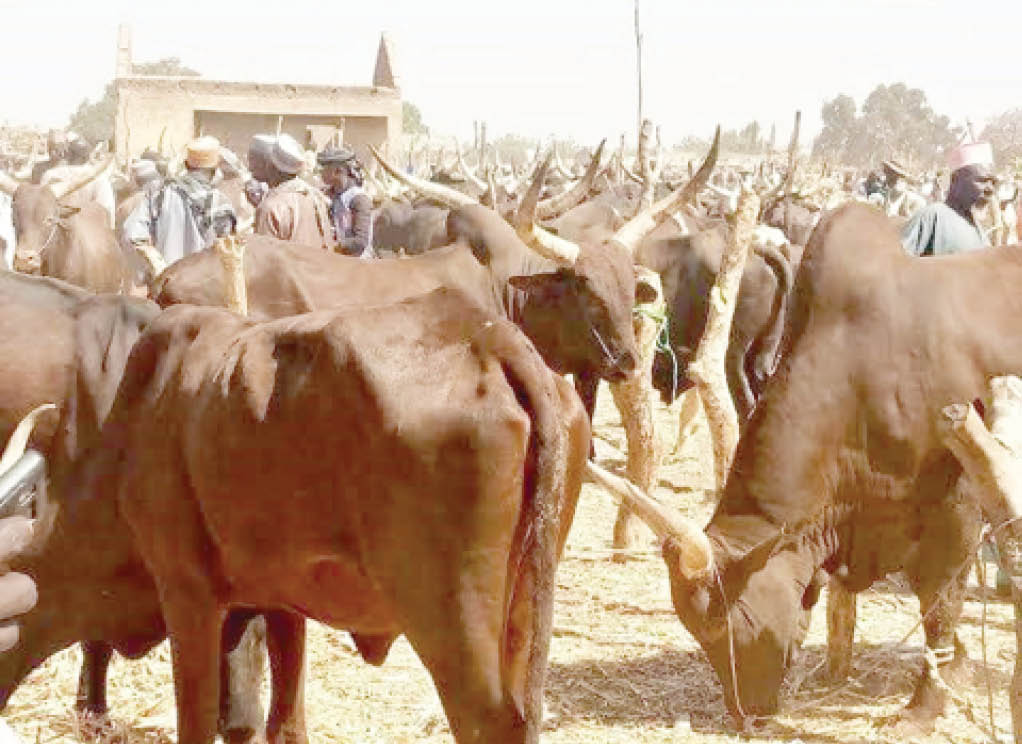
bulls at a livestock market in the area
The livestock market in Potiskum is believed to be one of the largest cattle markets in sub-Saharan Africa.
The market often described as a livestock powerhouse, accommodates more than 3,000 animals on each market day.
A visit by Weekend Trust showed a bustling hub where traders from within and outside Nigeria bring in livestock for sale and exchange. Observations showed the rigorous process of loading and offloading animals, as well as local techniques used to revive cattle weakened by long and exhausting journeys.
Some animals take hours to recover after being offloaded from trucks. While some succumb to the stress, others survive, and in rare cases, new calves are born shortly after arrival.
The town is notable for hosting one of the largest cattle markets in West Africa, attracting traders from countries such as Chad, Niger, Benin, and Cameroon.
Alhaji Abdulsalam Suleh Waya, a Kano-based trader who visits the market weekly for over 20 years, said the variety of cattle breeds is a major attraction.
“The unique nature of this market is what attracts us. You’ll find a wide range of cattle breeds here, distinguishable by their physical features such as long ears and tails. This market is truly one of the biggest livestock markets in West Africa.
‘‘I used to buy cattle at the Benishek livestock market, but due to security challenges, many of us stopped going there and now focus on Potiskum.
‘‘Every Wednesday, I buy about 10 cattle here, add my profit margin, and resell them in markets like Wudil in Kano, Enugu, or Anambra,” he said.
Another trader, Salihu Ibrahim Bello, noted that business in the market remains vibrant despite security challenges in northern Nigeria.
“Livestock markets in places like Garin Alkali, Yadin Buni, and Geidam no longer attract as many traders as before. But here, we see new faces every week. Trucks transport livestock from this market to Sokoto, Kano, Lagos, Calabar, Port Harcourt, Abuja, and Jos.
‘‘Prices have increased significantly. Cows that used to sell for between 300,000 and 400,000 now go for around 1,000,000. Bulls that were 1,000,000 to 1.5 million now cost about 2,000,000. Despite this, traders continue to buy,” he said.
A livestock seller, Abdulkadir Abubakar, highlighted the market’s role in job creation.
“The market has created employment opportunities for many youths. Some are involved in feeding and caring for livestock, others in meat processing, transportation, and the sale of veterinary drugs. Thousands of jobs have been generated through this market,” he said.
Malam Garba Musa, a cattle buyer, attributed the market’s sustained prominence to its wide customer base.
“Buying and selling cattle is unpredictable. Prices fluctuate, and the value of the naira has affected costs. Today, an average cow sells for between 1 million and 2 million. During festive periods like Christmas, prices can rise even higher.
‘‘Customers come from across Nigeria and beyond. Sometimes over 300 buyers visit the market in a day,” he said.
Another buyer, Malam Adamu Wammi, said that over 100 trailers transport cattle from the market weekly to southern Nigeria and neighbouring countries.
“Traders come from Lagos, Ibadan, Ogbomosho, Enugu, Umuahia, Port Harcourt, and Warri. At least 100 trailers move cattle out of this market every week.
‘‘Sellers pay 500 per cow as tax before entering the market, and buyers also pay 500 per cow purchased. This generates millions of naira for both the local and state governments,” he said.
Yobe State, once an epicentre of Boko Haram insurgency, witnessed a devastating attack on the market in May 2012, which claimed over 200 lives. However, the market has since recovered and regained its vibrancy.
The Sarkin Tike of Potiskum Emirate, Alhaji Ummaru Maidelta, said the market has overcome its past challenges.
“We experienced a tragic attack that claimed over 200 lives, but by God’s grace, the market has recovered. Today, it’s more active than ever.
‘‘Peace and order have returned, and the government has ensured that the market remains open despite security concerns. Apart from the temporary closure during the attack, business has continued uninterrupted.
‘‘We offer high-quality cattle of various sizes and breeds. Our focus is on customer satisfaction, fairness, and transparency in all transactions,” he said.