
Don’t give FRSC arms
Last month, Corps Marshal of Federal Road Safety Corps (FRSC), Shehu Mohammed, began another round of campaign to arm the agency’s personnel, saying this is the only way to effectively enforce traffic regulations on Nigerian highways, provide self-defence amid rising highway insecurity and enhance enforcement against non-compliant drivers especially those of overloaded heavy-duty vehicles. The […]
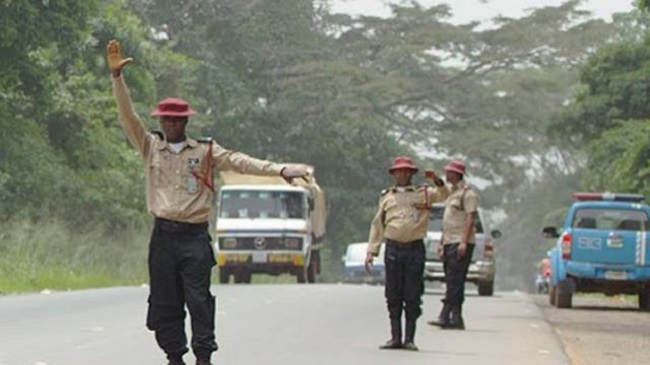
Last month, Corps Marshal of Federal Road Safety Corps (FRSC), Shehu Mohammed, began another round of campaign to arm the agency’s personnel, saying this is the only way to effectively enforce traffic regulations on Nigerian highways, provide self-defence amid rising highway insecurity and enhance enforcement against non-compliant drivers especially those of overloaded heavy-duty vehicles.
The advocacy followed the 2024 bill to amend the FRSC Act to create a ‘Special Armed Squad.’ This is not the first time such bill has come to the National Assembly. The ‘Bill for an Act to Amend the Federal Road Safety Commission (FRSC) Act 2007 to Provide for the Establishment of Road Safety Special Armed Squad and for Other Related Matters’ came with the same arguments.
The agency became a paramilitary organisation via Road Traffic Act CAP 141 of 1990, Amended in FRSC Act 2007 without authorisation to bear firearms. But the new quest got renewed traction in 2024 with the amendment bill introduced by Representatives Abiodun Derin Adesida and Olaide Lateef Mohammed. It passed second reading in October 2024.
Daily Trust believes that the quest to arm the FRSC is ill-advised as it will continue the militarisation of civilian spaces by every paramilitary agency in Nigeria. It would also increase the risky escalation of abuses, accidental shootings, extortion and brutality on the highways.
Moreover, experience has shown that the armed personnel would become an elite specialised squad that would essentially serve as body guards, protection units and other benefits for senior officials of the agency and other federal and state officials.
This newspaper is worried that it seems FRSC has not weaned itself off its merger with Nigeria Police Force (NPF). It has been merged with the Highway patrol of the Police. The most celebrated was in 1999 when late Maj. Gen. Haladu Hananiya was removed as the Corps Marshal. But the agency was formally handed over to the Police on February 18, 2000. The battle to revert FRSC to its original values led to a reversal of the merger in November 2003 when Gen Hananiya came back to head FRSC.
Therefore, we implore FRSC be content to being the lead agency in road traffic administration enforcing its core mandate of preventing road accidents, educating drivers and enforcing traffic laws. It should stick to its primary responsibilities which it has historically performed through non-lethal measures especially safe use of the highways, detection and arresting of traffic offenders, impounding of vehicles, penalizing offenders, rescuing accident victims and conducting research into ways to improve safety on the road.
It should drop the idea of being another police in a different garb, after all, before its establishment, road safety functions were handled within the Nigeria Police Force. In other words, there should be no any duplication or overlapping of duties.
This newspaper advices FRSC to stop the campaign of armament as it does not need “power of coercion” to enforce traffic laws. It should worry about the quality of its enforcement as in Q1 2025 alone, there were 2,650 accidents and 1,593 deaths – an 8.3 per cent rise from 2024. Generally, data on road traffic crashes reveals that between January and December 2023, 5,081 Nigerians lost their lives, and 31,874 were injured. Between January and July 2024, 2,776 persons were killed, and 16,309 injured due to road traffic crashes.
The agency should also explore the deployment of technology and automation for effective traffic management including vehicle tracking, installation of speed cameras, and license plate recognition gadgets. This would help minimise physical interaction with motorists and reduce vices of bribery and extortion associated with checkpoints. It should also invest in body-worn cameras, CCTVs, and better training that align with global best practices.
FRSC should work on enhancing its standing with the public by endearing themselves with Nigerians by eliminating the difficulties and enhancing efficient service delivery in the processing of drivers licences. It should rebrand as an efficient and corruption free organisation thus, favourably setting it apart from other law enforcement and paramilitary agencies in the country.
The agency should also embrace enhanced collaboration with sister agencies especially the police and Nigeria Security and Civil Defence Corps (NSCDC). Nigeria is already swamped by weapon-carrying security forces and arming FRSC could further worsen the situation.
Nigerians are daily contending with issues of accidental discharge and misuse of weapons by those authorised to carry them.
We implore FRSC to embrace again its traditional role as educators and enforcers of road traffic rules and regulations without any intimidation of drivers and passengers or exhibition of fearful or aggressive tendencies. They should not be allowed to take a detour into another militarised agency.