
ECOWAS @ 50: Stakeholders seek urgent reforms to prevent disintegration
As the Economic Community of West African States (ECOWAS) approaches its 50th anniversary, stakeholders and other experts from various sectors have called for immediate and holistic reform of the organisation. They made the call on Wednesday in Abuja at a high-level convening forum, organised by the Centre for Democracy and Development (CDD-West Africa) and the […]
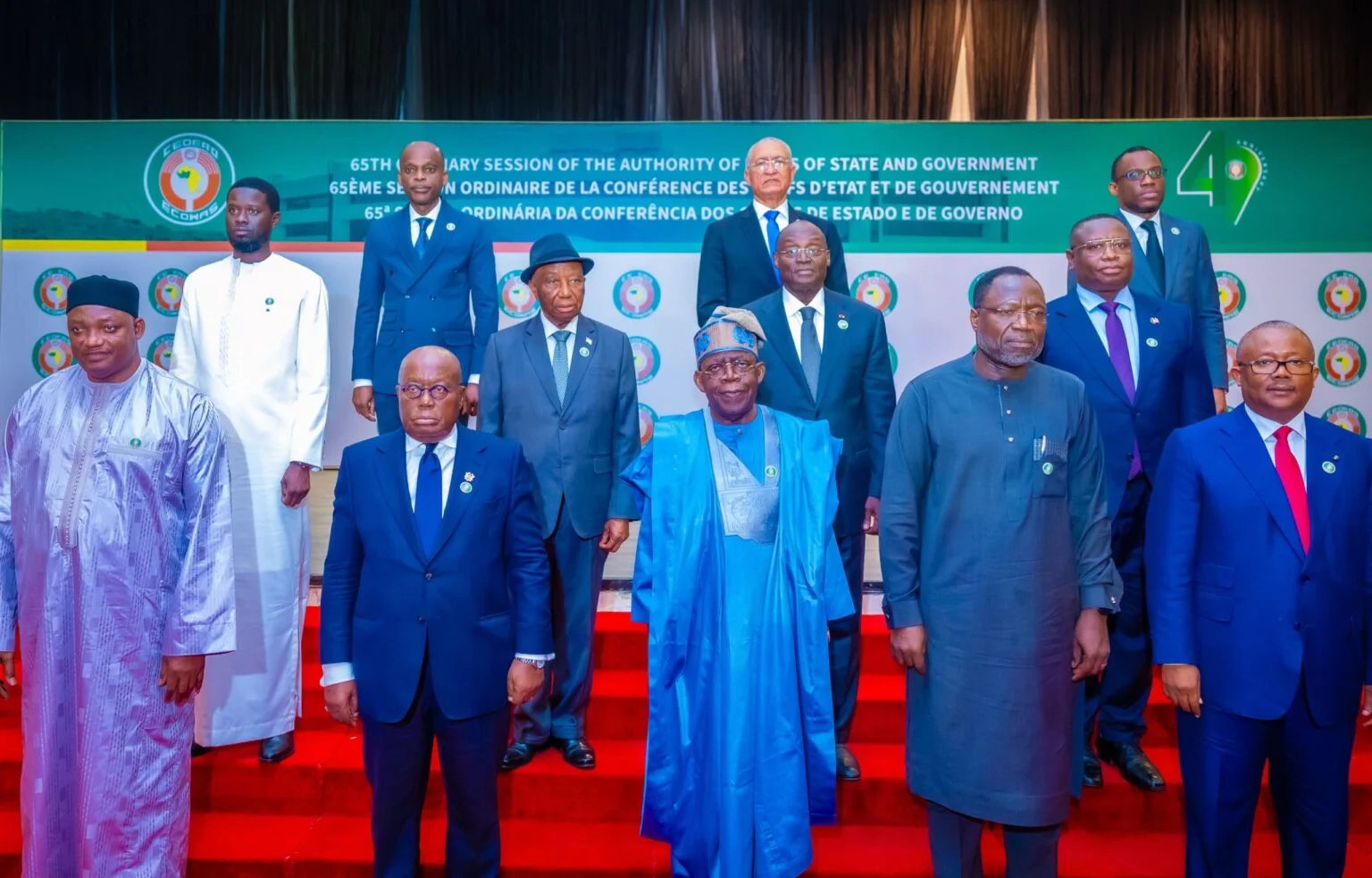
President Bola Tinubu, others during the opening of the 65th Ordinary Session of the Authority of ECOWAS Heads of State and Government on Sunday, in Abuja
As the Economic Community of West African States (ECOWAS) approaches its 50th anniversary, stakeholders and other experts from various sectors have called for immediate and holistic reform of the organisation.
They made the call on Wednesday in Abuja at a high-level convening forum, organised by the Centre for Democracy and Development (CDD-West Africa) and the West Africa Democracy Solidarity Network (WADEMOS), where they also expressed concern over the regional bloc’s future, noting the urgent need for structural reforms to avert potential disintegration.
Daily Trust reports that the regional bloc was founded on 28 May 1975 in Lagos, which was then the seat of the Federal Republic of Nigeria.
Speaking at the event, with the theme: ‘ECOWAS @ 50, Reform or Disintegrate: Which pathway for the Regional Bloc’, the CDD Senior Fellow, Prof. Jibrin Ibrahim, noted ECOWAS’s historical role in promoting democracy and integration in West Africa.
- Bauchi Deputy Gov Denies Slapping Foreign Affairs Minister
- Many trapped, five rescued as building collapses in Lagos
He, however, warned that recent developments, including military coups in Mali, Burkina Faso, Niger, and Guinea, posed significant challenges to the bloc’s cohesion and must be acted upon.
“ECOWAS has been instrumental in deepening democracy in our region. Yet, the emergence of unconstitutional regimes threatens the unity and progress we’ve achieved,” he said.
Ibrahim emphasised the importance of maintaining dialogue with the Sahelian countries that have experienced coups, advocating for their reintegration into ECOWAS through a renewed commitment to democratic principles.
He also noted the region’s economic struggles, saying that West Africa now hosts one of the largest populations of impoverished people globally.
He highlighted the inability of many ECOWAS member states to generate sustainable employment, particularly for the youth, fuels disillusionment and instability.
He said, “The dream of independence -access to education, opportunity, and self-determination- has faded. That broken promise is now being expressed in terrorism, displacement, and deepened poverty.”
He also underscored the necessity for ECOWAS to undergo comprehensive reforms, calling for dismantling systems rooted in colonial and imperial legacies and emphasized the need for inclusive governance structures that prioritize the welfare of all citizens.
“Without reclaiming West Africa’s resources for its people, genuine development and integration will remain a distant dream,” he said.
Also, chairman of the CDD Board, Comrade John Odah, reflecting on ECOWAS’s 50-year journey, acknowledging both achievements and challenges.
He urged civil society organizations to critically evaluate the bloc’s successes and shortcomings and to actively support the vision of regional integration.
“ECOWAS was established to integrate 15 sub-Saharan African countries socially, economically, culturally, and politically. Despite challenges, significant progress has been made. It’s imperative for civil society to ensure that the dream of ECOWAS integration is not aborted,” Odah said.
He acknowledged the contributions of founding fathers and the challenges faced, including efforts by former colonial powers to hinder integration, saying despite these obstacles, significant achievements have been made.
He urged stakeholders to interrogate what has been successful and what have been the challenges in the 50-year history of ECOWAS integration, and to contribute in whatever way possible to ensure the dream of ECOWAS integration is not aborted.
Also speaking on behalf of the WADEMOS, Paul Osei-Kuffour, the Program Manager, CDD-Ghana and Network Coordinator, WADEMOS, noted that ECOWAS is facing threats and vulnerabilities which are at the core of its foundation and existence and could undermine its legitimacy and relevance.
He said that theme of the convening reflects the reality of the situation confronting the region such as the exit of the three countries and the formation of the AES.
“Although we experienced the exit of Mauritania in the past, the historical, cultural, security and economic ties between the three countries and ECOWAS presents its unique challenges. Additionally, ECOWAS response to military coups and applications of sanctions have experienced challenges and setback, and not yielded the expected results with transition in Guinea remaining in perpetuity.
“The regional body has also been criticised for not doing much to integrate the voices of community citizens in ECOWAS decision making processes and the realization of the constitutional convergence principles in its structures and institutions.
And at the global level, which ECOWAS is not an exception, we are seeing persistent attacks on multilateral institutions as part of the playbook of authoritarian leaders hiding under the claim of sovereignty,” Osei-Kuffour said.
He said that all these challenges reinforce the call for the reform of ECOWAS, which he said is even more demanding to ensure a coordinated and harmonised response, cooperation and solidarity in countering cross-border security threats fueling instability and roll back deteriorating democratic norms and governance in the region.