
Educating the boy-child: Panacea to domestic violence
It could not have been a wrong submission that a family is the smallest unit of any country in the world. This implies that the state of the socio-political life of a country is a by-product of values embrace by different families. It is, thus, congruous with reason that most of the societal ills could […]
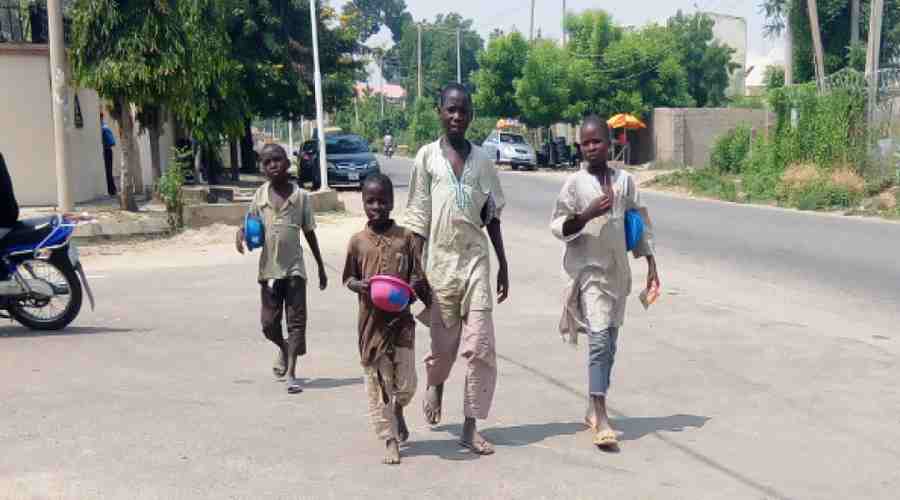
FILE PHOTO: School age children beg on a GRA street in Kano
It could not have been a wrong submission that a family is the smallest unit of any country in the world. This implies that the state of the socio-political life of a country is a by-product of values embrace by different families. It is, thus, congruous with reason that most of the societal ills could be traced to family dysfunctional. It is suffice to say: any country that does not place premium on family values will have miscreants presiding at the helm of its affairs. In other words, dysfunctional families invariably produce dysfunctional country. One of such prevailing ills is domestic violence.
The menace of domestic violence is a global disturbing issue, especially in developing countries. The United Nations Commissions Draft Declaration of 1992 on the status of women defines violence against women as: “any act of gender based violence that results in or is likely in, physical, sexual or psychological harm or suffering to women, including threats of such acts, as coercion or arbitrary deprivation of liberty whether occurring in public or private life.” In the same vein, the United Nations Declaration on the Elimination of Violence Against Women (1993) states that violence against women is a manifestation of historically unequal power relations between men and women, which have led to domination and discrimination against women by men.
Across the globe, many national and international instruments have been formulated with a view to tackling the menace of domestic violence. In Africa, the campaign first came to front burner in Senegal: African Platform for Action and the Dakar Declaration of 1994. The Charter, among other things, recognises that violence deprives women of their ability to achieve their full potential and threatens their safety, freedom and autonomy. At the international level, there are the Convention on the Elimination of All Forms of Discrimination Against Women, (CEDAW), the United Nations Universal Declaration on Human Rights (1948) and the UN Declaration on Elimination of Violence Against Women (1993).
It is, however, sad that despite the fact that Nigeria is a signatory to many of those Charters, domestic violence has always been on the increase while the culprits of the inhumane act often take advantage of the loop holes in the legal system to escape the rod of the law. Recently, on December 4, 2018, it was reported in the dailies that one Sina Kasali, a butcher who hails from Abosule area of Agbado, Ifo Local Government Area of Ogun State, beats his wife to death on the account of being rude. It is sad that the 10-year marriage ended on a sorrow incident while the deceased was a nursing mother with a three-month old baby.
Based on similar reports, in Lagos, the Lagos State Domestic and Sexual Violence Response Team (DSVRT), through the office of the Attorney-General, disclosed that an alarming 3,089 domestic violence cases were recorded in eight months between January and September 2018. Also, in Sokoto, the state Hisbah Commission revealed that the Commission recorded a disheartening 30,160 cases of domestic violence in 16 months from January 2017 to April 2018. It is equally sad that despite all the mechanisms meant to curtail the menace, the vicious incidents have continued to gain holds in the society.
Findings have shown that the socio-cultural and religious promotion of male chauvinist is a major contributing factor to domestic violence. According to UNICEF report in 2001, the beating of wives and children is widely indorsed as a form of discipline in most African countries, Nigeria in particular. Within the socio-cultural and religion context, emphasis is on the philosophy of submission of wives to their husbands under all circumstances. So, every attention is placed on women who, unfortunately, are often at the receiving end of all kinds of social ill-treatments. Consequently, a girl-child grows up with the mindset of inferiority-complex, regardless of the threat to life such circumstances may pose.
It is my humble submission to say that every boy is a potential woman-beater, especially a child who grows up in a hostile and dysfunctional home; every man who is a wife-beater was once a boy. So, the issue is a fundamental problem! If every concerned institution across the globe had put in place social apparatus that promotes and fosters moral values in schools, perhaps we would not have found ourselves in such societal decadence. One cannot rule out the breakdown of moral values in schools and institutions being a major fundamental contributing factor to the prevalence of domestic violence in every society across the world. If every boy is properly taught from childhood that it is morally wrong for a boy-child to raise his hand against a girl-child, the UN and other similar global bodies would not have spent so much on the campaigns against domestic violence. Boys should properly be taught how to respect the dignity of girls in every situation.
The truth is: every man who is involved in one crime or the other in a society comes from a family. Since most of the perpetrators of domestic violence are men, the onus lies on every family and social institution to promote the education and orientation of every boy-child as far as moral values are concerned. Although we cannot shy away from the fact that the socio-political life of Nigerian society is extremely characterised by male chauvinism, the onus still lies on relevant institutions to promote the orientation of every boy-child as far as domestic violence is concerned. It is the same extreme propagation of male chauvinism that necessitates the global campaign of educating a girl-child. Unfortunately, the same girls eventually become victims of domestic violence. If the Nigerian government really desires a domestic violence-free society, at least to a considerable extent, then, it is high time we focused, with concerted effort, on our young boys with a view to imbibing moral and ethical values in them as far as curbing domestic violence is concerned.
Bakare wrote this piece from Lagos.