
Entertaining Sultanate is rewarding – Royal Trumpeter
The art entertaining royalty in Sokoto is passed from one generation to another. Here the magaji of the Sultanate of Sokoto explains the nitty gritty of the business, which he stresses is as exciting as it is rewarding. Royal trumpeters of the Sultanate of Sokoto have remained an integral part of the palace paraphernalia. The […]
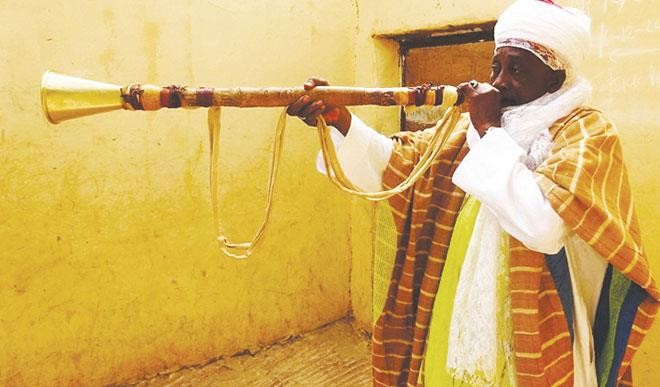

The art entertaining royalty in Sokoto is passed from one generation to another. Here the magaji of the Sultanate of Sokoto explains the nitty gritty of the business, which he stresses is as exciting as it is rewarding.
Royal trumpeters of the Sultanate of Sokoto have remained an integral part of the palace paraphernalia. The trumpeters group, popularly known as Masarta, is led by the magaji.
Members of the group use six musical instruments comprising fare, algaita (flute), kakaki (trumpet), ganga (drums), tabshi (round drums) and banga, in addition to praise singers. The Magaji uses the fare.
According to the Magaji, Alhaji Abdulra’uf Dan Jemage, the fare in his custody is over 100 years old and only the Sultan of Sokoto has monopoly of enjoying its service.
“You can’t find fare in any royal setting, except Sokoto, and it’s only meant for the sultan alone. This one (fare), with a golden head, is over 100 years old and it was originally from Gobir Kingdom which existed before the great Sokoto Caliphate,” he explained.
Abdulra’uf stated that ‘fare’ has a very significant place in the history of the sultanate, just like palace courtiers and guards. “There can’t be a palace or royal outfit without us,” he stressed.
‘Fare’ has a golden head which has remained the same since its creation for use by the Gobir Kingdom over a century ago. Its body is made from a bamboo pole. The blacksmith made it hollow, using a spike, the magaji explained. When blown, the hollow bamboo stick makes a distinct sound now associated with the presence of the sultan at any occasion.
All the royal trumpeters live in an area called Ruguzawa, which is a stone throw from the palace. They live just like a family.
“We are all here close to the palace and can assemble within minutes, whenever the need arises. During special public outings, the magaji stays in front of the sultan’s entourage and announces the presence of the sultan,” he explains.
“The group’s schedule involves going to the palace on daily basis to greet the sultan, just as other palace staff do, except on Thursday,” the magaji informed. “On Thursday, we don’t go to the palace for the daily homage because, on that day in the evening, we observe a special traditional entertainment where we collectively blow our instruments and beat our drums for sultan with the praise singers doing their own bit,” Abdulra’uf explained.
Every Thursday, the royal trumpeters assemble at the palace for a session which traditionally they have and passed from generation to generation.
So, on every Thursday’s evening, immediately after the evening prayer (isha’i), the group’s members come to the palace for what is called yamanci.
It all begins with the magaji making the first sign by blowing his ‘fare,’ signifying to the members of the group to assemble before moving collectively into the palace.
While inside the palace, the members break themselves into sets of ‘fare’ blowers, flutists (algaita), kakaki and drummers. The magaji, orchestrating from the centre, would blow his ‘fare,’ followed by his fellow ‘fare’ blowers.
They pause momentarily for kakaki blowers to do their thing and, after a short period, the flutists take over. But all within this cycle, the drum is beaten simultaneously with other instruments.
Despite the fact that the royal trumpeters are doing all the show for the sultan, they don’t need to see him to perform their duty. This activity is just part of weekly royal event.
From the sultan’s palace, members of the group trek to the waziri’s house, which is nearby, after which they disperse to their choice royal households for solo performances there.
The members, during a group or solo performance, get gratification in terms of cash or clothes from some well-to-do in society.
“It is not only the sultan that we entertain but also sultan’s senior council members, namely, waziri, magajin gari, magajin rafi, galadima, sarkin yakin Binji, baraden Wamakko and ardon Shuni. Some of our members also entertain some influential people and some royal households outside the sultan’s palace,” the magaji narrated.
He added that because their royal duties were inherited, he trains his siblings who now know how to use the instrument.
“I have three graduates from Usmanu Danfodiyo University who are also good ‘fare’ players. Someone has to take over from me when I die, just as I took over from my uncle,” he said.
“The ‘fare’ has been with my family since our ancestors because we are Gobir by origin but our great grandparents paid allegiance to Shehu Dan fodiyo, hence, our coming to be part of the sultanate royal history,” Abdulra’uf noted.
The first magaji was named Afwamfwam. He held the position during the reign of the first Sultan of Sokoto, Muhammadu Bello, the son of Shehu Usman Dan Fodiyo.
Others who came after him include Muhammadu, Muhammadu Dodo, Abubakar, Bawa, Sharu, Muhammadu Jabba, the present magaji’s father, Muhammadu Magu, uncle to the present magaji and the present magaji.
The present magaji was turbaned in 1979, after the demise of his uncle, magaji Magu.
“I survived four sultans from Sultan Abubakar III to the present Sultan Muhammadu Sa’ad Abubakar III,” he stated.
The magaji was there during the reigns of Sultan Abubakar III, Sultan Ibrahim Dasuki, Sultan Muhammadu Maccido and the present sultan.
“The necessity of my presence during a sultan’s official engagements allows me the privilege of travelling to almost everywhere in Nigeria. Wherever there is a traditional ruler in Nigeria, I have been there,” Abdulra’uf says proudly.
On their relationship with the sultan, he expressed gratitude that the royal father takes very good care of them, adding that: “He gives us cash, food and clothes. We lack nothing and people close to the sultan or visiting dignitaries do support us, too.”
For the magaji who has been in the position for over three-and-half decades, his most memorable outing was with late Sultan Abubakar III, when he travelled with the royal father by air, to attend a northern traditional leaders conference.
“I made a lot of noise with my ‘fare’ to the sultan’s admiration and when we returned to Sokoto, he showered me with a lot of gifts,” he called with nostalgia. “I will never forget that trip, especially because that was my first encounter with the plane.”