
Events that shaped world’s politics in 2016
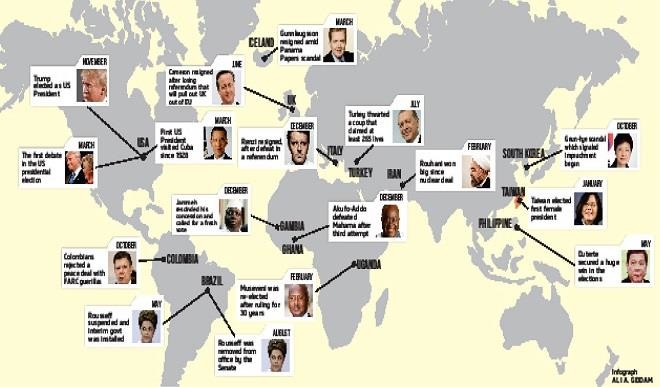
January Taiwan, an autonomous region in East Asia, elected its first female president in a landmark election that could unsettle relations with Beijing. But Tsai Ing-wen, in her victory speech, vowed to preserve the status quo in relations with China, saying Beijing must respect Taiwan’s democracy and both sides must ensure there are no provocations. […]

January
Taiwan, an autonomous region in East Asia, elected its first female president in a landmark election that could unsettle relations with Beijing. But Tsai Ing-wen, in her victory speech, vowed to preserve the status quo in relations with China, saying Beijing must respect Taiwan’s democracy and both sides must ensure there are no provocations.
Ms. Tsai, was the second president not to belong to the Kuomintang, the party that ruled Taiwan as an authoritarian state until democratic reforms began in the late 1980s.
February
Uganda’s President Yoweri Museveni, who has ruled the country for 30 years, was re-elected in an election overshadowed by arrests of politicians and allegations of rigging. His closest rival, Kizza Besigye, who was arrested on several occasions since the February 18 general election, rejected the results and proclaimed himself the winner.
In a dramatic twist, Besigye, on the eve of Museveni’s inauguration, was sworn-in as the elected president of the people’s government of Uganda in mock ceremony. In Iran, allies of reformist President Hassan Rouhani win big in the first parliamentary vote since the country signed a nuclear deal with world powers.
March
US President Barack Obama was in Cuba for an official three-day trip, the first US president to set foot in the country since 1928. The historic visit on March 20 was seen as a new chapter in U.S. engagement with the island’s communist government after decades of hostility between the former cold war foes.
April
Iceland’s Prime Minister Sigmundur David Gunnlaugsson resigned amid Panama papers scandal. His resignation follows intense pressure in Iceland after he was named in the leaked documents which apparently reveal tax evasion attempts. The Panama papers, a massive leak of documents from the Panama-based firm Mossack Fonseca, sheds light on the shady financial dealings of politicians and power figures around the globe.
May
Brazil suspended President Dilma Rousseff and installed an interim government led by Vice-president Michel Temer to allow for her impeachment trial to take place. Rousseff was accused of moving funds between government budgets, which is illegal under Brazilian law.
Also in May, anti-establishment firebrand Rodrigo Duterte secured a huge win in the Philippine presidential elections, after a campaign dominated by his profanity-laced vows to kill criminals. He took over on June 30, but almost immediately, extra-judicial killings started as police and vigilantes are emboldened by his crime-fighting agenda.
June
Britons stunned the world with vote to leave the European Union in a referendum, forcing the resignation of Prime Minister David Cameron and dealing the biggest blow since World War II to the European project of forging greater unity.
Cameron, who had campaigned against Brexit, was defeated by 52% to 48% despite London, Scotland and Northern Ireland backing staying in. Six months after the referendum, UK is yet to trigger Article 50 of the EU treaty, which sets out how a state can leave the bloc.
July
Turkey thwarted a military coup and commenced months of crackdown, jailing thousands of judges, public servants, teachers and military personnel accused of links with US-based cleric Fethullah Gulen.
The July 15 botched coup claimed at least 265 lives. Since then, 131 media outlets had been shut while prosecutors also issued warrants for detention of 47 journalists, media workers and executives.
August
Brazil’s Dilma Rousseff was removed from office by the Senate, who voted 61 to 20 to convict the country’s first female president on charges of manipulating the federal budget in an effort to conceal the nation’s mounting economic problems.
The impeachment put an end to the 13 years in power of her left-wing Workers’ Party. Ms Rousseff’s successor, Michel Temer is serving out her term, which is expected to end on January 1, 2019.
September
The first debate in the US presidential election pits Republican Donald Trump against Democratic Hillary Clinton and debate host Lester Holt. The presidential candidates argued vigorously over the issue of race, economy and foreign policy in their first televised debate in the run-up to November’s election.
Clinton accused her Republican rival of racism, sexism and tax avoidance, while Trump, a first-timer in politics, repeatedly cast his opponent as a career politician and demanded that she should account for her time in government.
October
Colombians stunned the world by rejecting a peace deal with FARC guerillas in a shocking referendum result, sending negotiators back to the table to revive the painstakingly negotiated plan to end the 52-year war. The deal was signed by President Juan Manuel Santos and FARC leader Timoleon Jimenez after nearly four years of negotiations. A week after the referendum, President Juan Manuel Santos wins the Nobel Peace Prize.
The month also witnessed the beginning of South Korea’s scandal which signaled the impeachment of the country’s first female president, Park Geun-hye.
November
The word is left agape with the election of a political outsider, Donald Trump as the 45th United States president-elect after a long, bitter and divisive campaign.
Trump clinched victory over the heavily favoured rival Hillary Clinton in the November 8 presidential election, ending eight years of Democratic rule and sending the United States on a new, uncertain path.
Trump collected enough of the 270 state-by-state electoral votes needed to win a four-year term that starts on January 20, against Clinton’s 232, even though the Democratic nominee garnered more popular votes.
December
In an upset victory that stunned the world, Gambians, December 1, voted to end 22-year rule of a leader who has ruled the tiny West African country by decree and whose two-decade regime was described by rights groups as repressive.
Yahya Jammeh was defeated in his bid for re-election by Adama Barrow, a real estate company owner. In a concession speech, Jammeh calmly accepted his loss and congratulated his rival for his “clear victory.” He also praised the elections as “transparent” and “rig-proof.”
A week later, Jammeh rescinded his concession and called for a fresh vote, citing “abnormalities” in the electoral process that produced Barrow. ECOWAS leaders pressured Jammeh to quit. But he defied the leaders, saying he will stay in power when his mandate ends in January.
The wave of stunning election victory also spread to Ghana, where electorate, on December 7, voted the incumbent John Mahama out of office. Opposition leader, Nana Akufo-Addo clinched victory after third attempt.
Mahama conceded defeat, and unlike Gambia’s Jammeh, never rescinded his concession, cementing the country’s reputation as a standard bearer of democracy.
“Ghana has enjoyed a very positive reputation as a model of democracy and I believe that this election has consolidated that reputation even further,” Mahama said at ECOWAS summit in Abuja.
In South Korea, the parliament voted overwhelmingly to impeach embattled President Park Geun-hye, amid the biggest political corruption scandal to hit Asia’s fourth-largest economy in a generation. The vote was 234-56, with six abstentions.
Italian Prime Minister Matteo Renzi resigned, after suffering a resounding defeat in a referendum over constitutional reform, leaving the euro zone’s third-largest economy in political limbo.
As Europe is recuperating from Renzi’s resignation, John Key, New Zealand’s centre-right prime minister, announced his sudden resignation, saying he did not see himself as a career politician and had “nothing left in the tank”.
Key, who has been prime minister for eight years, cited family reasons as one of the factors in his decision. Bill English is confirmed as his replacement a few days later.
DR Congo’s capital Kinshasa and other cities were convulsed by violent demonstrations as President Joseph Kabila, in power since 2001, completed his constitutional mandate December 19, without an election to choose his successor.
At least, 34 people were killed by the security forces during the demos, according to Human Rights Watch (HRW). Syria’s Bashar Al-Assad, backed by Russia and Iran, claimed victory in Aleppo, where thousands of rebels and civilians have perished in a relentless aerial bombing campaign. As the UN pressed for people not to forget the atrocities of Aleppo, an off-duty police officer killed Russian Ambassador to Turkey Andrei Karlov while he delivered a speech at an art gallery in Ankara, Turkey. Republican Donald Trump prevailed in U.S. Electoral College voting on December 19, to officially win election as the next president.
The year ended with United States-Russian spat over the latter’s alleged involvement in hacking U.S. political groups in the 2016 presidential election.
President Barack Obama on December 29 ordered the expulsion of 35 Russian suspected spies and imposed sanctions on two Russian intelligence agencies, an action seen as the strongest American response ever taken to a state-sponsored cyber-attack aimed at the United States.
But Russian President, Vladimir Putin ruled out tit-for-tat response, saying Russia would not “stoop” to the level of “irresponsible diplomacy” but would work to restore ties with the US under President-elect Donald Trump.