
FG earns N19.2bn from gold, others in Q1
Despite Nigeria not having a robust extraction of gold deposits and production, the commodity fetched the federal government N10.3bn in the first quarter of 2022, a report by the National Bureau of Statistics has shown. The report, titled ‘Trade In Goods Statistics,’ said the commodity classified as ‘Gold unwrought or in semi-mfr. forms, or in […]
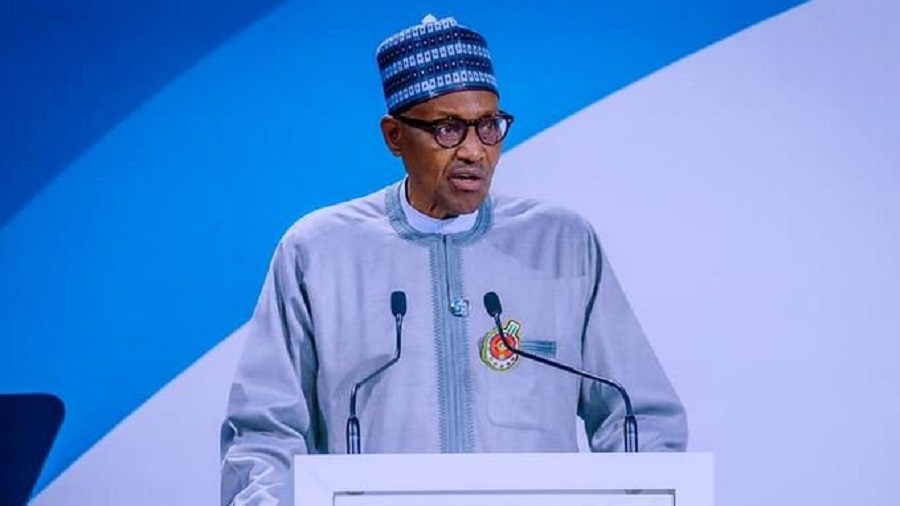
President Muhammadu Buhari
Despite Nigeria not having a robust extraction of gold deposits and production, the commodity fetched the federal government N10.3bn in the first quarter of 2022, a report by the National Bureau of Statistics has shown.
The report, titled ‘Trade In Goods Statistics,’ said the commodity classified as ‘Gold unwrought or in semi-mfr. forms, or in powder form’ was exported to Switzerland and the United Arab Emirates bringing in N10,057.83 and 329.39 respectively.
This is as Nigeria is struggling to modernise mining of the commodity, which is mostly extracted by artisan miners who use the crude form to extract them from the surface of the earth.
Even though the commodity has been found in states like, Zamfara, Kaduna, Kebbi, Niger, Kogi, Ogun, Osun Abuja, Bauchi, Cross River, Edo, Osun, Niger, Sokoto, Kebbi, Oyo, Ebonyi, Kwara, Nigeria still lacks the capacity to produce them into consumable products like jewelry.
The sector is also associated with illegal mining and smuggling with President Muhammadu Buhari saying Nigeria lost $3 billion to illegal smuggling of gold between 2012 and 2018, while it is estimated that 2 tons of gold per month is being mined by artisans presently in Nigeria.
Since Nigeria does not have a large-scale mining sector, gold refining is carried out by small-scale or artisans in local areas, unlike countries in West Africa such as Ghana and Burkina Faso, that have fully developed their mining potentials.
Similarly, crises in some states like Zamfara and Kaduna have been linked with the presence of gold deposits, forcing the National Security Adviser (NSA) to convene a security meeting last year to deliberate on the issue of illegal mining, which it said is fueling the crisis in Zamfara State.
The NSA in a statement had pointed out that beyond the problems of bandits and cattle rustlers, the scale of lawlessness in the state was “Aggravated by illegal miners who are harvesting resources they have no legal rights to exploit.”
However, the government is trying to breathe sanity into the sector with the Presidential Artisanal Gold Mining Development Initiative (PAGMDI).
The PAGMDI is an artisanal and small-scale gold mining that would enable the miners to send refined gold to the CBN and in accordance with the London Bullion Market Association (LBMA) standards.
President Buhari at an event to mark the first purchase said the initiative would improve gold mining operations in the country, generate 250,000 jobs and over $500 million in monetary value annually through the payment of royalties and taxes to government coffers.
Also speaking at the launch, Governor of Central Bank (CBN), Godwin Emefiele said the development would help Nigeria facilitate economic diversification.
“The Nigerian economy remains strong, remains resilient to withstand the exogenous shocks that we see around today.”
Meanwhile, N8.8bn was made from the exportation of cigarettes containing tobacco to neighbouring countries.
A breakdown saw the export of the commodity to Niger Republic valued at N3.567bn, Cameroon N1.944bn, Ghana N1.537bn, Burkina Faso N933m and Ivory Coast N869m.
Daily Trust reports that this is facilitated by the presence of the British American Tobacco’s, West and Central Africa, factory which is located in Oyo State.