
FG inches closer to 15% inflation target
The federal government is moving closer to achieving the 15 percent inflation target it projected in the 2025 Appropriation Bill submitted to the National Assembly in 2024. It would be recalled that President Bola Tinubu, while presenting the budget, assured that the inflation rate would decelerate from the 34.8 per cent it peaked in 2024 […]
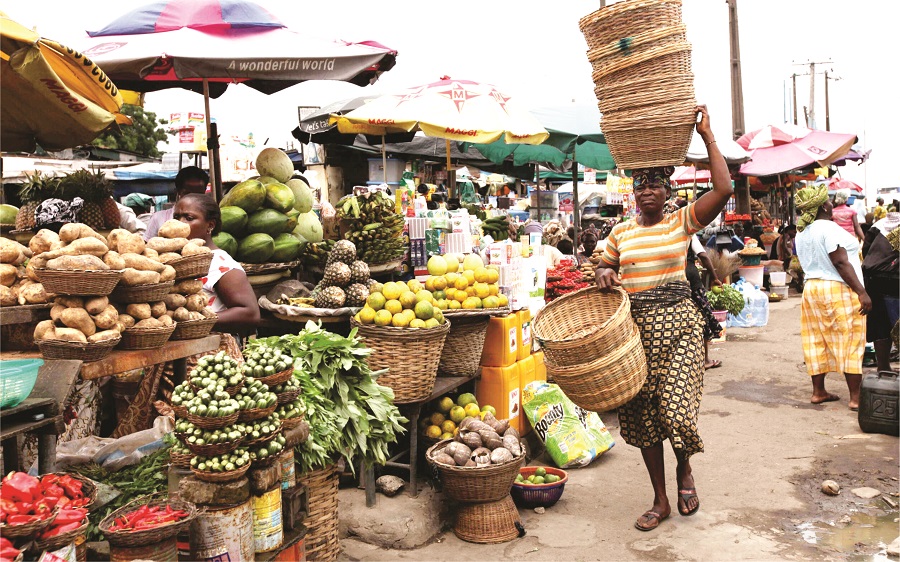
The federal government is moving closer to achieving the 15 percent inflation target it projected in the 2025 Appropriation Bill submitted to the National Assembly in 2024.
It would be recalled that President Bola Tinubu, while presenting the budget, assured that the inflation rate would decelerate from the 34.8 per cent it peaked in 2024 to 15 per cent.
With two months of data left for the completion of 2025, the government is inching closer to the 15 percent target as the month of October recorded 16.05 percent.
How inflation dropped in 2025
Buoyed by the rebasing of the Consumer Price Index (CPI), which saw the National Bureau of Statistics (NBS) adopting a new methodology and inclusion of new lists of items into the inflation basket, Nigeria witnessed 10.32 percent of its inflation wiped off from the national database.
This was followed by the reduction of food prices, mostly grains, which has historically been the major cause of an increase in inflation data.
The reduced food prices came despite the insecurity with farmers displaced from their farmlands.
Meanwhile, the steady gain of the naira in the foreign exchange market has also been lauded as influencing the drop in inflation, as goods imported have seen prices dropped marginally.
What October data says
According to the NBS, Nigeria’s Headline inflation rate eased to 16.05 per cent relative to the September 2025 headline inflation rate of 18.02 per cent.
In its October 2025 inflation report, the NBS said the inflation rate showed a decrease of 1.96 percent compared to the September 2025 Headline inflation rate and on a year-on-year basis, the Headline inflation rate was 17.82 percent lower than the rate recorded in October 2024 (33.88 percent.
“This shows that the Headline inflation rate (year-on-year basis) decreased in October 2025 compared to the same month in the preceding year (i.e., October 2024), though with a different base year, November 2009 = 100.”
It added that on a month-on-month basis, the Headline inflation rate in October 2025 was 0.93 per cent, which was 0.21 per cent higher than the rate recorded in September 2025 (0.72 per cent).
“This means that in October 2025, the rate of increase in the average price level was higher than the rate of increase in the average price level in September 2025.
For Food inflation, the rate was 13.12 per cent on a year-on-year basis.
“This was 26.04 percent lower compared to the rate recorded in October 2024 (39.16 percent). The significant decline in the annual Food inflation figure is technically due to the change in the base year.”
Food prices rose monthly
However, on a month-on-month basis, it said the food inflation rate in October 2025 was -0.37 percent, up by 1.21 percent compared to September 2025 (-1.57 percent.
It blamed the increase on the average prices of onions (fresh), fruits (oranges, pineapple), shrimp, groundnuts (unshelled), vegetables (ugu, okazi leaf), and meat (goat meat, cow tail, liver), among others.”
It added that the average annual rate of food inflation for the twelve months ending October 2025 over the previous Twelve-month average was 21.96 percent, which was 16.16 percent points lower compared with the average annual rate of change recorded in October 2024 (38.12 percent.
For “All items less farm produces and energy” or Core inflation, which excludes the prices of volatile agricultural products and energy, it stood at 18.69 percent on a year-on-year basis, showing a decline of 9.68 percent when compared to the 28.37 percent recorded in October 2024.
On a month-on-month basis, the Core Inflation rate was 1.416 percent in October 2025, down by 0.001 percent compared to September 2025 (1.417 percent). The average twelve-month annual inflation rate was 21.61 percent for the twelve months ending October 2025, which was 4.51 percent points lower than the 26.12 percent recorded in October 2024.
States profile
The report said the All-Items inflation rate on a year-on-year basis was highest in Ekiti (20.14 percent, Nasarawa (18.97 percent, and Zamfara (18.81 percent, while Bauchi (9.99 percent, Anambra (11.72 percent, and Gombe (11.73 percent recorded the lowest rise in Headline inflation on a Year-on-Year basis.
But on a month-on-month basis, however, October 2025 recorded the highest increases in Niger (4.90 percent, Anambra (4.90 percent, and Enugu (4.75 percent, while Edo (-4.00 percent, Katsina (-3.26 percent, and Adamawa (-3.10 percent recorded a decline in the month-on-month inflation.
While food inflation on a year-on-year basis was highest in Ogun (20.85 percent), Nasarawa (19.96 percent), and Ekiti (19.70 percent), while Akwa Ibom (3.98 percent), Katsina (4.15 percent), and Yobe (4.29 percent) recorded the slowest rise in Food inflation on a Year-on-Year basis.
On a Month-on-Month basis, however, October 2025 Food inflation was highest in Bauchi (6.77 percent, Abuja (5.11 percent, and Niger (4.84 percent, while Katsina (-7.72 percent, Oyo (-5.89 percent, and Taraba (-4.89 percent recorded a decline in Food inflation on a month-on-month basis.
It went on to state that on a year-on-year basis, the Urban inflation rate was 15.65 percent, showing 20.73 percent points lower compared to the 36.38 percent recorded in October 2024.
“On a month-on-month basis, the Urban inflation rate was 1.14 percent in October 2025, up by 0.4 percent compared to September 2025 (0.74 percent).
The corresponding twelve-month average for the Urban inflation rate was 22.68 percent in October 2025. This was 11.84 percent points lower compared to the 34.52 percent reported in October 2024.
For rural inflation, it was 15.86 percent on a year-on-year basis. This was 15.73 percent points lower compared to the 31.59 percent recorded in October 2024.
“On a month-on-month basis, the rural inflation rate in October 2025 was 0.45 percent, down by 0.22 percent compared to September 2025 (0.67 percent). The corresponding twelve-month average for the rural inflation rate in October 2025 was 20.81 percent. This was 9.42 percent points lower compared to the 30.24 percent recorded in October 2024.
Experts express skepticism
Speaking with Daily Trust, a Professor Emeritus of Economics and Former Director, Centre for Economic Policy Analysis and Research, University of Lagos, Prof. Ndubisi Nwokoma, while stating that the government is on course to meet its target, expressed skepticism on the accuracy of the data.
He said there is a question mark whether the figures are real or not, as the major drivers of the inflation decline are minute.
He said, “So, I have my skepticism. That’s all I can say and it doesn’t really reflect reality. I can’t really say anything has had a huge influence in driving the inflation down, because the only thing that they can look at is the exchange rate, which has been stable around that N1,450, or thereabouts. But the market is not favourable now.
“There is dollar in the market, but the supply is not as good as we expect. So, I don’t know what else they used. The other one is that there’s still insecurity. We can’t talk about food inflation improving when insecurity is still there. This means that people going to farms have not significantly improved.
“I don’t see any logical reason why the figure should come down. I think the narrative has been that the macro economy is improving, but at the micro level, the figures don’t rhyme, because the macro is supposed to be an aggregation of the micro.
“So, if the micro is not doing well, then I wonder why the macro should do well. So, there’s been this narrative by government officials that the economy is improving based on the macroeconomic indicators, but the finance from the micro level does not agree with the macro,” he said.
Nigeria recorded a significant moderation in inflation in October 2025, marking one of the strongest single-month disinflations this year. Headline inflation dropped from 18.02% in September to 16.02%, driven by base effects, exchange rate stability, and improving macroeconomic fundamentals. Similar moderation was seen across food and core inflation indices.
However, inflationary pressures remain elevated in critical household sectors—including food, transportation, housing, utilities, education, and health—which jointly account for 84% of inflation. Persistent structural weaknesses such as high logistics costs, energy challenges, security concerns in food-producing areas, and climate-related disruptions continue to constrain supply and limit the welfare gains of disinflation.
This policy brief outlines the inflation trends, identifies underlying pressures, and proposes targeted interventions to consolidate disinflation while addressing the root causes of cost escalation.
On his part, the Chief Executive Officer, Centre for the Promotion of Private Enterprise (CPPE), Dr Muda Yusuf, said Nigeria’s macroeconomic environment continued to stabilize in October 2025, reflected in a sharp deceleration in the inflation rate.
He noted that the persistent downward trend is indicative of improving policy coordination in monetary, fiscal, and exchange rate management, and the magnitude of the October decline exceeded expectations, signaling stronger confidence in the ongoing reform agenda.
He said that while annual inflation decreased sharply, month-on-month inflation rose slightly, indicating residual frictions in supply chains and price stickiness despite improving macro fundamentals.
He said the naira showed modest appreciation and sustained stability over recent months and helped ease imported inflation, particularly in sectors dependent on imported raw materials, inputs, and energy.
He identified monetary tightening measures, better FX market liquidity, a reduction in speculative demand for foreign currency and improved investor sentiment due to ongoing reforms for improving macroeconomic coordination.
He added that currency differentials with neighbouring CFA-zone countries create incentives for informal exports of food items, tightening domestic supply while farmer-herder conflicts, banditry, and rural insecurity reduce agricultural output and raise supply chain risks.
He called for robust coordination between the CBN, the Ministry of Finance, the Ministry of Agriculture, the Ministry of Transport, Customs, and trade agencies to achieve holistic inflation management.
To ensure that disinflation translates into real cost-of-living relief, Nigeria must undertake deliberate and sustained reforms across critical sectors. With coordinated monetary, fiscal, and structural policies, the current trajectory can be strengthened, broadened, and sustained.”