
Food prices crash further in FCT rural markets
The price of foodstuffs, especially local rice, beans, guinea-corn, maize, millet, cassava flour, yam, and garri, has further crashed by up to 50 percent in various rural markets in the Federal Capital Territory (FCT), our correspondent reports. Abuja Metro, who visited Abaji main market on Wednesday—a market that holds every five days in the area […]
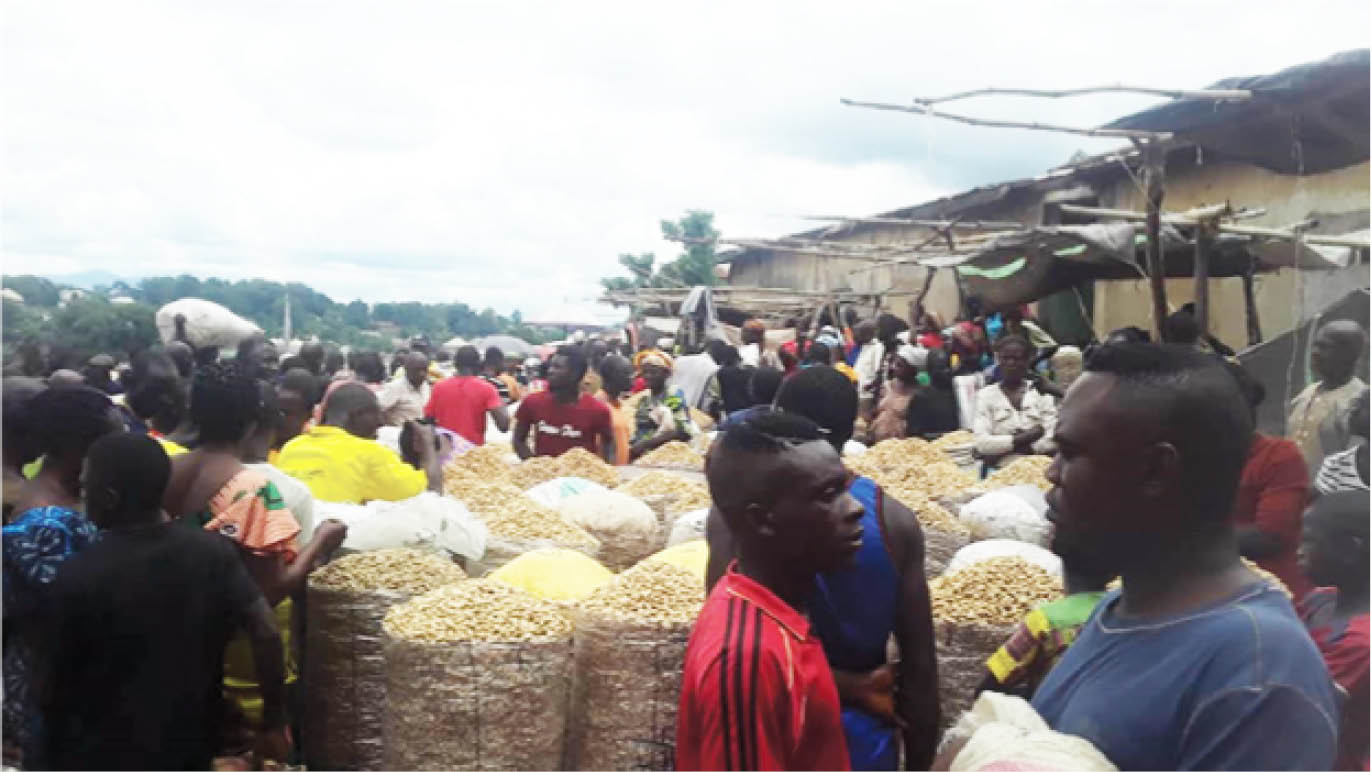
Groundnut section of Adikpo market in Benue State
The price of foodstuffs, especially local rice, beans, guinea-corn, maize, millet, cassava flour, yam, and garri, has further crashed by up to 50 percent in various rural markets in the Federal Capital Territory (FCT), our correspondent reports.
Abuja Metro, who visited Abaji main market on Wednesday—a market that holds every five days in the area council—reports that a mudu (measure) of local rice, which was sold between N2,000 and N1,800 two months ago, is now sold between N1,500 and N1,300 during the market day.
Findings also showed that a mudu of maize, which was sold between N800 and N600, is now sold between N350 and N400 per mudu.
Similarly, a mudu of white big beans, which sold at N2,500, is now N2,000. A mudu of guinea-corn, previously sold at N1,000, is now N750, and a mudu of millet, which sold at N1,200, is now N900.
However, some traders at the Abaji market, who spoke to our reporter, said prices for some foodstuffs vary, especially beans and rice, which they said are of different types.
“We have local rice that is so clean you might mistake it for foreign rice. But there is also another locally harvested rice whose appearance makes the price different, though the difference is not more than N200,” said a trader, Mrs. Asibi Haruna.
Further findings also showed that five tubers of yam, which cost between N10,000 and N15,000 two months ago, are now sold for prices ranging from N4,000 to N7,000, depending on their sizes.
A visit to Kwaita market in Kwali Area Council on Thursday, which holds every four days, showed that a mudu of rice, which was sold between N1,800 and N1,600 few months ago, is now sold for N1,200 and N1,100, though sellers noted the price depends on the variety of rice.
A mudu of beans, which was sold at N2,500, is now N2,000. Traders clarified that the big beans variety is sold at N2,000, while the small white beans is sold between N1,400 and N1,600.
A mudu of guinea-corn, which sold at N1,000, is now N750 per mudu, and a mudu of millet, which sold at N1,200, is now N900.
A trader at Kwaita village market, Malam Garba Abdullahi, said the crash in foodstuffs was due to the bumper harvest experienced by farmers in various rural communities in the FCT.
“Unlike last year, when I always traveled to the north to buy bags of beans to bring here to sell, this year, local farmers are bringing their harvest to the market to sell in droves. However, one cannot only attribute the crash of foodstuffs to the bumper harvest alone; rather, the lack of money in people’s hands to buy the foodstuffs is the major challenge,” he said.
Also, at Paikon-Kore and Dobi markets in Gwagwalada Area Council, findings showed that prices of foodstuffs have further crashed by up to 65 percent in the area.
Some traders, who spoke to our reporter on Thursday, said prices of foodstuffs, especially grains, have crashed beyond expectations, noting that consumers mostly come from neighboring towns with trucks to buy in large quantities.
“For example, a big bag of maize, which was sold for N30,000 two months ago, is now sold between N18,000 and N20,000. Similarly, a bag of guinea-corn, which sold at N35,000, is now N25,000,” a trader identified as Mathew Nyiste said.
Nyiste said despite the challenges of crop destruction by cows in rural communities, the majority of rural farmers were still able to enjoy a bumper harvest this year.
“Although, the major problem is that there is no money in people’s hands, as the country’s economy is biting harder on the people. This has contributed to the crash of foodstuffs in the market because the majority of consumers have no money to buy the food, despite the crash,” he said.
Further findings at Kwaku village market in Kuje Area Council of the FCT also showed that the prices of foodstuffs—comprising rice, beans, guinea-corn, millet, yam, and cassava flour—have crashed.
It was gathered that the price of a mudu of rice, beans, millet, and cassava flour, as well as tubers of yam, had crashed by up to 67 percent during the last village market, which held on Sunday in the area.
Mr. Wabari James, a resident of Kwaku village, told our reporter that a mudu of rice, which sold at N1,700, is now N1,100. A mudu of beans, which sold at N2,300, is now between N1,600 and N2,000. He added that a medium size of five yam tubers is now sold for N3,500 to N4,000.
“But the major problem is that there is no money. If not for that, foodstuffs in Kwaku market this year are cheap. However, only a few traders who come from Abuja city and parts of Kogi and Edo states are buying in large quantities,” he said.