
Ganduje’s resignation sparks jostling for control in Kano APC
The dramatic resignation of Abdullahi Umar Ganduje as National Chairman of the All Progressives Congress (APC) has set off a fresh scramble for control within the party’s influential Kano chapter, potentially reshaping the power dynamics ahead of the 2027 general elections. Ganduje’s exit—announced abruptly on Friday—has not only created a vacuum at the national level […]

The dramatic resignation of Abdullahi Umar Ganduje as National Chairman of the All Progressives Congress (APC) has set off a fresh scramble for control within the party’s influential Kano chapter, potentially reshaping the power dynamics ahead of the 2027 general elections.
Ganduje’s exit—announced abruptly on Friday—has not only created a vacuum at the national level but also triggered an intense political recalibration back home, where rival factions and ambitious players are now scrambling to reposition themselves as the new powerbrokers of Kano APC.
At the centre of this unfolding drama is Senate Deputy President Barau Jibrin, currently the most senior elected APC official from the state, who many now view as the party’s presumptive leader in Kano. His growing influence, fuelled by a steady influx of defectors, mostly from the rival Kwankwasiyya Movement, has only strengthened his standing in recent months.
But Barau is not the only one believed to be eyeing the crown. Former deputy governor and 2023 APC governorship candidate, Nasiru Yusuf Gawuna, his running mate Murtala Sule Garo, two federal ministers from the state, and the state APC chairman Abdullahi Abbas are all emerging as key gladiators in what is shaping up to be a fierce battle for the soul of the party in one of Nigeria’s most politically strategic states.
- Jubilation as Shinkafi Volunteer Forces kill Bandit Commander, Danbokolo
- Security operatives order PDP BoT members out of meeting hall
Many believe that Senator Barau’s consistent reception of defectors—especially from the Kwankwasiyya camp—has boosted his popularity within the APC, positioning him as a potential de facto leader in Kano if Ganduje chooses to remain quiet or is offered a federal appointment as compensation, as some insiders speculate.
Party chieftains say Barau has been consolidating influence beyond his Kano North senatorial base, funding APC activities across the state. This has been widely interpreted as a move to prepare for a 2027 gubernatorial bid under the ruling party.
Political analysts believe that Barau, who hails from the same district as Ganduje, now enjoys an edge in their long-standing political rivalry.
However, this depends largely on the real reason behind Ganduje’s resignation. If it was strategic, paving the way for a bigger role—such as Secretary to the Government of the Federation (SGF) or a vice-presidential slot—he could retain influence and continue pulling strings in the Kano APC.
Conversely, if Ganduje was pressured out without compensation, many believe his political future may be bleak, given that he never built a robust grassroots political structure during his time in office similar to the Kwankwasiyya Movement.
Meanwhile, despite being the APC’s last gubernatorial candidate, some believe Gawuna may not wield as much influence as others vying for control. His failure to secure a ministerial slot—allegedly due to internal power plays—has been interpreted as a strategic move to weaken his chances of clinching the 2027 ticket without federal backing.
Gawuna’s former running mate, Murtala Sule Garo, is another major contender. He is widely seen as one of the masterminds of Ganduje’s political movement, having served as Commissioner for Local Government Affairs. Garo reportedly controls a solid political structure across Kano.
Intriguingly, Garo and Barau both hail from Kabo Local Government Area and are said not to be on good terms, further intensifying the intra-party rivalry.
The two ministers from Kano are seen as proxies of the two leading blocs within the APC. Mariya Mahmud, a former Ganduje commissioner, was reportedly recommended by him for her federal appointment. In contrast, Yusuf Ata is believed to have been nominated by Barau.
Another figure potentially in the mix is Abdullahi Abbas, the current APC chairman in Kano and a longstanding Ganduje loyalist. Abbas, who has led the state party since 2018, is also believed to be eyeing the governorship in 2027, despite remaining firmly in Ganduje’s camp for now.
These individuals form the major gladiators now contending for control of one of Nigeria’s most politically strategic states, as Ganduje exits the scene.
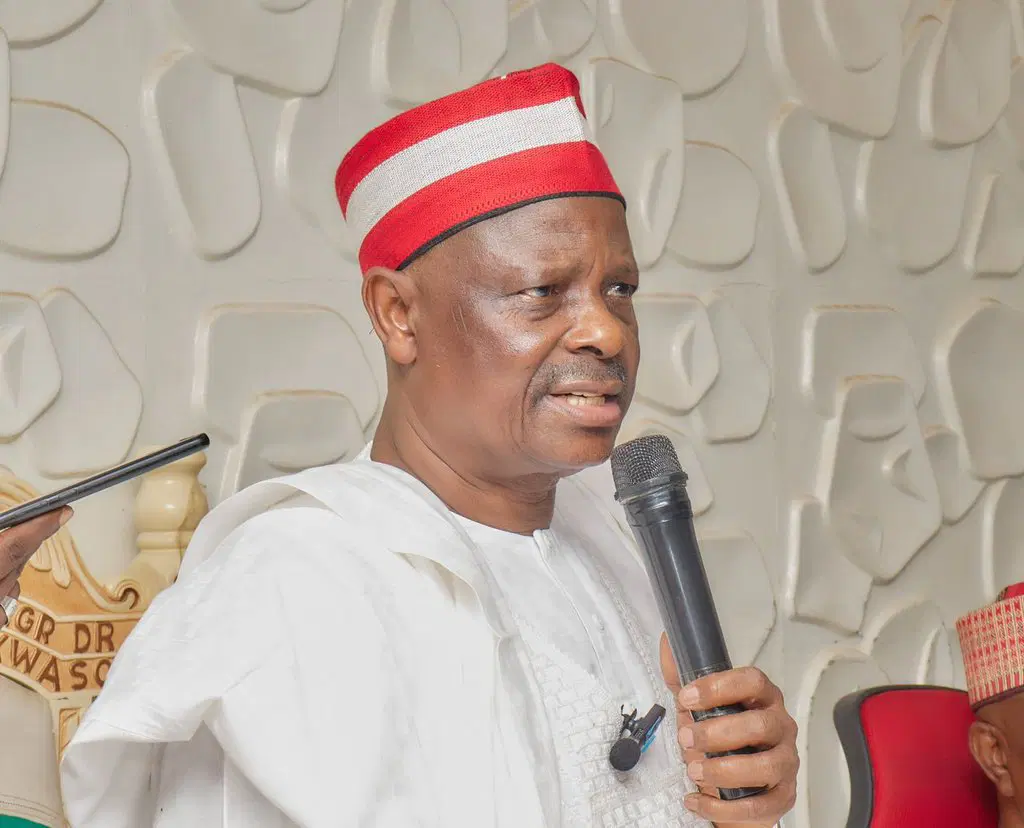
Kwankwaso’s defection rumours gain ground
Outside the immediate APC structure, speculation is rife that Ganduje’s ouster was intended to facilitate Senator Rabiu Musa Kwankwaso’s entry into the ruling party.
Should this materialise, analysts believe the leadership structure will tilt towards Kwankwasiyya, with Kwankwaso likely assuming de facto control. Under APC constitutional guidelines, however, Kano’s Governor Abba Kabir Yusuf would be recognised as the formal party leader if he joins the party alongside his political mentor.
Kwankwaso has long been rumoured to be mulling a return to the APC, possibly with an eye on the vice-presidential ticket ahead of 2027.
In 2023, President Tinubu reportedly asked Ganduje to negotiate Kwankwaso’s return, but the former NNPP presidential candidate rejected the idea, insisting he would never rejoin the APC while Ganduje remained chairman.
Kwankwaso and Ganduje were once close allies, having contested and won Kano’s governorship elections together in 1999 and again in 2011. Ganduje succeeded Kwankwaso in 2015, but their relationship soured less than two years into Ganduje’s tenure. Kwankwaso subsequently left the APC and has not returned to the same party as Ganduje since.
Political watchers believe President Tinubu may now be banking on Kwankwaso’s popularity and his control of Kano through the NNPP to shore up support for the next presidential election.
Everything depends on who joins, capitalises on vacuum – Prof. Fage
Renowned political scientist, Professor Kamilu Sani Fage, says the future of the APC in Kano hinges not only on Ganduje’s exit but on who strategically moves in to fill the power vacuum it has created.
Fage said if it turns out that Ganduje was compelled to resign and is not compensated with another federal position, then it would confirm fears that he has been used and discarded by the presidency.
“Without a new appointment, Ganduje’s political relevance could drastically diminish. He simply hasn’t built the kind of deep grassroots machinery that someone like Kwankwaso has,” said Fage, a lecturer at Bayero University Kano’s Department of Political Science.
Fage noted that Senate Deputy President Barau Jibrin, who is not known to be politically aligned with Ganduje, may now have a freer hand to pursue his reported 2027 governorship ambition. Given the current shift in the political landscape, Barau could well consolidate control of the APC structure in the state.
Still, Fage warned that any lasting power shift would depend heavily on how key political actors realign in the coming months—especially if speculation about Senator Rabiu Musa Kwankwaso and Governor Abba Kabir Yusuf joining the APC proves accurate.
“Everything depends on who joins whom and who is able to capitalise on the vacuum that has now been created,” he said.
On the uncertainty surrounding Ganduje’s resignation, Fage argued that the real reasons remain speculative. “If he was forced out on certain grounds, he might not get anything. That’s the way our politicians operate—they use and discard. Tinubu may have seen Ganduje as useful at a point, but if Kwankwaso or someone else now offers more strategic value, he may well switch allegiance.
“In politics, there are no permanent friends or enemies—only permanent interests,” he said.