
Grazing reserves are essential to the economy
The abandonment of the 417 grazing reserves that are scattered across Nigeria clearly indicates the extreme neglect to which the livestock sub-sector has been subjected. It also explains the sharp decline in livestock production, which has continued to have negative effects on agriculture in particular and the national economy as a whole. Available statistics have […]
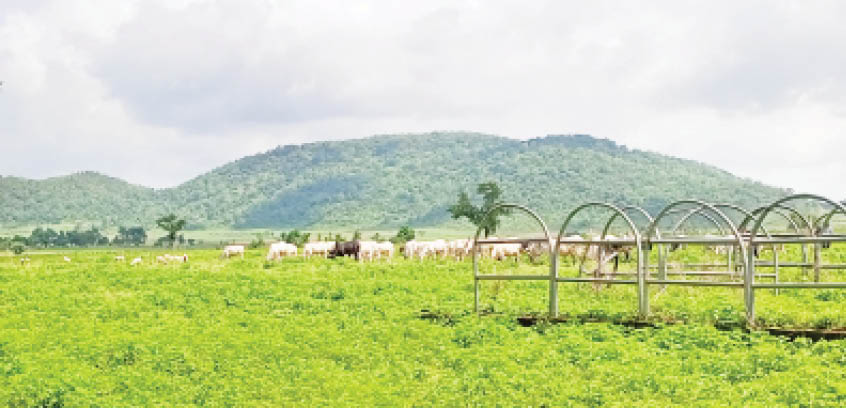
Pasture development at Paiko-Kore Grazing Reserve in Gwagwalada Area Council of the FCT
The abandonment of the 417 grazing reserves that are scattered across Nigeria clearly indicates the extreme neglect to which the livestock sub-sector has been subjected. It also explains the sharp decline in livestock production, which has continued to have negative effects on agriculture in particular and the national economy as a whole.
Available statistics have shown that the 417 grazing reserves, approximate to more than four million hectares of land that cut across 21 states and the Federal Capital Territory, when properly catered for, should be adequate for the rearing of livestock in the country. The classification of such vast and long stretch of land as grazing reserves in 1942 and the subsequent enactment of the Grazing Reserves Law by the Northern Regional Government in 1965 were a testimony to the commitment of the past leaders to livestock development.
It is, therefore, unfortunate that at present, when the need for grazing reserves has become even more compelling, considering the remarkable quantitative growth of livestock, such vital facilities have been so abandoned. Even with some of the issues that have constituted a challenge for the government in the preservation of grazing reserves, the level of the neglect remains unacceptable.
Admittedly, the noticeable conversion of a lot of portions to farmlands as well as erection of structures, coupled with the fact that far greater number of them have remained ungazetted, are truly problems that have made utilisation of the grazing reserves absolutely difficult, if not impossible. The lingering insecurity in many northern states is, perhaps, the biggest factor that inhibits pastoralism, thereby militating against livestock development in Nigeria.
- Bauchi unveils 10 priority areas for investment as economic summit begins today
- Kano TikToker remanded over indecent video with woman
It is, for example, a matter of utmost concern that out of the 417 of the reserves, only 142, that is a little over one quarter of them, have been gazetted; a reality that has posed huge legal and operational constraints in the management and utilisation of the facilities. If this is added to the various threats to security like kidnapping, banditry, cattle rustling and farmers-herders clashes, a whole picture of unsecured environment where livestock rearing is an impossibility will readily emerge.
But all these are challenges that must have to be surmounted in order to raise the level of livestock production and, by extension, guarantee the food security of the country. The proper step should be taken towards the resuscitation of the grazing reserves, which are critical national assets that should be safeguarded.
In this regard, the new Federal Ministry of Livestock Development, in collaboration with the state and local governments, should carry out an auditing of all the grazing reserves in the country with a view to ascertaining their present condition. This will enable them to know the extent of encroachment, level of deterioration and possibly establish the need for a redesign of some of them in line with the present realities.
Daily Trust welcomes the move by the ministry to start a pilot programme, such as the one in the outskirt of Abuja, aimed at resuscitating some of the abandoned grazing reserves. This should be taken with all seriousness. State governments must also take similar measures in their grazing reserves.
Similarly, governments must reclaim all the grazing reserves that have been encroached by individuals and institutions and revert them to their original status.
We believe this, and subsequent measures would go a long way towards addressing the security concerns in many of our states.
Federal and state governments must collaborate to ensure the success of the programme.
The current farmers-herders clashes can be effectively addressed only if the governments adopt a common approach that will make the enforcement of measures as well as monitoring and evaluation relatively easy.
Although the immediate past federal government under late Muhammadu Buhari mooted the idea of ranching which has now been substituted with the Fulaku Initiative, the failure of the two programmes justifies the strong agitation for the resuscitation of the grazing reserves. The reversal of the ugly situation in the livestock sub-sector will be possible only if the grazing reserves are quickly resuscitated and upgraded.
We agree with the view expressed by the President of the Miyetti Allah Cattle Breeders Association of Nigeria (MACBAN), Alhaji Baba Othman Ngelzarma, in an interview with this newspaper that the “government has to strike a balance between crop production and livestock”. The livestock sub-sector which, according to experts, contributes five to seven per cent of the national Gross Domestic Product and 20 per cent of the country’s overall agricultural output, is no less important than any other sub-sector and should be supported to grow further.