
How El-Rufai, Ribadu Fell Apart After Tinubu Backed ex-EFCC Boss in 2011 President Poll
A panel of political commentators on Inside Sources with Laolu Akande on Channels Television has shed light on the long-standing rift between Mallam Nuhu Ribadu, Nigeria’s current National Security Adviser, and former Kaduna State governor, Nasir el-Rufai. According to the panelists, the cracks in their once-close relationship trace back to Ribadu’s 2011 presidential bid under […]
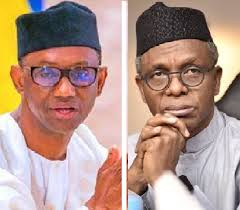
ribadu el rufai
A panel of political commentators on Inside Sources with Laolu Akande on Channels Television has shed light on the long-standing rift between Mallam Nuhu Ribadu, Nigeria’s current National Security Adviser, and former Kaduna State governor, Nasir el-Rufai.
According to the panelists, the cracks in their once-close relationship trace back to Ribadu’s 2011 presidential bid under the Action Congress of Nigeria (ACN).
Laolu Akande, host of the programme, provided historical context, noting that the Ribadu–el-Rufai alliance was forged during the Olusegun Obasanjo administration, when both men were part of the inner circle of influence.
“I think the problem between Ribadu and el-Rufai started much earlier,” Akande said. “If you go back to the history of their relationship, it got strengthened during the Obasanjo era where el-Rufai was one of the cabals. And Ribadu was also one of them. The ‘but’ then was el-Rufai wanted to be president. The plan was that Rufai becomes the president and will make Ribadu the IGP which was what Ribadu wanted to be. Come 2011, Asiwaju is supporting Ribadu to run for President. That was where the problem started. El-Rufai couldn’t imagine Ribadu would be the one to have that platform.”
Ismail Omipidan, Deputy Political Editor of The Sun newspaper, also weighed in, arguing that rivalry and ambition were inevitable factors.
“There is no how you will have an el-Rufai in this government and he will not want to outshine the likes of Ribadu,” Omipidan stated. “I know that they were quite close. Both of them were hunted at the same time by the Yar’Adua’s government. I also know when some persons around Obasanjo were toying with the idea of making Buhari president in 2007, I understand that both Ribadu and el-Rufai were also trying to persuade Obasanjo.”
Public affairs analyst Etim Etim added his perspective, noting that the 2011 ACN presidential ticket marked a turning point for Ribadu, but also sowed seeds of rivalry that have lingered over a decade later.
Ribadu, once a celebrated anti-corruption czar as chairman of the Economic and Financial Crimes Commission (EFCC), emerged as the ACN’s flag bearer in the 2011 election. His candidacy, heavily backed by Bola Ahmed Tinubu (now president), was seen by many as a bold attempt to challenge the dominance of the ruling Peoples Democratic Party (PDP).
El-Rufai, who at the time was still navigating his political rehabilitation after clashes with the late President Umaru Musa Yar’Adua’s government, reportedly felt sidelined by Ribadu’s elevation. According to the panelists, this political divergence fractured their camaraderie, turning trusted allies into uneasy rivals.
The discussion on Inside Sources also highlighted how the rift has resurfaced in the present day. El-Rufai recently accused Ribadu, now National Security Adviser, of secretly paying bandits—a claim that sparked nationwide debate and underscored the deep fissures between the two men.
For analysts, the Ribadu–el-Rufai story is emblematic of Nigeria’s political culture, where friendships forged in the corridors of power often collapse under the weight of personal ambition and shifting alliances. As the country continues to grapple with insecurity and governance challenges, the strained relationship between two of its most influential figures remains a subject of intrigue and consequence.