
How watermelon boosts Jigawa economy, creates job
Watermelon business is booming in Jigawa State, particularly in Kirikasamma, Birniwa and Guri local government areas, where major hubs for farming and trading are taking place. The business is booming because it is harvest season when trucks and traders congest the roads as they transport the fruit to other parts of the country. The business […]
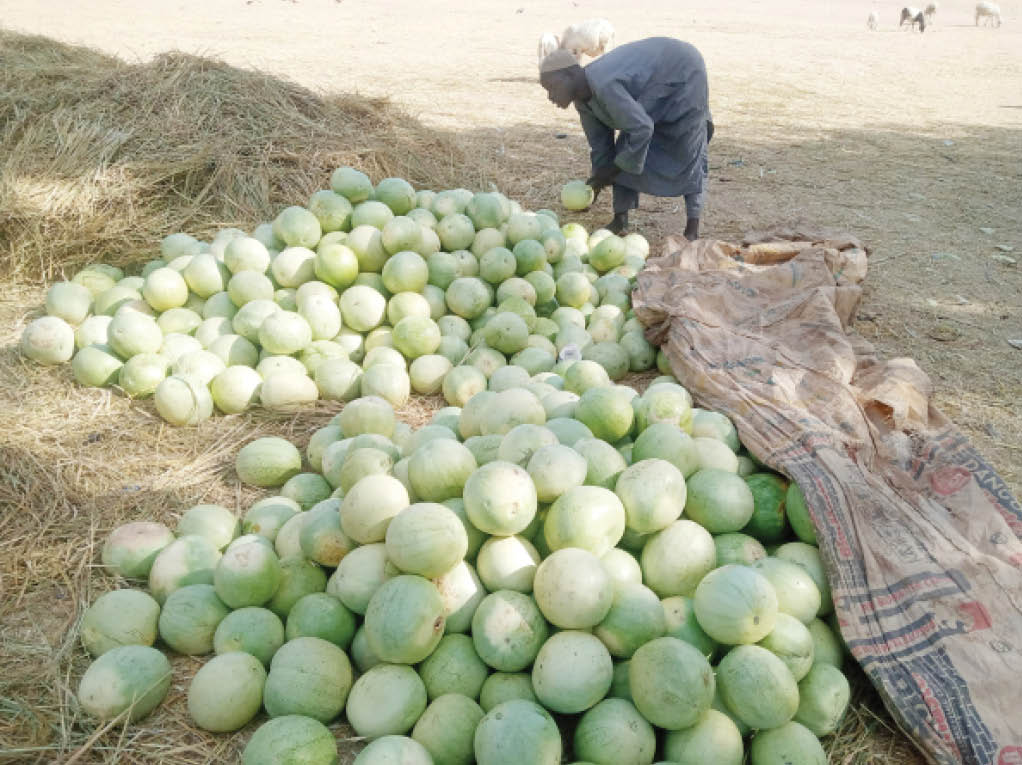
A watermelon farmer sorting out his harvest in Bara village, Bauchi State
Watermelon business is booming in Jigawa State, particularly in Kirikasamma, Birniwa and Guri local government areas, where major hubs for farming and trading are taking place.
The business is booming because it is harvest season when trucks and traders congest the roads as they transport the fruit to other parts of the country.
The business provides employment and income opportunities to numerous groups of people, including farmers, traders, exporters, drivers, food vendors and labourers throughout the season.
Majority of the residents of the three local government areas – Kirikasamma, Birniwa and Guri – are farmers. They rely heavily on farming, animal husbandry and other businesses to sustain their livelihoods and boost local economy, as well as pay tax to the local governments.
Farmers transport their produce from nearby villages to major markets in Kirikasamma, Birniwa and Guri, particularly Kargidi, Madaci and Marma villages for sale.
Traders across Nigeria travel to these markets to purchase watermelon and transport to cities like Enugu, Abuja, Lagos and other parts of the country to make profit and earn a living.
Halliru Ibrahim, a watermelon trader from Kebbi State, told Weekend Trust that he used to visit Jigawa to buy watermelon and supply to his major buyers in Lagos, Abuja and Enugu.
‘‘This is not my first time of coming here; it is something I do seasonally. The business is booming and the markets are growing, unlike what they used to be.
‘‘One of the most interesting things is that Jigawa is one of the most peaceful states, there is no issue of security challenges. I think this is one of the major factors that contribute to the development and booming of this business,’’ he said.
According to him, watermelon business is profitable when compared to other local businesses in northern Nigeria, such as mangoes, onions among many others.
‘‘Some of the crops you have heard are not profitable cannot take stress like watermelon due to some reasons you might know.
‘‘I have customers in Abuja and Lagos.
“Majority of my customers are owners of restaurants. We have an agreement with them to supply watermelon to them, some weekly, while others are on a daily basis,’’ he added.
Similarly, Mr Moses, an Enugu-based trader, said he used to export watermelon from North to southern Nigeria, adding that the business has been putting food on his table.
“I transport watermelon to different places for sale. The business has been making good profit for me.
‘‘One of the things that keep the business booming is that Jigawa is one of the most peaceful states in Nigeria. However, this is my first time of doing business here.
‘‘We are calling on the authorities to provide a temporary shed (trampoline) for customers. This will protect the commodities from heat waves and boost revenue,’’ he said.
Alhaji Musa Muhammad, the information officer of Kirikasamma and Malam Madori local government areas, told Weekend Trust that many farmers in the three local government areas shifted their attention from mills, maize and groundnut to watermelon farming.
‘‘Our farmers are changing the pattern of their farming from local crops we normally do to watermelon because the business is booming due patronage from our neighbours in southern Nigeria.
‘‘Watermelons is categorised into four sizes: number one in size sells at N80,000 to N100,000, number two sells at N50,000 to N55,000, number three sells at N35,000 to N40,000, while the last one sells at N20,000,” he noted.
The chairman of Watermelon Sellers’ Association, Kirikasamma branch, Malam Shu’aibu Maikankana, said large quantities had been harvested and transported to major markets for sale.