
In US Congress recorded edition, Inside Sources host wants FG to embrace Trump
Former presidential aide Laolu Akande has called on the Nigerian government and citizens to fully embrace the support being offered by the United States in addressing the persistent killings and terrorist attacks across the country. Speaking on the My Take segment of Inside Sources on Channels TV on Sunday, Akande argued that the renewed American […]
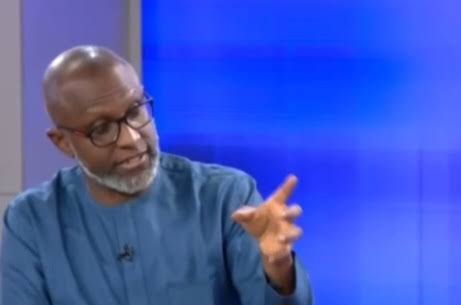
akande
Former presidential aide Laolu Akande has called on the Nigerian government and citizens to fully embrace the support being offered by the United States in addressing the persistent killings and terrorist attacks across the country. Speaking on the My Take segment of Inside Sources on Channels TV on Sunday, Akande argued that the renewed American focus on Nigeria’s security crisis presents an unprecedented opportunity to finally confront the violence that has claimed thousands of lives for decades.
Akande began by recalling the recent designation of Nigeria as a “country of particular concern” by the U.S. government — a move initially made under President Donald Trump. According to him, this designation, now reinforced by renewed congressional scrutiny, places Nigeria’s security challenges at the center of U.S. foreign policy discussions.
“The issue of the designation of Nigeria as a country of particular concern by the U.S. government has been on for quite a while since Mr. Donald Trump made that surprise decision a few weeks ago,” he said.
He noted that on Thursday, the Africa Subcommittee of the U.S. House of Representatives held a special hearing on the killings in Nigeria, taking testimonies from both Nigerians and Americans.
The hearing, he explained, coincided with the visit of a Nigerian delegation led by National Security Adviser Nuhu Ribadu.
“Several times during the hearing on Thursday, there were references to the meetings that Mr. Nuhu Ribadu and his delegation… had with a number of members of the committee,” Akande recounted, emphasizing that U.S. lawmakers—including Subcommittee Chairman Chris Smith—spoke openly about their engagement with the Nigerian team.
For Akande, this heightened American interest should not be viewed with suspicion but rather embraced as a strategic advantage.
“From the look of things, the Americans are very determined to keep a focus on the Nigerian killings and in my view, this is a big advantage for Nigerians who have been suppressed… with the incessant killings that have continued for several decades,” he said.
Akande stressed that President Trump’s actions had inadvertently created a moment Nigeria must not waste.
“Mr. Trump has given Nigeria an opportunity, in my view, to resolve what the Nigerian government has not been able to tackle over the years,” he noted.
By leveraging U.S. intelligence, military assistance, and international attention, Nigeria could finally deliver “a death blow to these merchants of terror… and merchants of violence.”
On the contentious debate over whether the killings constitute a Christian genocide, Akande offered a nuanced perspective.
While acknowledging that both Christians and Muslims are victims, he insisted that deliberate targeting of Christians is real and well documented.
Drawing from his experience as Executive Director of the Christian Association of Nigerian Americans, he said: “I have met several of those Christian victims who narrated how their family relatives were killed basically because they refused to give up on their faith… So I know that there is a direct targeting of Christians.”
He added that events in Plateau and Benue States clearly support this conclusion, though he also affirmed that “non-Christians, Muslims, are also being killed.”
Ultimately, he urged Nigerians to focus on the fundamental truth: “Nigerians are being killed, whether they are Christians or whether they are Muslims.”
Akande argued strongly that with an American president and Congress now prioritizing the issue, Nigeria should not hesitate to accept their help.
“Get the help of the Americans. Get the help of the global community to help us deal with this terrorism,” he said, noting that victims themselves do not care where help comes from.
“If we as a people cannot on our own defeat these matters of death and violence, why can we not accept the help of outsiders who are sufficiently keen to help us?” he asked.
Looking ahead, Akande highlighted another development from the congressional hearing: the creation of a task force dedicated to addressing the crisis. U.S. State Department officials Jonathan Pratt and Jacob McKee disclosed that following the “country of particular concern” designation, new policy initiatives — including the task force — would be launched.
Akande urged Nigeria not to resist but to collaborate fully:
“I think the Nigerian government should embrace the idea of a task force… to determine how we can use the help of the Americans to fight what all of us clearly agree is not acceptable. We have to stop the killings.”
He concluded with a clear, emphatic appeal:
“Let us embrace the offer of the Americans. There are no reasons to continue to deny whether it is Christian genocide or whether other Muslims are also involved… We have the American government… willing to offer us the support. Let us embrace that support.”
With his remarks, Akande positions the U.S. designation not as an indictment, but as a rare window of opportunity — one that Nigeria must seize to finally end decades of bloodshed.