
In whose interest is national interest?
These are definitely not the best of times for Senator Matthew Uroghide the People’s Democratic Party (PDP) Senator representing Edo Central. Last week he was jostled, abused and physically threatened by All Progressives Congress (APC) supporters at the Benin Airport. The Distinguished Senator’s “offence” was that he moved a motion in the Upper Chamber to […]
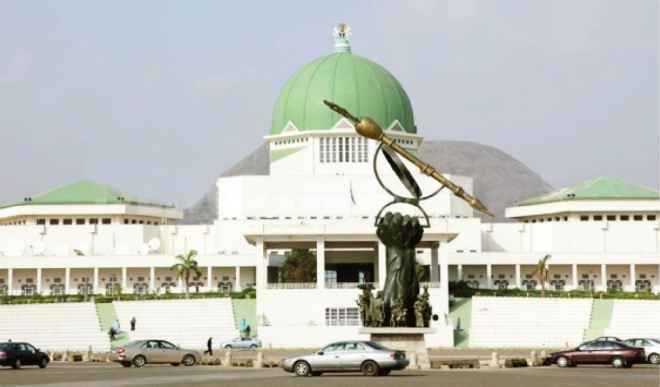
National Assembly
These are definitely not the best of times for Senator Matthew Uroghide the People’s Democratic Party (PDP) Senator representing Edo Central. Last week he was jostled, abused and physically threatened by All Progressives Congress (APC) supporters at the Benin Airport. The Distinguished Senator’s “offence” was that he moved a motion in the Upper Chamber to activate Section 143 of the Nigerian Constitution which deals with the impeachment of the President. His justification is the behind the scenes payment of $496 Million to the United States Government for the procurement of Super Tucano fighter Jets.
In the House of Representatives many lawmakers kicked against the President’s letter requesting approval for the payment for the aircraft, and the request failed to scale the second reading. Speaker Yakubu Dogara referred the matter to the House committee on Rules and Business to establish whether there is any precedence on such an issue. Many lawmakers were of the opinion that the President had already breached the Constitution by spending the money without due process.
The President’s defence is that he gave “anticipatory approval” for the payment in the national interest. This is a lame excuse to say the least. In constitutional democracies “national interest” is not subjective and applied at whim. Institutions, rules and procedures exist in order to both define and protect the national interest. Ignoring and by-passing these institutions and procedures is a matter of expediency not national interest! Expediency arose because the United Arab Emirates, Brazil and the US initially refused to sell military aircraft to Nigeria. President Trump agreed to sell and the government felt they had to pay quickly before he changed his mind consequently unappropriated money was withdrawn from the Excess Crude Account. In order to rectify the anomaly Deputy Senate Leader Bala Na’Allah raised a motion for the inclusion of the $496 Million in the 2018 Appropriation Bill. This was ill-considered bunkum, as it would mean the Nigerian appropriation process boils down to spending money first and then including it in the budget at later!
There is little doubt that the objective of the expenditure is well meaning and was not for any pecuniary interest, but there are many who like Senator Uroghide believe that the President’s action was procedurally wrong and a violation of the Constitution. Those in the Upper chamber defending the President like Senator Abu Ibrahim, claim Uroghide’s impeachment motion is “politically motivated” because never before has spending from the Excess Crude Account been brought before the National Assembly (NASS). Apparently oblivious of the fact that two wrongs don’t make a right, they cite the fact that both Presidents Obasanjo and Jonathan withdrew money from the account without NASS approval. Uroghide is supported by the likes of Senator Samuel Anyanwu who believe that the fact that the money had been spent was a vindication of his motion that something was amiss. There are others like Senator Sheu Sanni who don’t agree with impeachment but feel that the money should be returned.
Meanwhile state governors have thrown their weight behind the President giving him their endorsement after the fact. If there is one fault with the way in which Nigeria is governed it’ the weakness of our institutions. Leader after leader has walked roughshod over our institutions, laws, rules and procedures and committed all sorts of illegalities all in the name of “national interest”. Every military coups; the annulment of the 1993 election, and the infamous “doctrine of necessity” were all committed in the name of “national interest”. The most brazen use of the national interest excuse is the continued detention of both Shiite Leader El Zakzaky, and former NSA Dasuki Sambo despite Court rulings to the contrary.
In Nigeria the so called “national interests” always seems to work against accountability, due process and the rights of the common man. The real problem with Nigerian democracy isn’t the absence of a messiah to put the nation back on the path to success a saviour (which every President to date had considered himself to be) but the failure to abide by rules and regulations. All Nigerian Presidents surround themselves with sycophants who worship their very shadow and are in no position to tell them when they are doing wrong. Former Finance Minister Ngozi Okonjo-Iweala despite all her touted World Bank credentials fraudulently “borrowed” money from the Excess Crude Account through simply because President Jonathan unconstitutionally approved for her to do so! The claim that the $496 Million had to be paid before America changed its mind doesn’t hold water.
Nigeria pretends to copy US style democracy. Under virtually every US President government has had to shut down because the appropriation Bill had not been passed. Earlier this year when it happened under Donald Trump, civil servants stayed at home and the US Government could not authorise any expenditure during that time. Nigeria as a nation would have been respected much more if the US government had been told to wait until the money had been duly appropriated. One can only imagine what they think of “Sh*t hole” countries like Nigeria where unappropriated public money is disbursed upon a whim by one man’s approval.
As for Senator Uroghide and the PDP opposition, impeachment is far-fetched but they have every right to ask the pertinent question as to whether this money is part of the $1 Billion that the President approved for purchase of arms and ammunitions? There is little disputing that somehow the figures just don’t add up. If President Buhari wants to leave a lasting legacy after he leaves office be it after four years or eight years, it will not revolve around anything he was able to achieve by riding roughshod over procedures. Anticipatory approval is not the manner in which democratic governments operate. The leader who will leave a lasting legacy will be the one who eschews expediency and establishes the precedence of institutions, regulations and constitutionality above all else.