
Incidents of building collapse must be tamed
The rising incidences of building collapse have become a disturbing trend. Many structures collapse at the construction stage, while some collapse when fully occupied, resulting in fatalities. Nigerians now die or get maimed from either improperly constructed or ill-maintained buildings which collapse like a pack of cards. The latest is the one that occurred at […]
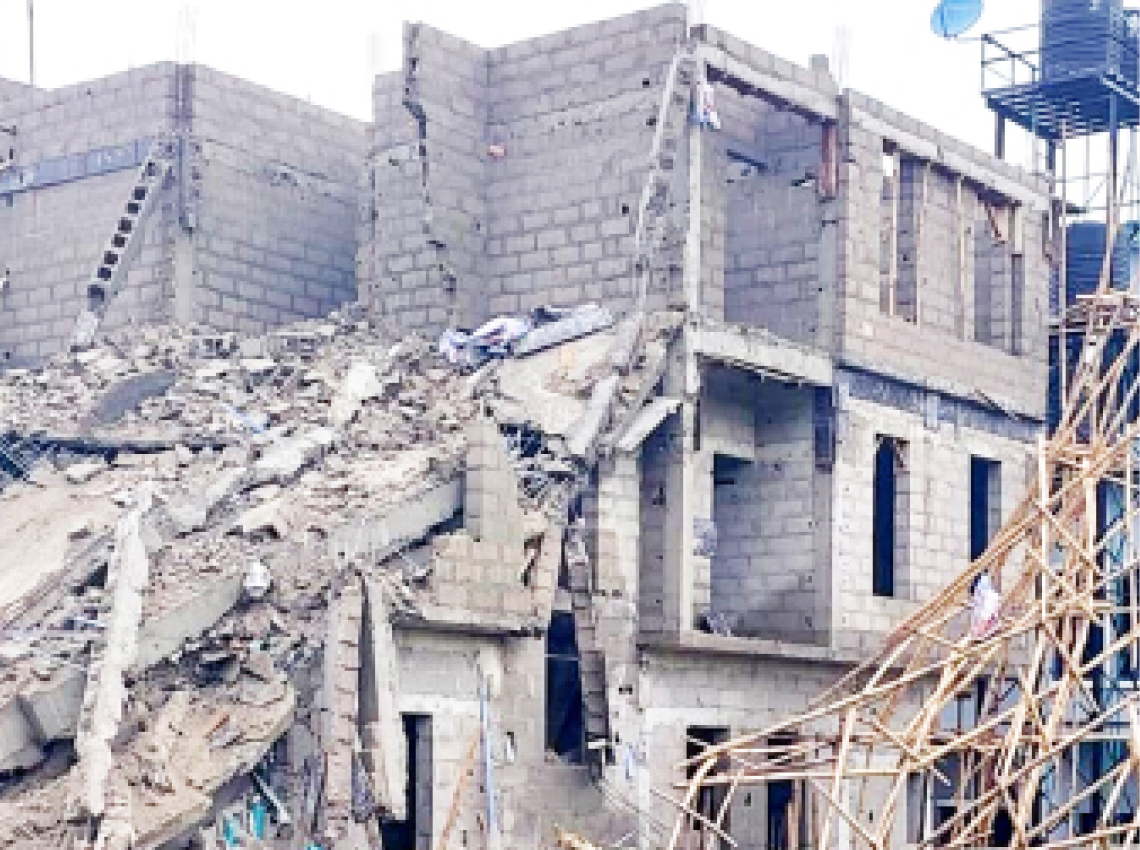
FILE PHOTO
The rising incidences of building collapse have become a disturbing trend. Many structures collapse at the construction stage, while some collapse when fully occupied, resulting in fatalities. Nigerians now die or get maimed from either improperly constructed or ill-maintained buildings which collapse like a pack of cards.
The latest is the one that occurred at 54 Cole Street, Cemetery Bus Stop, Oyingbo in Lagos State, where two persons were confirmed dead and 26 rescued from under the rubble on October 28. On August 4, the nation woke up to yet another sad story that a mother and her five children died when their house collapsed on them in Dankama village of Kaita Local Government Area of Katsina State.
So far, data independently gathered by this newspaper show that about 44 people have died and more than 125 others injured in 29 incidents of building collapse since the beginning of this year, with Lagos State topping the list with 13 incidents, followed by other states across the country. The data further show that from 2023 till date, there have been 127 deaths, while more than 373 were injured in such incidents across Nigeria. In 2023, there were 49 deaths and 201 injuries in 37 incidents; in 2024, there were 83 deaths and 248 injuries; while in 2025, there were 42 deaths and 114 injured.
It is beyond doubt that shoddy workmanship is often behind structural failures. This is often facilitated by officials who compromise their site supervisory duties and property owners who, in their apparent ignorance or selfishness, want to get more for less. Many reports on building collapse have attributed such incidents to the use of substandard materials and the engagement of incompetent or unqualified artisans. Non-compliance with specifications and standards due to weak supervision could also be a factor. Also, lax enforcement of building codes and the endemic poor work ethic in some professions have been cited in many reports on building collapse in the country.
It is this culture of complete disregard for law and order and complacency that makes a Nigerian alter land-use regulations by building, say, a four-storey structure when he or she has been given approval to build a two-storey one. Unfortunately, relevant officials often turn a blind eye to the infraction. This, of course, brings upon us the tragedies we have been mourning for a long time now. Surely, a stop has to be put to this particular case of negligence, which has made it possible for just about anybody to put up any structure that is nothing more than a death trap for many innocent Nigerians.
The Minister of Housing and Urban Development, Ahmed Dangiwa, described the frequent incidents of collapsed buildings as a national embarrassment. According to him, the government could no longer afford to allow the crisis to continue unchecked. To avoid further loss of lives due to building collapse, he inaugurated a 14-man task team to address the growing crisis of building collapses nationwide on June 18 this year.
The committee is made up of representatives of the Architects Registration Council of Nigeria; Council for the Regulation of Engineering in Nigeria; Quantity Surveyors Registration Board of Nigeria; Town Planners Registration Council of Nigeria; and Surveyors Council of Nigeria. Others are the Estate Surveyors and Valuers Registration Board of Nigeria, Council of Registered Builders of Nigeria, and the Building Collapse Prevention Guild.
Daily Trust hopes that the recommendations of the expanded committee will be fully implemented to avoid further loss of lives.
At the national level, the government should ensure inspections at ongoing projects are professionally done. The procedure that allows only the architect and the surveyor to sign the appropriate documents to attest to the integrity of structures should be strengthened. Often, people submit plans to build a one-storey structure but illegally add more floors during actual construction. Effective supervision should eliminate this practice that puts lives at risk. Many architects act as building contractors when that duty properly belongs to structural engineers and building technologists. Before any development takes place on a parcel of land, soil tests and topographical surveys should be carried out to determine the suitability of the structure for the site; but this is seldom done.
Government should also license building contractors who must have a recognised qualification, as well as enforce an easily understandable building code. If the relevant insurance firms did their work properly, ensuring that every building adheres to the minimum standards, the spate of building collapses would be minimized, if not eliminated entirely.
But overall, we believe that this tragedy can only be averted when those responsible for such tragedies are fully brought to book. We should not spare any official or selfish property owner who continues to cause avoidable deaths in the country.