
INEC, EFCC differ on Reps’ move to establish electoral offences commission
We can’t arrest, prosecute offenders — INEC chair Functions performed by existing agencies — EFCC The Independent National Electoral Commission (INEC) and the Economic and Financial Crimes Commission (INEC), yesterday, differed on the quest by the House of Representatives for a National Electoral Offences Commission (NEOC) to investigate and prosecute electoral offenders. While INEC queued […]
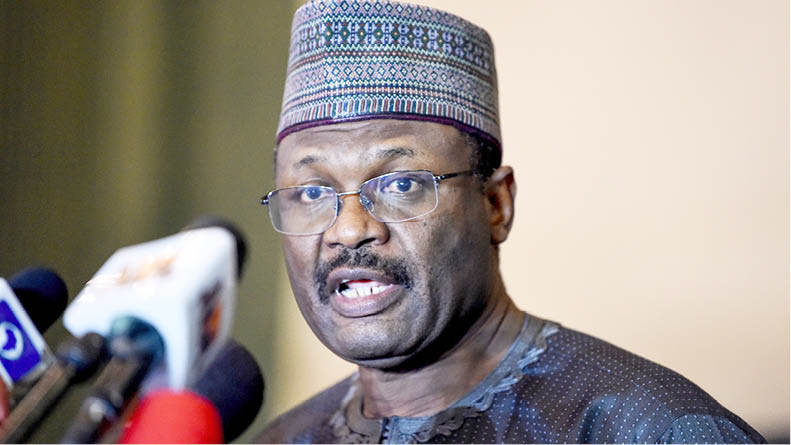
INEC Chairman, INEC Chairman, Prof. Mahmood Yakubu
- We can’t arrest, prosecute offenders — INEC chair
- Functions performed by existing agencies — EFCC
The Independent National Electoral Commission (INEC) and the Economic and Financial Crimes Commission (INEC), yesterday, differed on the quest by the House of Representatives for a National Electoral Offences Commission (NEOC) to investigate and prosecute electoral offenders.
While INEC queued behind the parliament to establish the body, the anti-corruption body has kicked against it, saying the functions of the proposed agency are performed by existing institutions.
The House of Representatives yesterday organised a one-day public hearing on a bill to establish the electoral offences commission.
Speaking at the public hearing, the Chairman of INEC, Professor Mahmood Yakubu, stressed the need for the establishment of the commission.
“It is clear that the reform of our electoral process cannot be completed without effective sanctions against violators of our laws. At present, INEC is saddled with the responsibility of prosecuting electoral offenders under the Electoral Act.
“This has been very challenging for the commission. For instance, since the 2015 general elections, 125 cases of electoral offences have been filed in various courts, of which 60 convictions have been secured so far, including the most recent one in Akwa Ibom State,” he said.
He said the bill is a critical legislation and has been part of all national conversations on constitutional and electoral reforms for the last 13 years.
According to him, the Justice Mohammed Uwais Committee on Electoral Reforms recommended the establishment of the commission in 2009, which he said was re-echoed by the Sheikh Ahmed Lemu Committee following the post-election violence of 2011 and recently, by the Senator Ken Nnamani Committee on Constitutional and Electoral Reform in 2017.
“Similar recommendations are contained in reports of police investigations, INEC administrative enquiries, court judgments, reports by the National Human Rights Commission, as well as several accredited election observers,” he said.
However, in its presentation, the EFCC opposed the establishment of the commission.
The EFCC’s position, which was conveyed by an assistant commander of the agency, Deborah Ademu-Eteh, said there was no need for the creation of an agency solely for the purpose of investigating and prosecuting electoral offences when the electoral process is seasonal as elections are held once in four years in the country.
According to EFCC, a holistic review of the contents of the proposed bill showed that the offences contained in part (iv) (sections 13-32) largely constituted offences that have already been criminalised by extant laws such as the Electoral Act, 2022 (see sections 114-129); the penal and criminal codes, the Independent Corrupt Practices and other related offences Act, 2000; and the Economic and Financial Crimes (Establishment) Act, 2004.
“It is our suggestion that the existing law enforcement agencies should be strengthened to achieve maximum output instead of creating a new agency of investigation and prosecution of electoral offences,” the agency stated.
On his part, the Speaker, House of Representatives, Femi Gbajabiamila, who was represented by his deputy, Ahmed Idris Wase, said the public hearing would bring forth new ideas for the establishment of the commission and, by extension, provide the means for free, fair and credible elections in the country.
“In truth, electoral crimes lead to low quality, corrupt and violent political leadership. Election riggers and offenders take control of governments against the democratic will of the electorate. Electoral offences are self-inflicted injuries to be avoided at all cost,” he said.
Similarly, the Chairman, Senate Committee on Electoral Matters, Senator Kabiru Ibrahim Gaya (APC Kano), stressed the need for the establishment of the commission to investigate and prosecute offenders.
In a submission, CLEEN Foundation supported the establishment of the commission, saying it would facilitate the prosecution of electoral offences committed on or before elections.
YIAGA Africa, represented by Yetunde Bakare, also supported the establishment of the commission, while calling for some amendments to certain provisions of the bill.
The bill proposes 20 years’ imprisonment or N40 million fine for an electoral offender.