
Insecurity: Minister, National Assembly differ
The Minister of Defence, Abubakar Badaru said yesterday that a security strategy will serve the country more than the proposed summit by the Senate. He also differed with the House of Representatives on their claim that the insurgents had more sophisticated weapons than the military. The Senate had, at the resumption of plenary on Tuesday, […]
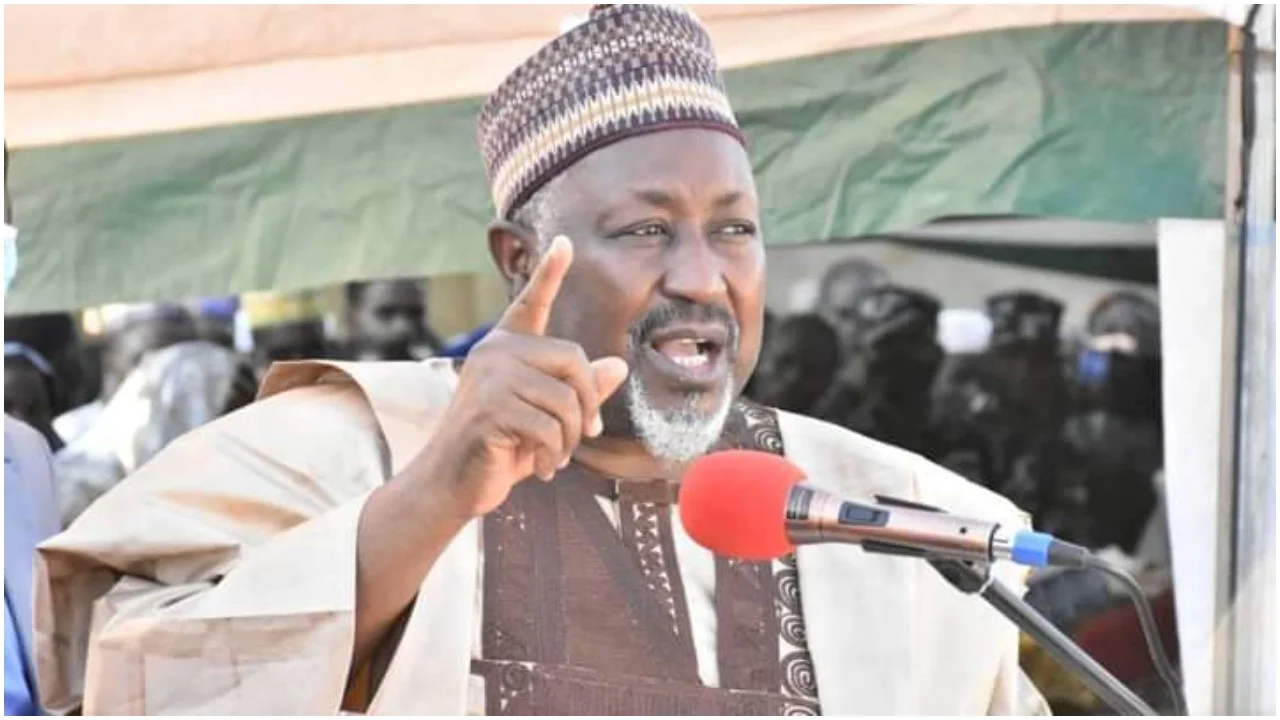
FILE PHOTO: Minister of Defence, Mohammed Badaru
The Minister of Defence, Abubakar Badaru said yesterday that a security strategy will serve the country more than the proposed summit by the Senate. He also differed with the House of Representatives on their claim that the insurgents had more sophisticated weapons than the military.
The Senate had, at the resumption of plenary on Tuesday, proposed a two-day national security summit to address the situation.
But the Minister of Defence, Abubakar Badaru, during the ministerial press briefing in Abuja yesterday, said a well-thought out security strategy is more important.
The minister also countered the Tuesday’s claim by the House of Representatives that terrorists possessed superior weaponry.
Amidst the development, two soldiers and three Boko Haram terrorists died yesterday in a gun duel at Izge community of Gwoza Local Government Area of Borno State.
The Senate had, after adopting a motion by Senator Jimoh Ibrahim (APC, Ondo-South), stated that none of the geopolitical zones could be said to be completely safe.
It also said its proposed security summit would draw participants from different stakeholders, including heads of security agencies and state governors.
Fielding questions from journalists during the inter-ministerial briefing organised by the Ministry of Information and National Orientation, the Minister of Defence, Abubakar Badaru, said, “On the summit, yes, strategy is far more important than summit, but the summit will give you some inputs for the strategy.
“When you hold a summit, you have people, they talk, we take what they expect and we go back to design or renew our strategy, and then the Chief of Defence staff gives operational orders based on the strategy they must have developed.
“So, what the National Assembly is trying to do, maybe, is to bring people together to discuss issues. You hear a lot.
“I visited most of the past defence ministers. I visited most of the past service chiefs to discuss issues of security during their time and what we see today and how we do it. And I’m sure the service chiefs also do the same. So, the summit can help, but the strategy is much more important.”
Badaru while reacting to the concerns raised by the lawmakers over a recent explosion on a military facility in Giwa Barracks, Borno State, said, “Yesterday (Tuesday), the House of Representatives said that the terrorists have better weapons than us. That is absolutely not true. We have much more sophisticated weapons and we have much more sophisticated drones.
“The issue is, this war is not a conventional war. It’s like a guerrilla war. They watch us, they have informants around us. They help the people that we try to protect. And they give them information. And they jump at us the way we don’t expect.
“So, they don’t have more equipment than us. We have much more. We have much more sophisticated equipment. And that is one of the sources that I just mentioned,” the minister said.
Badaru also addressed concerns about the use of drones by terrorists, clarifying that so far, they had only deployed civilian-grade drones improvised with explosives.
“They are not using armed drones with strategic guidance. We are doubling our intelligence efforts, both locally and internationally, to track and cut off supply sources,” he stated.
COAS ‘relocates’ to Borno
Meanwhile, the Chief of Army Staff, Olufemi Oluyede, a Lieutenant-General, is said to have relocated to Borno to boost the morale of the frontline troops in the fight against terrorism.
A source at the army headquarters told Daily Trust yesterday that “We don’t know when he (the army chief) will be back to Abuja. He is currently carrying out the assignments given to him by the Commander-in-Chief to weed out the marauding terrorists,” the official, who did not want his name mentioned, said.
Confirming the ‘relocation’, army authority, in its official X page (formerly Twitter), said Oluyede was overseeing the operations of all the troops attached to the Operation Hadin Kai.
The post read, “Chief of Army Staff, Lieutenant General OO Oluyede currently in the North-east overseeing Army operations in Operation HADIN KAI.”
‘Troops killed 13,541 terrorists; 17,469 criminals in 21 months’
Earlier in his presentation during the briefing, Badaru said the troops eliminated 13,541 terrorists and apprehended 17,469 criminals across the country between May 2023 and February 2025.
He said that the troops also rescued 9,821 kidnapped hostages; while a total of 124, 408 Boko Haram/ISWAP terrorists surrendered within the period.
He said the period under review saw the killing and capture of numerous terrorists and rescue of several hostages and the recovery of large catch-of-arms and ammunition.
“Troops have also restored peace to hundreds of communities and thousands of our people have been brought to their ancestral homes.
“For instance, from May 2023 to February 2025, our troops have neutralised 13, 543 terrorists and criminals. We have arrested 17,469 and rescued 9,821 hostages.
“Meanwhile, 124, 408 Boko Haram/ISWAP terrorist combatants, fighters and their families also surrendered within the period.
“The summary of our operational success induced by the renewed synergy include the recovery of 11,118 weapons and 252,596 assorted ammunition.
“As attested by the president during the July 64th independence, in the independence broadcast, he said over 300 terrorist commanders have been eliminated.”
The minister said security had improved significantly in many communities that had been ravaged by insecurity in the North-east and North-west with many displaced persons returning to their ancestral homes.
“This shows the slow but steady return of peace through our kinetic and non-kinetic efforts. Our non-kinetic efforts include operations at Borno and the North-east, which is sustained by the ministry.
“This programme which has received commendations and visits by foreign non-kinetic think-tanks has been very effective,” he said.
He said improvement had been recorded along the Kaduna-Abuja highway and other roads like Kaduna-Birnin-Gwari, Funtua-Gusau-Sokoto and Gusau-Kaura-Namoda-Zuru-Jibia.
“Similarly, the markets in the areas such as Niwa, Birnin-Gwari, Kasuandaji and Jibia are now booming with businesses as attested by many traditional leaders, political leaders,” he said.
The minister also gave updates on domestic defence production efforts, disclosing that 10 out of 53 companies involved in the Defence Industrial Complex had begun production of drones, aircraft parts, helmets and other military equipment locally.
He said the government hoped to have at least 20 of those companies in full production by year’s end, with plans to begin exporting by next year.
The minister stated: “We are working to see if we can sustain a section in Ajaokuta that will support our efforts to make DICON more vibrant.
“Currently, with the support of the president, the governor, and the Chief of Defence Staff, DICON— as many of you know — is hosting 53 companies. Most of them are at various stages of constructing their factories.
“About 10 of these companies have already commenced production, including the manufacturing of drones, aircraft components, personal computers, helmets, safety vests, and other equipment.
“So far, 10 have begun production, and we are targeting at least 20 companies to be operational by the end of the year. By next year, we aim to begin export”.
‘We’re bringing mechanism to end insurgency’
Speaking when he paid a courtesy call on the Yobe State governor, Mai Mala Buni, at the Government House, Damaturu, the army chief assured Nigerians that the high military command and its operatives would soon end Boko Haram attacks in the North-east region.
He said the Nigerian Army would bring in more enablers, mechanisms and troops to bring peace and end the prolonged insurgents’ attacks in the region.
The army chief, who worked for more than two years as brigade commander and sector commander in Yobe State, said he was going to do everything possible to ensure that peace is restored in the region.
“I was there for more than two years as a brigade commander, as well as sector commander. So, I am very familiar with Yobe State, and I’m part of the Yobe and North-east region.
“I’m here today, particularly, just to assure the people of Yobe State that despite a few setbacks that we’ve had things are going to improve. We’re bringing in more enablers and bringing in more troops.
“I can assure you that we will not go back to the years like 2015, because it would be out of place for me to have worked so hard there to bring peace, and now that I’m the chief of army staff, to see that peace is being eroded.
“So we are going to do everything possible to make things better. So, Yobe people should be rest assured that things will improve and they shouldn’t have any need to fear,
“As Nigerians, we need to come together more than ever before to see that we checkmate all this myriad of insecurity. Because if we don’t, at some point we will not have a country to live in.
“It’s essential we do that now because if you look at what is happening in the Sahel region, the region is on fire and if we allow that fire to come down this way, then we’ll be in trouble”, he said.
Responding, Governor Buni called for an enhanced synergy between the Nigerian Army and Air Force in the fight against terrorism and other crimes in the country.
Buni said the government and people of Yobe State would continue to support the army and all other security agencies to succeed in the war against terrorism.
“The issue of security is a collective responsibility, we will do everything possible to ensure the success of the fight against insecurity,” Buni said.
NSA seeks mechanism to prevent usage of IEDs by terrorists
Meanwhile, the National Security Adviser, Nuhu Ribadu, has called for development of effective mechanisms to enhance the ability of the states to prevent and counter the use of Improvised Explosive Devices (IEDs) by terrorist groups in West Africa.
Ribadu also said the threat of terrorism knows no bound, and that it was through collaborative efforts by critical stakeholders that they could effectively confront and defeat the menace.
The NSA, who spoke during the opening of the stakeholders meeting on Consolidating Collaborative Efforts to Prevent and Counter the Acquisition and Use of IED by Terrorist Group in West Africa, was represented by Mohammed Sanusi, Permanent Secretary, Special Services, Office of the National Security Adviser (ONSA), at the event organised by the Global Counter-Terrorism Forum (GCTF).
He stated: “This regional meeting serves as a platform for us to share knowledge, best practice and experiences in addressing the threats of IEDs by bringing together representatives from ministries, departments, and agencies in Nigeria, as well as experts from the West Africa region, member states, and other relevant stakeholders.
“We aim to develop effective mechanisms to enhance our ability to prevent and counter the use of IEDs. The recommendations that will emerge from this meeting are vital in sharing and shaping our strategies and initiating to safeguard our communities from IEDs,” he said.
The Ambassador of Algeria to Nigeria, Hocine Mezoued, said African countries must be able to take adequate measures to make the fight against terrorism effective.
These measures, he said concerned not only the prevention and dismantling of IEDs, but also proactive and preventive actions that aimed to deconstruct them and seek a provision to promote coordination and cooperation and adapt to new threats driven by technological progress.
According to him, the use of these explosive devices remains one of the most potent tools used to carry out terrorist attacks in the interior, against the states of West Africa and the countries of the Sahel region.
He called for an integrated approach by combining security measures and initiatives to prevent use of IEDs, and consolidating the sustainable development approach.
Mezoued added: “It is also worth recalling, on a broader point, the debate at the United Nations Security Council on the fight against terrorism in Africa.
“It served as an opportunity to raise awareness of the alarming rise of terrorism in Africa and to reaffirm the urgent need to live it in the global interest and to revive international momentum to address this crisis that now threatens security and development on our continent at this time.
“The efforts of our group to strengthen West African capacities take into account local and regional realities and require the reaffirmed commitment of the international community and its determination to combat the use of improvised explosive devices.”
Expert suggests solutions
In an interview with Daily Trust last night, an intelligence expert, Abdullahi Garba, noted that both the executive and legislative arms of the government can sit on a roundtable and take a position.
“I don’t think there is any need for hullabaloo on this. Both the executive and the lawmakers can sit together and have a dialogue whether they would hold the summit or not,” he said.
According to him, what Nigeria needs is not a summit but a strategic mechanism that would enhance security of the borders and the internal security.
Garba said, “When our porous borders are secured, we can easily tackle the internal crimes in different zones. Like I told you last time, if we don’t secure our borders, we will be dancing on the same spot.
“So, it is important we first secure our borders, while police strengthen their intelligence in order to fight crimes internally, there is no need for any talk again.”