
INSECURITY: Reps ask security agencies to do more
The House of Representatives yesterday called on the Chief of Defence Staff, Gen. Christopher Musa, the Inspector-General of Police, Kayode Egbetokun and heads of other security agencies to step up efforts to safeguard lives and property in the face of worsening insecurity across the country. This resolution followed two motions of urgent public importance moved […]
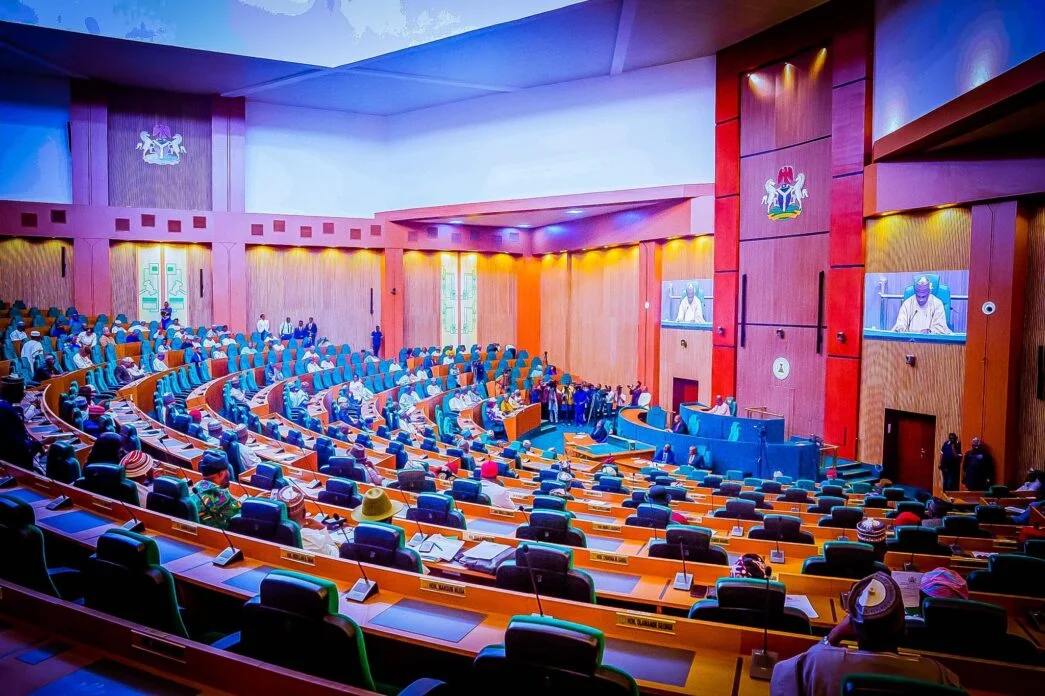
house of reps
The House of Representatives yesterday called on the Chief of Defence Staff, Gen. Christopher Musa, the Inspector-General of Police, Kayode Egbetokun and heads of other security agencies to step up efforts to safeguard lives and property in the face of worsening insecurity across the country.
This resolution followed two motions of urgent public importance moved by Reps. Zakaria Nyampa (Adamawa) and Sulaiman Gumi (Zamfara), who raised alarm over recurring attacks in their constituencies by terrorists and armed gangs.
Rising under matters of urgent public importance, Rep. Nyampa told lawmakers that communities in his Madagali/Michika Federal Constituency had come under repeated attacks, with the latest assault on Tuesday leaving at least five dead and several others abducted in Dar and Pambla communities of Adamawa State.
He said the victims who are mostly rural farmers had been displaced from their homes and farmlands, undermining national food security and worsening humanitarian conditions in the area.
- Coalition members move to exit old parties
- Makkah Grand Mosque Friday sermon to be translated into 35 languages today
Nyampa said the attacks had persisted due to the absence of sustained security presence, which had emboldened the perpetrators to act with impunity. “Just yesterday, these two communities were attacked again. The silence and slow response by security agencies is deeply troubling,” he said.
The lawmaker called for the urgent establishment of a military base in Madagali and the designation of affected areas as security priority zones.
He also urged the National Emergency Management Agency (NEMA) to immediately provide relief and support to displaced families.
Similarly, Rep. Gumi of Zamfara said his constituents in Gummi/Bukkuyum Federal Constituency were being forced from their homes due to incessant bandits’ attacks. He called on federal authorities to intervene and prevent further loss of lives and property.
Speaker Tajudeen Abbas referred the motions to the House Committees on Army, Police Affairs, and National Emergency and Disaster Management for further legislative action.
In a related development, Rep. Princess Chinwe Clara Nnabuife (Anambra) has called on the Inspector-General of Police to immediately investigate the killing of 10 Ebonyi indigenes in Ogboji, Orumba South LGA of Anambra State.
Speaking at the National Assembly Press Centre in Abuja, Nnabuife condemned the killings, describing it as senseless and avoidable. She blamed the violence on an internal leadership crisis within the Ebonyi Union in the community.
“This is not an ethnic or communal conflict,” she said. “It is a tragic outcome of an internal dispute among members of the same ethnic group,” she said.
Nnabuife called on security agencies to apprehend the culprits and ensure they were brought to justice.
Military kills notorious terrorists, arrests 1,191
Meanwhile, the Defence Headquarters (DHQ) has announced the killing of several high-profile terrorists and the arrest of 1,191 others across the country between April and June 2025.
Director of Defence Media Operations, Maj.-Gen. Markus Kangye, disclosed this during a quarterly media briefing in Abuja. He said troops under various operations—Hadin Kai, Safe Haven, UDO KA, Fasin Yamma and Delta Safe—recorded significant gains.
Among those neutralised were terrorist kingpins such as Amir Abu Fatimah, Abdul Jamilu, Mallam Jidda, Maiwada, and Onowu. Kangye also confirmed that Yellow Danbokkolo, another notorious bandit leader, died from injuries sustained in a previous encounter.
The DHQ also listed the arrest of several wanted gunrunners and kidnappers, including Buhari Umar, Hassan Mohammed, and Saleh Sani. “Our troops also rescued 543 kidnapped victims,” Kangye said.
He added that 682 terrorists and their families surrendered during the period under review, while the military foiled oil theft worth over N3.5 billion under Operation Delta Safe.
Recovered items included over 2 million litres of stolen crude oil, 605,393 litres of illegally refined diesel (AGO), 41,465 litres of kerosene, and 26,905 litres of petrol.
“We reaffirm our commitment to ending all threats to national security. Troops across theatres remain resolute,” Kangye assured.
Anti-aircraft ammunition recovered in Niger
Separately, the Niger State Police Command said it recovered 50 rounds of anti-aircraft live ammunition abandoned by bandits following a joint military-police bombardment in Biyemu Forest.
Command spokesman, SP Wasiu Abiodun, said the operation followed reports of bandit attacks in Watari village, near Rijau. He confirmed that several casualties were inflicted on the criminals during the operation.
“The police received a report on June 25, at about 9am that suspected bandits attacked Watari village via Rijau and its environs.
“Operatives carried out a bombardment from Sulupawa village via Rijau to Kumbashi and Kakihum areas of Mariga.
“During the operation, the hoodlums recorded heavy casualties,” the police said.
During a follow-up assessment of the operation, he said the police operatives of Rijau Division, recovered 50 rounds of anti-aircraft live ammunition abandoned by bandits at Biyemu forest on June 28, as a result of the bombardment.”
He said that security assessment and investigation was ongoing with a view to fortify the area against reoccurrence, while tactical teams were still being maintained at strategic locations for security coverage.
Recent attacks and killings
Across northern Nigeria and other parts of the country, violence continues to escalate. In Benue State, over 100 people were killed recently in Yelwata community alone. On May 10, armed herders attacked Tse-Abwa and Tse-Gbuusu in Gwer West LGA, killing eight in a late-night raid, among several other incidents.
In Plateau State, at least 25 people were killed on May 19 in coordinated attacks on communities in Mangu LGA.
Other affected states such as Borno, Zamfara, Sokoto, Yobe, and Niger have also seen a spike in attacks in recent weeks, with both civilians and soldiers falling victim to ambushes and raids by insurgents and bandits.
Reacting to the worsening security situation, a retired Assistant Inspector-General of Police, Wilson Inalegwu, has called for a return to community-based policing and stronger public engagement by the security agencies to stem the tide of insecurity.
Speaking to Daily Trust, Inalegwu said no security architecture can succeed without public involvement and trust. “Security can’t be achieved by force alone. You need an informed and engaged public to support early warning and response efforts,” he said.
He urged security agencies to invest in sensitisation and build systems that allow civilians to report unusual activities promptly. “The public must be situationally aware. Every crisis starts from a place—when people notice strange things, they should have the channels and trust to report,” he added.
He also advocated cross-border cooperation between state governors, especially in conflict-prone areas. “Governors of Benue, Nasarawa, Kogi, Plateau and Taraba must come together. These attacks don’t respect state boundaries.”
Inalegwu emphasised the need to revitalise divisional police stations, which he said were neglected. “Today, some of our best officers are attached to VIPs instead of manning stations. That weakens our response structure,” he said.
He called for better police training facilities, mandatory CCTV installation in business premises, and legislation that mandates private sector support for surveillance efforts.
“Security must be seen as a shared responsibility between the state and the people,” he said.
Meanwhile, in an interview with one of our correspondents last night, a retired director from the Department of State Services (DSS), Mike Ejiofor, attributed attacks in most of the rural areas to poor communications networks in those areas, particularly in remote areas.
Ejiofor, who is also the President, Alumni Association of the National Institute for Security Studies (AANISS), explained that the criminals operate freely and carry out their attacks unhindered because the victims could hardly mobilise by informing others due to poor communications.
He, however, said people need to be involved in security matters in their respective domains in order to solve the insecurity challenges, adding that creating military formations can only help reduce the menace.
“Yes, setting up military formations can only help to reduce the challenges, but we can’t solve all the problems militarily. People need to get involved in order to ensure that the problem is solved,” the former intelligence officer told Daily Trust.