
Is Governor Ganduje guilty as charged?
Several videos which purportedly show Governor Abdullahi Ganduje of Kano State receiving American dollars alleged to be kick-backs from contracts have arguably put him on the spot like nothing else since he assumed office – if not in his entire life. The Governor has categorically denied the allegations and has reportedly instructed his Attorney – […]
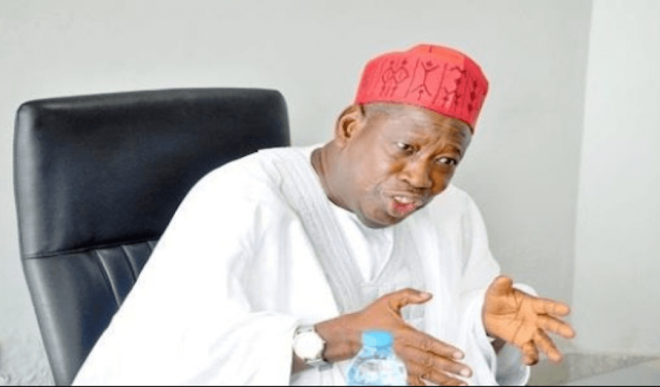
Gov Abdullahi Ganduje of Kano
Several videos which purportedly show Governor Abdullahi Ganduje of Kano State receiving American dollars alleged to be kick-backs from contracts have arguably put him on the spot like nothing else since he assumed office – if not in his entire life. The Governor has categorically denied the allegations and has reportedly instructed his Attorney – General to institute proceedings for criminal defamation and malicious falsehood against the online publication which broke the ‘story’. The State House of Assembly has also waded in by setting up a Committee to investigate the videos.
Regardless of the veracity or otherwise of the allegations, I believe that it is worthwhile to examine the status of the law on the issue, particularly the legal framework for investigating allegations of graft against public officers generally, and State Governors in particular.
The Allegations
The videos appear to show the Governor receiving cash, alleged to be gratification for purportedly using his position to award or influence the award of a contract or contracts to a faceless/anonymous contractor. This is a serious criminal allegation. However, like everyone else, His Excellency is presumed innocent until proven guilty. Suffice it to say that, if the allegations are true, they constitute gross official misconduct, for which the Governor may not only be impeached, but can be prosecuted (after leaving office) for violating the Code of Conduct for Public Officers under the Constitution as well as relevant provisions of the Independent Practices and Other Related Offences Commission (“the ICPC”) Act.
The Kano State Legislature reportedly launched its inquiry pursuant to its “mandate to investigate any matter of public concern” with the aim of “ensuring peace and harmony in the State”. As lofty as this motivation might sound, however, it doesn’t appear to justify the probe, having regard to relevant constitutional provisions which confer oversight powers on the House.
To my mind, the question is, whether in initiating the probe, the House overreached itself, having regard to those constitutional provisions. I believe that an analysis of relevant provisions of the 1999 Constitution and the ICPC Act would suggest that the House acted rather hastily in initiating the probe. This necessarily calls for an in-depth look at relevant provisions of both statutes. Are they complementary or are they mutually-exclusive? This all-important question, in my view, will determine the validity of the probe launched by the House.
The ICPC Act
By virtue of Sections 8, 10 and 17 of this Act, it is an offence punishable with 5 or 7 years imprisonment (in the former case, with hard labour), for a public officer, inter alia: “to receive any property of any kind for himself or any other person, on account of anything already done or omitted to be done or for any favour already shown to any person by himself in the discharge of his official duties or in relation to any matter connected with the functions, affairs or business of a Government department, public body or other organization or institution in which the public officer is serving as such”.
Section 52 of the Act empowers the Chief Justice of Nigeria to appoint an independent counsel to investigate allegations such as those against Governor Ganduje and report “his findings to the State House of Assembly”.
Code of Conduct for Public Officers
Paragraph 6(1) of the Code of Conduct for Public Officers contained in Part I of the 5th Schedule of the 1999 Constitution, prohibits a public officer from asking for or accepting “property of any kind for himself or any other person on account of anything done or omitted to be done by him in the discharge of his duties”. Paragraph 6(2) drives home the point by providing that “the receipt by a public officer of any gifts or benefits from commercial firms, business enterprises or persons who have contracts with the government shall be presumed to have been received in contravention of sub-paragraph 1 unless the contrary is proved”.
Paragraph 12 provides that an allegation that a public officer has committed a breach of, or has not complied with the provisions of the Code shall be made to the Code of Conduct Bureau established under Section 153(1) of the Constitution. There is no question that as a State Governor, Mal. Ganduje is subject to the Code of Conduct. See Section 209 and Paragraph 4 of Part II of the Fifth Schedule to the Constitution.
Oversight Powers of State Houses of Assembly
Section 128 of the 1999 Constitution gives the Assembly wide powers to, inter alia, direct an investigation into the conduct of any person charged with the duty of or responsibility for disbursing or administering moneys appropriated or to be appropriated by the House. Such powers are, however, to be exercised strictly for the purpose of enabling the House to make or correct laws or to expose corruption in the disbursement or administration of funds appropriated by it. See Section 128(2) of the Constitution and DIEZIANI ALLISON-MADUEKE vs HOUSE OF REPRESENTATIVES (2014).
Are these provisions Co-extensive?
It can be seen that the constitutional provisions which empower State Houses of Assembly to exercise oversight powers over public officers – such as Governor Ganduje – are couched in general terms. By contrast, the Code of Conduct for Public Officers under the Third and Fifth Schedules to the Constitution and the ICPC Act make copious provisions which ban specific behaviour by public officers, including demanding and receiving gratification, bribes and kick-backs for government contracts. The Code establishes special structures (Code of Conduct Bureau and the Code of Conduct Tribunal) which are charged with investigating such allegations and imposing sanctions in established cases. See Paragraphs 15 and 18.
While Governors admittedly enjoy immunity from prosecution (by virtue of Section 308(1) and (3) of the Constitution), they can however be investigated by relevant law enforcement agencies, such as the ICPC and the Code of Conduct Bureau as aforesaid. To that extent, I humbly submit that the Code of Conduct provisions of the Constitution, as well as Sections 8, 10 & 17 of the ICPC Act, are applicable to the allegations levelled against Governor Ganduje in the videos.
This is because special constitutional/statutory provisions derogate from general ones. See INDEPENDENT TELEVISON AND RADIO vs. EDO STATE BOARD OF INTERNAL REVENUE (2014) All FWLR pt. 759 pg. 1144 @ 1167G; ATT-GEN OF THE FEDERATION vs. ATIKU ABUBAKAR (2007) All FWLR pt. 375 pg. 405 @ 524. In other words, where a specific allegation against a Governor amounts to a misconduct under the Code of Conduct for Public Officers, only the Code of Conduct Bureau is competent to investigate it. This obviously rules out the probe purportedly launched by the Kano State House of Assembly into the videos.
Conclusion
Given the overwhelming majority enjoyed by Governor Ganduje’s party in the State House of Assembly, the probe launched by the House into the videos must be seen to be transparent and credible. Anything less risks being perceived as a white-wash. This is all the more reason, in my view, why the independent counsel-driven investigation provided for under Section 52 of the ICPC Act, referred to above, is to be preferred. After all, the outcome of such an investigation will still be subject to ratification by the House.
As for the authors and publishers of the videos, they should either stand by them (i.e. justify them) or face the consequences. To achieve the former, their witnesses (if any) will have to give up the toga of anonymity conferred by the videos. If and when the matter eventually makes its way to court, the video’s authors and/or publishers (and the State Attorney-General?) will have to contend with the provisions of Section 84 of the Evidence Act which prescribe the modalities for tendering electronic evidence, such as the videos in question. Either way, the saga is a cautionary tale to all media practitioners (especially so-called bloggers) and public office-holders alike. The former, in particular, should be ever-so-conscious that free speech is not a license to defame others.
Sani, Esq., wrote this piece from Kano.