
Kano gov accuses police of partisanship over Independence Day parade withdrawal
Governor Abba Kabir Yusuf of Kano State has accused the Commissioner of Police in the state, Ibrahim Adamu Bakori, of partisanship following the withdrawal of police personnel from the Independence Day anniversary parade held in Kano. Speaking during the event on Wednesday, the governor described the action as an affront to the people of Kano […]
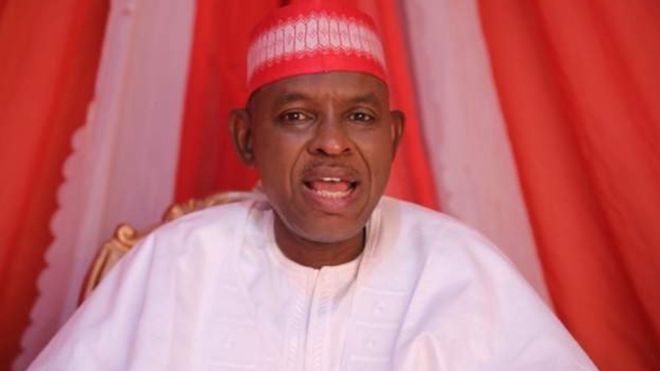
Abba Kabir-Yusuf
Governor Abba Kabir Yusuf of Kano State has accused the Commissioner of Police in the state, Ibrahim Adamu Bakori, of partisanship following the withdrawal of police personnel from the Independence Day anniversary parade held in Kano.
Speaking during the event on Wednesday, the governor described the action as an affront to the people of Kano and an insult to the spirit of national unity.
“Security agencies, particularly in Kano, should not involve themselves in partisan politics, which will do no good to the people of Kano State or Nigeria as a whole.
“I wish to use this opportunity as a Nigerian, as a Kano citizen, and as the Chief Security Officer of Kano State, to condemn the unethical and partisan attitude of the current Commissioner of Police in Kano State,” the governor said.
He noted that the commissioner’s absence, along with his personnel, was a deliberate act that embarrassed the state on a day of historic significance.
“As you can see, on this historic day—the independence anniversary of Nigeria—he decided to pull out of the parade with his personnel.
“This is for reasons best known to him and his associates. As the Chief Security Officer of Kano State, on behalf of the government, I must say we are not happy with this attitude of the Commissioner of Police,” he said.
Governor Yusuf stressed that Kano remains a peaceful state and that residents had anticipated celebrating Nigeria’s independence together.
“The good people of Kano are peace-loving. They have been looking forward to this day, when we could all gather to celebrate our country’s independence.
“Yet one of the most important security agencies, represented by its chief in Kano, chose to stay away. This is a message to the people of Kano,” he added.
The governor alleged that the withdrawal was politically motivated and contrary to the Nigerian Constitution, which designates him as the Chief Security Officer of the state.
Describing the commissioner’s conduct as “unethical,” he continued: “You can see I had to use my own pilot car to go around. This is unethical. This is disloyalty to the Federal Republic of Nigeria.”
When contacted, the Commissioner of Police said briefly, “I am on a condolence visit, I will call you back later.” He was yet to do so as at press time.
Our correspondent observed that while other security agencies, including the military, attended the parade, police operatives were absent from the venue.
However, police officers were sighted in strategic parts of the Kano metropolis earlier in the day.
‘Absence reflects struggle over police neutrality’
Some Kano residents described the incident as part of a deeper struggle between state governments and federal-controlled security agencies.
A resident, Salihu Maikudi, told Daily Trust that the confrontation highlighted a longstanding contradiction.
“The constitution designates governors as chief security officers of their states, yet in practice, they do not control the police. What happened in Kano is a manifestation of this structural flaw,” he said.
Maikudi noted that the commissioner’s absence could be seen as symbolic. “It could be interpreted as a statement of autonomy or protest by the commissioner, which the governor read as partisan.
“The governor sees it as political interference, while the commissioner may see it as following directives from above. Either way, public confidence in security agencies is at stake,” he added.
Another resident, Aminu Sulaiman, cautioned that the governor’s strong words might escalate tensions if not carefully managed.
“Calling for the outright removal of the commissioner shows the depth of mistrust. But the federal government may also be reluctant to appear as bowing to political pressure. This is where dialogue and institutional reforms become important,” he said.
Gov Yusuf vs police
The latest confrontation between Governor Abba Kabir Yusuf and the Kano State Police Command is not the first, as both sides have clashed repeatedly over sensitive political and traditional matters.
Analysts and residents said the recurring disputes expose a deeper tension between state autonomy and the federal control of the police.
In May 2024, under the leadership of CP Muhammad Usaini Gumel, the police refused to recognize the reinstatement of Muhammadu Sanusi II as the 16th Emir of Kano, citing court orders and security concerns.
Instead, they provided security for the dethroned emir, Aminu Ado Bayero, who returned to the state and occupied the Nassarawa Palace.
Governor Yusuf accused the police of undermining his authority and “protecting illegality.”
The standoff escalated in June 2024, when the governor ordered Bayero’s eviction from the palace, but the police declined, pointing to a Federal High Court ruling that temporarily restrained the state from enforcing its new emirate law.
Yusuf described their refusal as “a breach of constitutional order.”
Between July and August 2024, the emirate tussle triggered mass protests in Kano, with rival supporters clashing violently.
Governor Yusuf petitioned the Inspector General of Police and the National Security Adviser, calling for CP Gumel’s removal.
While the police publicly maintained neutrality, their continued protection of Emir Bayero deepened accusations of external interference in Kano’s internal affairs.