
Kashim Shettima: 2 years in the saddle with a visionary, historical reformer
The trademark of governance in a democracy is its regular consolidation. This has been the challenge with Nigeria’s democratic journey since 1999. Yearly, at individual and corporate governance levels, aspirations are set out to be pursued – objectives to be achieved and missions to which unflinching commitment is required. Where the vision is strong, the […]
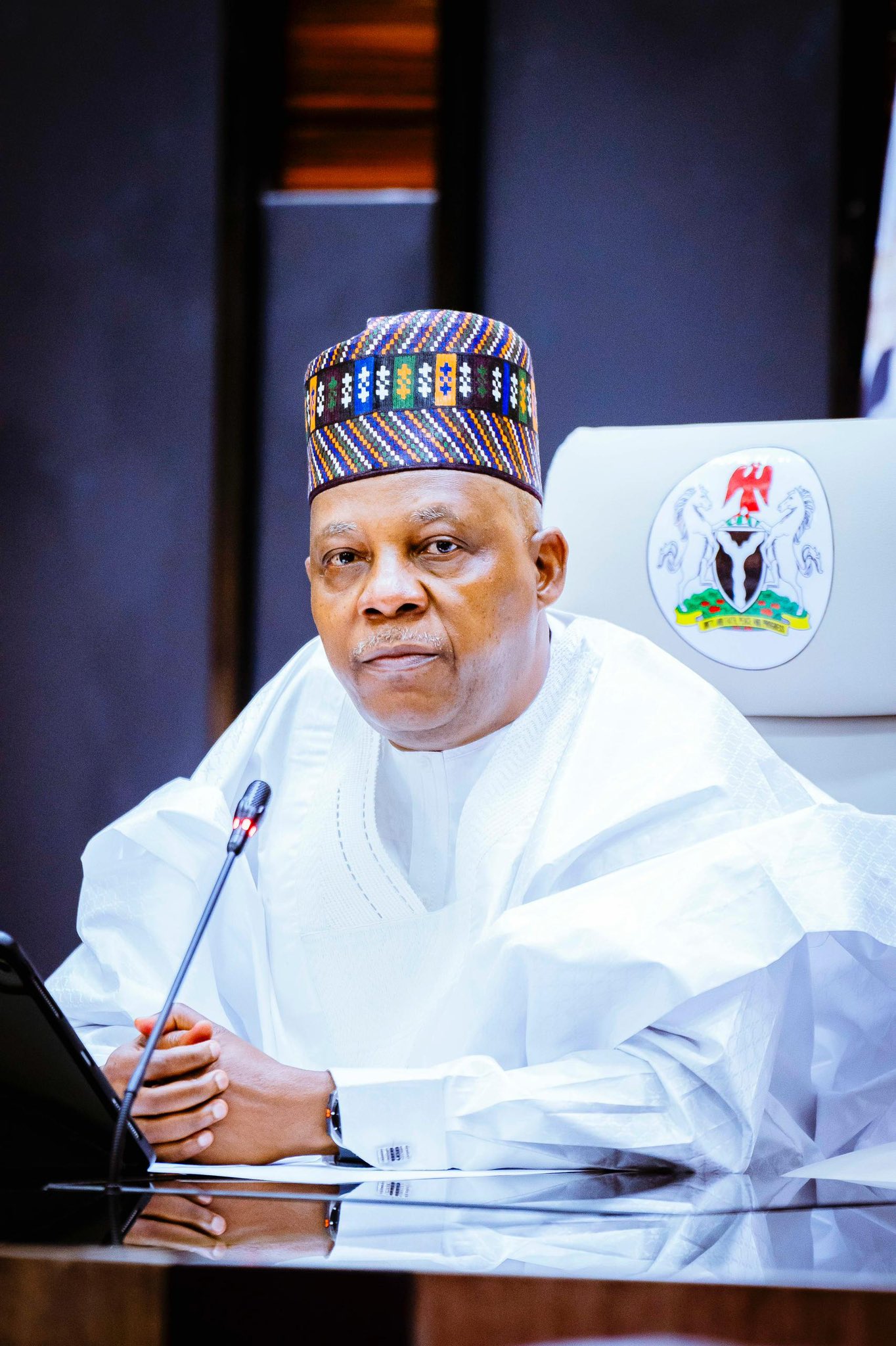
shettima
The trademark of governance in a democracy is its regular consolidation. This has been the challenge with Nigeria’s democratic journey since 1999. Yearly, at individual and corporate governance levels, aspirations are set out to be pursued – objectives to be achieved and missions to which unflinching commitment is required. Where the vision is strong, the pursuit is fierce.
The slogan of the President Bola Ahmed Tinubu presidency on assumption of office on May 29, 2023 was, and remains, a significant cut-down on insecurity, poverty, enhanced transparency in the conduct of government affairs and management of the nation’s commonwealth, increased provision of infrastructure as well as enhancing economic condition of Nigerians.
In this pursuit, President Tinubu and his deputy, Vice President Kashim Shettima, set out to pursue economic transformation with all the vigour available to them. They spent the first few months criss-crossing the length and breadth of the global investment space, all in a bid to explain to the world the ease of doing business in Nigeria and why the country should be the investor’s delight.
Undoubtedly, the last two years of President Tinubu and Vice President Shettima have unveiled what is possible where a president is engrossed in selfless service to his nation, and his deputy is devoted to his boss’s policies, principles and ideals. Senator Shettima has consistently declared that he will remain loyal to his principal, President Tinubu, whom he has described as a reformer, builder and visionary leader. At various fora, he has constantly assured Nigerians that the President is fully committed to his campaign promises encapsulated in the administration’s Renewed Hope Agenda.
- Foreign missions under burden of infrastructure decay, poor staff welfare
- Democracy requires constructive patriotism, not sabotage
Two years down the line, it is evident that the administration’s multi-pronged approach is working. The economy has witnessed positive growth in the last two years and is progressing strongly. Just like the President has maintained that he will not have respite until Nigeria’s reputation as a $1 trillion economy and investment destination is restored, his deputy, Senator Shettima, has sustained the tempo in his capacity as Chairman of the National Economic Council (NEC), with meaningful government interventions, programmes and initiatives being spearheaded in the office of the Vice President.
Below are some of the key accomplishments of the Tinubu administration initiated and overseen by the office of the Vice President in the last two years:
Agriculture
It has been manifestly clear from the beginning in 2025, when President Tinubu was seeking the position of the president of the country, that agriculture was going to be the major thrust of his administration. It is not surprising to see the President living up to that promise. The administration set out a regime of incentives to make farming more attractive once again, as it was in the 60s. Then Nigeria had enough to feed its population and an excess for export.
To this effect, Vice President Shettima embarked on international diplomacy to attract agricultural investments. As chairman of the NEC, he has been overseeing several agricultural initiatives. At the 3rd Belt and Road Initiative (BRI) Forum in China in November 2023, he promoted Nigeria as a safe investment destination for the agricultural sector. During his visit to the United States for the African Development Bank (AfDB) World Food Prize-facilitated Norman Borlaug International Dialogue, he sought investors’ commitments towards Nigeria’s agro-food sector development.
The Tinubu administration, through the Ministry of Agriculture and Food Security, signed a Memorandum of Understanding (MoU) with the American agricultural machinery manufacturer John Deere. The partnership aims to establish a tractor assembly plant in Nigeria to boost agricultural mechanisation and food production. Under the agreement, John Deere is to supply about 2,000 tractors annually to Nigeria over the next five years. The Vice President played a key role in initiating this partnership during his visit to the United States, where he met with John Deere officials.
Also, the international engagement tripled the African Development Bank’s (AfDB) agricultural interventions in Nigeria from $500 million to over $1 billion. The cumulative effects of the commitment from AfDB include the groundbreaking for the federal government’s Specialised Agro-Processing Zones (SAPZ) recently performed in Kaduna and Cross River State to revitalise Nigeria’s agricultural sector and reduce food import dependence. SAPZs are designed to industrialise rural economies by adding value to agricultural products, attracting investment, and reducing youth unemployment. Others are improved fertiliser availability for farmers, the establishment of Agro-Rangers to address farm security issues, and the implementation of modern agricultural practices.
In a bid to advance the Green Imperative Agricultural Project, the Vice President presided over the commercial signing of the $1.1 billion Nigeria-Brazil Green Imperative Project at the Presidential Villa. This initiative seeks to modernise Nigeria’s agriculture sector by supporting smallholder farmers and integrating them into global value chains. A government-catalysed, private-sector-driven agricultural industrialisation programme in Nigeria, VP Shettima is championing the Green Imperative Programme as an important component of the government’s broader strategy to boost agricultural productivity, increase crop yields, and make Nigeria self-sufficient in food production.
And to lead by example, Vice President Shettima launched the Kashim Shettima Foundation’s Agricultural Empowerment Programme in 2024. This personal initiative includes the distribution of essential farming inputs such as tractors, seeds, fertilizers, and herbicides to beneficiary farmers for the 2024 farming season; financial support of N100,000 per month to 50 beneficiaries for 4 months during the planting period, and the provision of startup funds up to N30 million for farmer cooperatives to establish commercial farms.
Food security
Throughout the history of humanity, agriculture has always played a pivotal role in social and economic development. When President Tinubu came to power in 2023, the first appeal he made was for Nigerians to return to the land, for therein lies true prosperity.
Acting on the President’s directive, Vice President Shettima inaugurated the Presidential Food Systems Coordination Unit (PFSCU), an initiative of the administration to tackle hunger and food insecurity in Nigeria. The PFSCU is tasked with harnessing resources and ideas from stakeholders, including state governors, to modernise farming practices, increase crop yields, and transform Nigeria into a self-sufficient food producer.
NCP and economic reforms
In 2023, Vice President Shettima inaugurated the National Council on Privatisation (NCP) committee to drive the economic reforms of the Renewed Hope administration. The Council has remained a key institution in Nigeria’s journey toward a market-driven economy, balancing the challenges of reforms with the need for sustainable development. In late 2023, Vice President Kashim Shettima chaired a meeting of the National NCP focused on the recapitalisation and restructuring of the Bank of Agriculture (BOA). This initiative has helped greatly in revitalising the bank and making it more effective in supporting Nigeria’s agricultural sector.
Nutrition
Under the administration, the Vice President, who is the chairman of the National Council on Nutrition (NCN), has emphasised the importance of reinforcement in agriculture to combat malnutrition. Accordingly, he approved a 5-year National Multi-Sectoral Plan of Action for Food and Nutrition. Senator Shettima went on to push for the Nutrition 774 Initiative at the National Economic Council, an initiative aimed at tackling malnutrition by providing life-saving nutritional support across all local government areas. It focuses on community-based impact, particularly for mothers and children. A significant landmark within the initiative is the establishment of a House Committee on Food and Nutrition, the first of its kind, at both federal and state legislatures.
Human capiat development (HCD)
As part of its resolve to position the nation among top 80 countries on the global Human Capital Index (HCI) by building a healthier, better-educated, and empowered Nigeria, the Tinubu administration stepped up government’s Human Capital Development (HCD) initiative aimed at improving education, healthcare, and skills training across the country to boost economic growth and create a more productive workforce. Under the chairmanship of Vice President Shettima, NEC took the initiative to its second phase (HCD 2.0), which focuses on areas like gender equality, climate change, digital economy, financial inclusion, and food and nutrition. It also aims to address unemployment, the informal sector, and low labour force participation. About 24 million Nigerians are set to benefit from the federal government’s Human Capital Development initiative, which aims to improve education, healthcare, and skills training across the nation.
MSMEs
Vice President Kashim Shettima has played a central role in championing and overseeing the MSME Clinics programme, launching editions in states Benue, Ogun, Enugu, Jigawa, and Ekiti States, with federal government grants for business owners. The MSME Clinics aim to boost economic empowerment and support small-scale enterprises, including agricultural businesses, by facilitating access to finance, markets, skills, and regulatory compliance. The MSME Clinics have led to the launch of major ultramodern fashion hubs in these states. The fashion hubs are expected to create millions of jobs.
RSPIC
The Tinubu administration launched the Resettlement Scheme for Persons Impacted by Conflict (RSPIC), a national initiative aimed at addressing the humanitarian crisis caused by internal displacements across Nigeria. The project, which is in its pilot phase, focuses on seven states disproportionately affected by farmer-herder conflicts. They are Sokoto, Kebbi, Benue, Katsina, Zamfara, Niger, and Kaduna. Last year, Vice President Shettima, representing President Tinubu, presided over the groundbreaking ceremony for the RSPIC project in Kaduna State. Earlier, VP Shettima had inaugurated a steering committee to coordinate the implementation of the RSPIC initiative, fulfilling President Tinubu’s promise to improve the lives of Nigerians affected by conflict.
While the primary focus of the RSPIC is on providing relief and rehabilitation for conflict-affected communities, it is also linked to the administration’s efforts to address food insecurity in Nigeria.
Financial inclusion
Vice President Shettima has played an important role in advancing financial and economic inclusion as a foundation stone of the administration’s development agenda. In April 2024, he led the signing of the landmark Aso Accord for Economic and Financial Inclusion, uniting federal and state actors, financial institutions, and development partners around a shared commitment to integrate over 30 million unbanked Nigerians into the formal economy. He followed this with the launch of a national operating model aimed at transforming Nigeria into a $1 trillion economy by 2030 through improved access to credit, digital payments, and financial literacy. And to promote economic growth and financial inclusion, the Vice President, in February 2025, inaugurated the Presidential Committee on Economic and Financial Inclusion (PreCEFI). The financial inclusion efforts of the administration have been serving as a vehicle that helps Nigeria to bring life to dead capital.
As the administration steps into mid-term of its first term in office, there is no doubt that President Tinubu’s foresight, vision, reforms, well-thought-out policies and programmes will impact tremendously on the lives of Nigerians. His absolute trust in the capacity of the Vice President and all others in the cabinet to plan and execute the programmes and interventions of the Renewed Hope Agenda will motivate them to ramp up the business of governance for the overall benefit of the people.
Nkwocha is the Senior Special Assistant, Media and Communications to the President (Office of the Vice President)-