
Mahmuda: Nigeria can’t be a junkyard of terrorist groups
The emergence of an Islamic sect, Mahmuda, with a queer doctrine, linked to Boko Haram (Jama’atu Ahlis Sunna Lidda’awati wal-Jihad – JAS) in Mali and Niger Republic demonstrates that Nigeria has become a soft ground for terrorist groups who cannot survive under intense security in other African countries. In reality, the sect is not totally […]
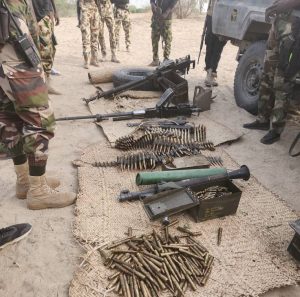
FILE PHOTO: Some weapons recovered by troops from the terrorists
The emergence of an Islamic sect, Mahmuda, with a queer doctrine, linked to Boko Haram (Jama’atu Ahlis Sunna Lidda’awati wal-Jihad – JAS) in Mali and Niger Republic demonstrates that Nigeria has become a soft ground for terrorist groups who cannot survive under intense security in other African countries. In reality, the sect is not totally new in Nigeria; it operated in Niger State a few years ago. Its members were sent packing due to their suspicious doctrine. But the complacency among our security agencies has given them the space to explore other softer locations in Kwara State and the vast Kainji Lake National Park (KLNP). Today, Mahmuda is responsible for kidnapping, violence, and killings in parts of Niger and Kwara states.
Though the Niger State Police Command has said it was “Working in collaboration with the military to dislodge this group,” it is shameful that the authorities had failed to clear the National Park of bandits and kidnappers who occupied the national asset in the last five years since bandits and kidnappers migrated from the North East to parts of the North West and North Central. The series of clearance operations being carried out now within the National Park ought to have been carried out long before now to prevent mischief makers and criminals from becoming entrenched in the vast forest. The Kainji Lake National Park (KLNP) in Niger State covers an area of approximately 5,341 square kilometers (2,062 square miles). The KLNP is almost double the size of Lagos State, which has a total landmass of approximately 3,345 square kilometres (1,292 square miles). With the size of the park and the barriers created by forestry, it is clear that the terrorists would have enough hiding space to escape from the military operation being carried out.
Mahmuda crept into North Central in a fashion similar to Lakurawa in Sokoto and Kebbi states. Pretending to be a moderate sect that provided security for the people, it operated in the Gongono Forest of Tangaza Local Government Area in Sokoto State between 2016 and 2018. Lakurawa projected itself as a self-defence force to protect communities against bandit attacks and gained some local support due to the perceived absence of effective government security. However, the group revealed its true violent nature, as a radical Islamist ideology and aimed to establish their own strict interpretation of Sharia law in the territories they controlled. Like Boko Haram, the sect is an anti-Nigerian State, increasingly opposed to regular state agencies and were working to establish themselves as the primary authority in their areas of operation. They are believed to be affiliated with the Islamic State (IS).
In the last 15 years, the failure of our intelligence agencies and the lack of proactive steps by our military have rendered Nigeria vulnerable for invasion by violent sects. Apart from Boko Haram, the Islamic State West Africa Province (ISWAP) emerged as a faction of Boko Haram in 2016, pledging allegiance to the Islamic State. The ISWAP has also carried out numerous violent attacks and is believed to control territories in the Lake Chad region. There was also the Ansaru (Jama’atu Ansaril Muslimina Fi Biladis Sudan), another breakaway faction from Boko Haram in 2012. Unlike Boko Haram, which has often engaged in indiscriminate attacks, Ansaru initially focused more on high-profile targets, including Westerners and Nigerian security forces. Ansaru had ties to Al-Qaeda in the Islamic Maghreb (AQIM) and aimed to establish a Salafi-Islamist state. They have reportedly resurged in recent times, particularly in the North West and North Central. They are linked to banditry and kidnappings.
- Kwankwaso’s political future in limbo as defections rock NNPP, Kwankwasiyya movement
- Hunger worsens in IDP camps as UN agencies cut operations
Nigeria has been dealing with terrorism in piecemeal; there does not seem to be a policy framework and knowledge-based strategies to get rid of these destructive sects that sneak into the Nigerian territory. There seems to be no genuine preventive measures against the emergence of similar groups. It is clear that these groups enter into Nigeria with the objective of propagating religious doctrines, but Nigerians are already aware that those preoccupied with doctrines that are anti-State, discriminatory, full of hatred, and segregation usually turn violent. Our security operatives must look out for such groups and halt their activities, whether they are foreign or indigenous. The groups have no space to operate in many West African countries, but tend to have a large space in Nigeria to carry out their violent ideologies. The police and military must rise to this challenge. They must resist interventions by politicians who prevent them from carrying out their duties. Nigeria cannot continue to create space for all sorts of dangerous ideological groups who destabilise and destroy lives and properties in our towns and rural areas. Not again!