
Maryam Sanda: Compassion vs Enforcing the law?
It’s no longer news that the Abuja High Court sentenced nursing mother Maryam Sanda to death by hanging for allegedly killing her husband Bilyaminu during a domestic dispute. The story in brief is that the couple dated each other prior to marrying other partners; later divorced their original partners and married each other in a […]
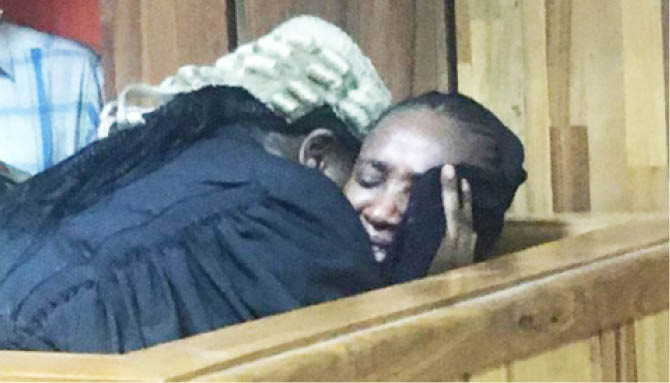
File Photo
It’s no longer news that the Abuja High Court sentenced nursing mother Maryam Sanda to death by hanging for allegedly killing her husband Bilyaminu during a domestic dispute. The story in brief is that the couple dated each other prior to marrying other partners; later divorced their original partners and married each other in a “high-society” wedding; and fought while she was pregnant and saw pictures which a naked female sent to his phone.
No one will ever know for sure what really happened, but Maryam was found guilty of stabbing her husband causing his death even though the lack of eyewitnesses, video footage or any forensic evidence means there is always a chance that she is actually innocent. Trending on the internet is the sardonic question of whether the tragedy was caused by the telephone, the husband, the convicted wife, Nigerian society, or the Court? Telephones like guns can’t operate themselves therefore can’t be at fault. However these days Nigerians have developed an ill-advised penchant for using phones to send naked pictures or record sexual acts. Many, such as the recent Babcock University Sex-Video, leak causing avoidable public embarrassment to the “actors”.
It’s difficult to understand why people engaged in extra-marital relationships would need to send each other naked photographs. Matters of “the other room” should be kept there especially since it’s well known that Nigerian wives can’t resist habitually checking their husband’s phones! Bilyaminu bears some blame for being a poor judge of character. Previously married, he divorced only to marry a hot-tempered woman who allegedly killed him. Maryam definitely bears a lot of blame even if her actions were a result of deep seated love and not vindictive selfishness. Ironically she left one husband and married Bilyaminu breaking up his home in the process, yet flew into a jealous rage upon discovering that he was seeing someone else!
Evidently she egoistically believed that his extra-marital affairs would end with her marriage to him. Nigerian society must bear some blame because government fails to promote social counseling and the negative results are evident. As Daily trust reported, domestic murder is on the increase and 53 spouses have been allegedly killed by their partners subsequent to Bilyaminu’s murder. Many of these deaths could have been prevented if counseling had been readily available. Male chauvinism is prevalent in Nigeria and there is unreported widespread domestic violence and emotional abuse of women. In a narcissistic display of ownership and control an “honorable” Legislator assembled his four wives in Lower Chamber and ridiculed them to the shameful amusement of his colleagues declaring himself to be “powerful”.
When divorcing Nigerian men habitually throw their wives out of the house leaving them in disgrace, whereas in developed countries the man packs out leaving his wife and children in the house. If such was the case in Nigeria there would be far more divorces and far fewer wives murdering their husbands! As for the Court, the Judge must carry blame. Legal experts contend that whether Maryam is innocent or not it’s easy to fault the Judgment.
The Judge committed an elementary fatal blunder by delivering his verdict without ruling on preliminary objections challenging the competence of the charge and jurisdiction of the Court. Apparently it’s settled law that by failing to rule on preliminary objections the judgment is null and void. Under normal circumstances Maryam’s conviction should be overturned on appeal, but then again very little is normal in the Nigerian Judiciary theses days. Her defense lawyer quite correctly pointed out that the prosecution had failed to prove their case because they didn’t call any eyewitnesses nurses or doctors from the hospital, nor did they produce the murder weapon, pictures of the naked body, an autopsy report or indeed any form of forensic evidence.
The Judge agreed, but said that even though the prosecution didn’t prove their case beyond reasonable doubt, the circumstances surrounding the crime were compelling! He said that by sentencing her to death, true justice has been dispensed for the deceased and for society. Quite inappropriately the Judge confused religion with law. Rather than refer to codified murder laws he said Maryam should “reap what she has sown” and that “it has been said that thou shall not kill and whoever kills in cold blood shall die in cold blood”. The truth is that Maryam’s death sentence wasn’t about justice, it was about vengeance. True justice requires justice to the deceased, justice to the perpetrator and justice to society. The Judge erred when he said that the deceased’s “innocent blood cries to the high heavens for vengeance”.
How did he know that Bilyaminu’s spirit has not reflected upon his philandering ways and forgiven her? Even if his spirit has not legal experts point out that there are big differences between premeditated planned killing, killing as a result of fracas, and accidental killing which merit death penalty, imprisonment, or acquittal respectively. Concern for “justice for society”, it’s a strange assertion when trained terrorists who declared war on society, committed mass murder and killed gallant Nigerian troops are forgiven and rehabilitated, while no attempt is made to rehabilitate or forgive a woman who isn’t a trained killer and did none of the above.
Opponents of the death penalty quite claim that it is simply “State sanctioned murder” which should be used as a last resort for the most heinous of crimes. There are those who take solace in the fact that there is little chance Maryam will be hanged. State Governors are understandably reluctant to authorize executions and there is no reason why she should be executed before any of the almost three thousand condemned convicts awaiting execution in Nigerian prisons before her conviction. A nation which allows its condemned prisoners to simply rot away in prison is neither enforcing the law nor being compassionate.