
Measurable outcomes key to FG-states collaboration
The federal government recently convened a two-day National Economic Council (NEC) conference in Abuja to strengthen economic coordination and accelerate inclusive growth across the 36 states and the Federal Capital Territory (FCT). The summit drew governors and key national stakeholders. Organisers said the conference was designed to align federal and state priorities under the Renewed […]
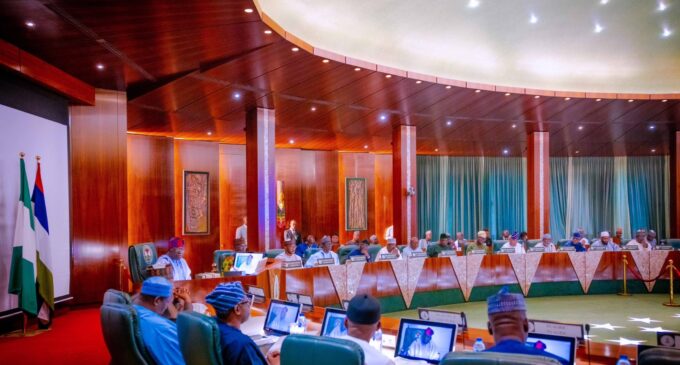
The federal government recently convened a two-day National Economic Council (NEC) conference in Abuja to strengthen economic coordination and accelerate inclusive growth across the 36 states and the Federal Capital Territory (FCT). The summit drew governors and key national stakeholders.
Organisers said the conference was designed to align federal and state priorities under the Renewed Hope Agenda. Themed “Delivering Inclusive Growth and Sustainable Development,” the event featured seven panel sessions and nine lead papers addressing fiscal governance, interstate collaboration, human capital development, security, domestic production and partnership frameworks for growth.
President Bola Ahmed Tinubu, represented at the closing ceremony by Senate President Godswill Akpabio, emphasised that reforms require courage, patience and consistency. He urged stakeholders to ensure that policy decisions translate into tangible benefits like jobs, infrastructure, improved health care and education and expanded economic opportunities. A communiqué called for non-kinetic approaches to insecurity, harmonised tax laws, strategic investments in oil and gas, diversification into non-oil sectors, and prioritisation of bankable projects in agriculture, manufacturing, energy, transport, logistics and digital infrastructure.
This sounds appropriate. It is what Nigerians have heard repeatedly for decades.
Our concern is not with the language of reform, it is with the absence of visible outcomes.
Sixty-five years after independence, and after the creation of multiple states meant to harness local comparative advantages, the same fundamental issues of nationhood, fiscal federalism, economic coordination and development strategy remain recurring subjects of discussion at every forum. We cannot continue like this.
This conference ought to have gone beyond declarations. It should have been a rigorous peer review session, a platform where states showcased measurable achievements, compared performance indicators and accounted for the resources received. Nigerians deserve to know which states are converting revenue into productivity, jobs and prosperity and which are not.
Revenue to governments at all levels has increased, particularly after subsidy removal and exchange rate adjustments. Yet borrowing continues from left, right and centre. Citizens are still waiting to feel meaningful impact. Payment of salaries, while necessary, is not economic transformation. Removing subsidies and imposing new taxes without a clear blueprint and measurable milestones, cannot on their own rebuild a struggling economy.
The removal of fuel subsidy and the floating of the naira were presented as bold reforms. But reform without structured execution, coordination and clarity of roles between the federal and state governments creates confusion. There appears to be no firm consensus on what the federal government should strategically drive and what individual states should pursue based on comparative advantage.
Even within a federal system, the centre must provide clear strategic direction. Federalism does not mean fragmentation, it means coordinated autonomy. States cannot operate as isolated islands, each improvising economic policy while waiting for FAAC allocations.
The recent disagreement over revenue sharing, including issues around electricity subsidy, is a reminder that cooperative federalism remains fragile. Yet with most governors belonging to the same political platform as the federal government, coordination should be easier, not more difficult. Governance must not descend into a monologue. Economic management must be expert-led, evidence-based and insulated from partisan convenience.
Another uncomfortable reality concerns local government autonomy. Many states still act as custodians of local government funds. In some cases, even where there is nominal freedom, funds are withdrawn and redirected. This practice undermines grassroots development and contradicts the spirit of fiscal decentralisation. If development is to be inclusive, resources must reach the level closest to the people.
It is also erroneous to suggest that government has no business in enterprise. Strategic state participation in productive sectors is not ideological heresy. Countries such as China demonstrate how sub-national governments can catalyse growth by driving industrialisation and creating jobs. The issue is not whether government participates; it is whether it does so efficiently, transparently and competitively.
Nigeria possesses enormous economies of scale in livestock, agriculture, mining, tourism, manufacturing and energy. At the creation of states, Nigerians were assured that each had viable economic potential. Numerous studies, including those by reputable institutions, have mapped these potentials. Why then do most states still rely overwhelmingly on federal allocations?
The answer lies in policy misalignment, weak execution and politicisation of economic management. Too often, political calculations override economic logic. Projects are announced without feasibility. Borrowing occurs without productivity. Conferences are held without accountability mechanisms.
This administration is now deep into the first term of its mandate. Nigerians expect visible transformation, not extended policy seminars. Reform must be measured in reduced poverty, expanded employment, functional infrastructure and improved living standards and not in the number of communiqués issued.
Future NEC gatherings must be structured around measurable targets. States should present data on internally generated revenue growth, sectoral output expansion, job creation figures and capital project completion rates. Independent experts should interrogate assumptions and performance. Best-performing states should be models. Underperforming ones should be challenged.
Nigeria does not lack ideas. It lacks disciplined execution.
The time for rhetorical consensus has passed. What the country needs now is coordinated, expert-driven implementation anchored on comparative advantage, fiscal responsibility and transparent accountability. Anything less will reduce another well-intentioned conference to an annual ritual of familiar promises.
Nigerians deserve results, not rehearsed resolutions.