
Motorists demand cheaper petrol as crude price falls
Motorists and commuters across several states have urged the federal government and petroleum marketers to reduce the pump price following the recent drop in the global crude oil price. The crude oil price has fallen after tensions in the Middle East eased. On Wednesday, Brent crude, the international benchmark for oil prices, dropped from the […]
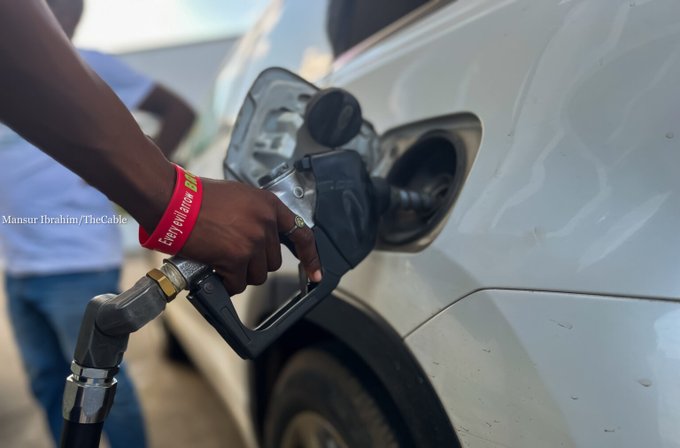
fuel
Motorists and commuters across several states have urged the federal government and petroleum marketers to reduce the pump price following the recent drop in the global crude oil price.
The crude oil price has fallen after tensions in the Middle East eased.
On Wednesday, Brent crude, the international benchmark for oil prices, dropped from the highs recorded during the peak of the war on Iran by the United States and Israel which raised geopolitical tensions in the Middle East and triggered the closure of the Strait of Hormuz, the waterway controlling one-fifth of global oil supply.
Brent Crude dropped to $73.14 per barrel while WTI-the US variant dropped to $69.85. It further dropped to $72 yesterday morning before rising to $74 later.
Daily Trust reports that a litre of PMS, which was sold between N770 and N800 before the Iran war, is now between N1,200 and N1,300 per litre depending on the location.
On Thursday, Dangote Refinery slashed its gantry price by N50, reducing it to N1,125 per litre.
It was also gathered that the landing cost for imported PMS also reduced marginally yesterday with marketers slashing their prices.
In Kano, Rivers, Borno, Benue and Kwara states, respondents, who spoke to Daily Trust, expressed frustration over the continued high cost of petrol, decrying that transportation costs, business operations and household budgets remain under severe pressure despite improvements in the global oil market.
They noted that increases in petrol prices were implemented immediately when crude oil prices rose due to geopolitical tensions, but reductions have been slow now that international prices have dropped.
In Kano, commercial drivers said rising fuel costs continue to erode their earnings and make transportation increasingly unaffordable for passengers.
A litre dropped to N1,330 from N1,370 against the expectation of a significant drop following the crash of crude price.
A driver, Abdullahi Musa, said operators are caught between rising operating costs and resistance from passengers whenever fares are increased.
Some motorists in the state said they had significantly reduced the use of their personal vehicles and now rely more on public transportation to manage expenses.
In Rivers State, motorists and commuters voiced similar concerns, lamenting that fuel prices remained high despite the reported decline in the crude oil price.
They said petrol was still being sold for between N1,200 and N1,300 per litre in many filling stations.
Commercial drivers in the state expressed readiness to reduce fares if the price of petrol is reduced.
In Maiduguri, Borno State, motorists and tricycle operators described the continued high cost of petrol as disappointing.
Our correspondent, who went round Maiduguri, reports that a litre of petrol was being sold between N1,300 and N1,400; and a liter of diesel, N2,200.
A motorist, Modu Baana, questioned why independent marketers continued to sell petrol at prices above N1,300 per litre despite favourable developments in the international oil market.
Another resident, Bilya Abubakar, said as a major crude oil-producing nation, Nigeria should be better positioned to shield consumers from international price shocks.
He questioned the speed at which fuel prices rise whenever crude oil prices increase and the apparent reluctance of marketers to reduce prices when market conditions improve.
Tricycle operators in Maiduguri also reported a decline in patronage following fare increases necessitated by higher fuel costs.
They said many passengers now avoid short-distance trips or seek alternative means of transportation, reducing daily earnings for operators.
In Taraba State, motorists accused fuel marketers of failing to reflect changes in international market conditions in local pump prices as a litre is still sold for N1,390 in many parts of the state.
A retired civil servant, Mallam Sadanu Sani, called on regulatory authorities to strengthen monitoring and enforcement activities to ensure consumers benefit from favourable market developments.
In Kwara State, motorists expressed a similar concern. One of them, Demola Akinyeki, said the situation questions the country’s pricing mechanisms and broader economic management framework.
Another resident, Oladuni Ishola, urged the federal government and industry stakeholders to provide clear explanations for the continued high prices and take steps to ease the burden on consumers.
Why prices remain high – Marketers
Executive Secretary, Major Energies Marketers Association of Nigeria (MEMAN), Clement Isong, told Daily Trust that a crash in the global crude oil price is an indicating measure which does not translate to significant drops in the local price of fuel in Nigeria.
He also explained that there is a lag between the price of crude oil and the price of refined petroleum products which create a shock cost.
He expressed optimism that the cost of fuel would soon come down significantly in line with the reduced cost of crude oil at the international oil market.
Forex, logistics, others determine fuel price – experts
Speaking to Daily Trust, Professor Emeritus of Petroleum Economics and Senior Fellow, United States for Energy Economics, Wumi Iledare, said crude oil prices are driven primarily by the fundamentals of supply and demand.
He described the current situation as the market gradually readjusting to those fundamentals and the geopolitical risk premium that pushed prices upward during the period of heightened tensions is likely to decline significantly.
He stated: “That does not mean geopolitical risks will disappear entirely. The Middle East will remain strategically important, and uncertainties will persist. However, the market’s sensitivity to those risks is likely to diminish, reducing their impact on crude prices.”
For fuel prices, he noted that a sustained decline in crude oil prices could eventually translate into lower pump prices but the extent and timing will depend on other factors such as refining costs, exchange rates, taxes, transportation costs, and domestic market policies.
“Therefore, while some price moderation is possible, a return to pre-conflict fuel prices is not guaranteed. From a petroleum economics perspective, the key issue is whether the easing of geopolitical tensions leads to a sustained increase in supply relative to demand. If it does, crude prices could soften further. If global demand remains strong or supply constraints emerge elsewhere, prices may stabilize at levels higher than those seen before the conflict.”
On his part, Prof. Dayo Ayoade, an energy law expert at the University of Lagos, explained that oil prices rise and fall depending on market demand and market supply with passive risks like war risks, driven by geopolitical tensions as seen with the Strait of Hormuz, always playing a contributory factor to price increase.
Why pump price may not mirror drop in crude price – NNPCL
The Chief Corporate Communications Officer of the Nigerian National Petroleum Company Limited (NNPCL), Andy Odey, said pump prices may not immediately mirror movements in global crude oil prices.
He, however, said the NNPC had adjusted its petrol prices in response to prevailing market conditions and continues to review its pricing in line with prevailing conditions.
“It is important to note that the retail price of petrol is influenced by several factors beyond crude oil prices alone, including product acquisition costs, transportation and distribution expenses, foreign exchange dynamics, and existing inventory held by marketers,” he said.
He added that as a deregulated market, individual retailers determine their pump prices based on their respective cost structures.
According to him, “NNPC Ltd remains committed to ensuring adequate supply and reflecting market realities in its pricing decisions while delivering value to Nigerian consumers.”
On his part, the Director of Public Affairs of the Nigerian Midstream and Downstream Petroleum Regulatory Authority (NMDPRA), George Ene-Ita, noted that the country is operating a completely deregulated petroleum downstream sector, therefore, pump price for products including PMS is subject to market forces.
From Abdullateef Aliyu and Muhammed Musbau, Lagos; Faruk Shuaibu (Abuja); Sani Ibrahim Paki and Ahmad Datti, Kano; Bassey Willie, Port Harcourt; Mumini Abdulkareem, Ilorin and Hope Abah, Makurdi